


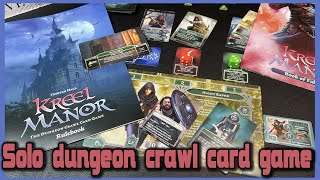



Creel Manor Deep Dive
What the Community Thinks About Creel Manor
Creel Manor has earned genuine enthusiasm from solo board game reviewers who appreciate its seamless integration of theme and mechanics. Compared to designer Tristan Hall's earlier work Veil Wraith, Creel Manor delivers everything that works mechanically while adding atmospheric storytelling that gives weight to every decision. Reviewers praise it as a dungeon crawler that respects the player's time and intelligence, offering a tight experience that scales from solo play to cooperative adventures with up to three players. The game has found its audience among players seeking dark, character-driven adventures with meaningful narrative branches that change based on the paths chosen during gameplay.
Core Mechanics That Define Creel Manor
Narrative Choice and Branching Adventure
Creel Manor structures its campaign around meaningful decisions that shape the player's journey. A single campaign consists of five sequential missions, with the first and final adventures always following the same path but adventures two through four offering distinct branching options based on player choices. This structure gives the game strong replayability within a single playthrough and across multiple campaigns. Each player character comes with their own deck of story cards, and these cards feed directly into the Book of Fables, a narrative companion that provides the flavor text and story consequences for each decision. The game doesn't simply shuffle players through locations; it invites them to make choices about how to engage each encounter, reading different paragraphs based on whether they choose to fight, sneak, or explore past a given challenge. This hands-on narrative agency transforms what could be a rote card game into a collaborative storytelling experience.
Exhaustible Actions and Strategic Resource Management
Every hero in Creel Manor operates under a beautifully simple action economy: each turn, the player selects one of three core actions, fight, explore, or sneak, and exhausts it, choosing which skill or asset to use for that particular action. This system creates meaningful tension because the player must decide not only how to overcome each challenge but also which of their limited tools to spend. The game includes a variety of skills and assets unique to each character class, with opportunities to upgrade skills during the campaign, so no two playthroughs with the same hero feel identical. The encounters themselves are structured around a plot card system where players must overcome a series of plot challenges to progress, with optional encounter cards representing threats that can be engaged or avoided depending on strategy and available resources.
The Creel Manor Experience
Dark, Atmospheric Horror
The art direction of Creel Manor creates a genuinely eerie atmosphere that pulls players into a haunted manor setting. Reviewers consistently note that the artwork and design elements enhance immersion, making the game feel like a descent into a cursed location rather than a series of card draws. The manor itself is presented as a vertical, multi-level space with thematic locations such as the Infirmary, the Bath House, the Guard Room, and the Tower of Menar. Each location carries its own visual identity and thematic flavor. The inclusion of a variety of enemy types, from lowly vermin swarms to powerful bosses like the Goblin Chief and Lord Creel himself, and the escalating difficulty curve as the campaign progresses create a sense of mounting dread. The game's pacing deliberately builds tension, with a Lord's Vengeance card serving as a timer that forces players to win before they run out of threat cards.
Personal Character Progression and Asymmetry
Each of Creel Manor's three character classes, Night Raven, Wolf of the North, and War Mage, feels genuinely distinct, with unique skills, assets, and story cards that reflect their thematic identity. The ability to choose male or female versions of each character adds another layer of personalization. Over the course of a five-mission campaign, heroes gain loot, recruit followers, acquire weapons and armor, and upgrade their core skills, creating a genuine sense of advancement. This progression is not merely numerical; it fundamentally changes how a hero can approach problems. A War Mage early in the campaign might lack the sneak tools available to a Night Raven, forcing different tactical choices. Reviewers appreciate that this asymmetry makes each hero feel like they are on their own distinct adventure, even when playing the same campaign structure.
What Makes Creel Manor Stand Out
Elegant Mechanical Tightness with Thematic Resonance
Creel Manor succeeds where Veil Wraith struggled: it delivers the mechanical elegance and tight card play that define Tristan Hall's design philosophy but wraps it in theme that players can actually feel and engage with. The three-action exhaustion system is simple enough to teach in minutes but complex enough to generate interesting tactical puzzles across multiple scenarios. More importantly, every mechanic serves the theme. When a player exhausts the sneak action, they are genuinely sneaking past a challenge. When they choose to fight, they are committing their hero to a direct confrontation. The plot cards they must overcome represent real obstacles in the manor, and the story cards they play are not merely mechanical triggers but narrative beats that advance their hero's personal journey. This fusion of mechanism and story means that the game engages both the tactical brain and the imaginative one.
Setup Complexity with Payoff in Replayability
Reviewers acknowledge that Creel Manor's setup is involved; each adventure requires the creation of custom subdecks from the game's sizable card pool, with different threat groups, assets, and encounter cards depending on which location card was drawn. This complexity at the table is a deliberate design choice that pays dividends in replayability. Because adventure selection is partly randomized and the threat composition changes based on location, each mission feels fresh even on replay. The game also includes an endless mode for players who want to forgo the narrative campaign structure, which demonstrates the designers' confidence that the core mechanics can sustain play without relying solely on story novelty. The larger-than-necessary box size, which reviewers have noted, reflects the sheer variety of content packed inside. While the box could theoretically be smaller, the wealth of options it contains is what keeps players returning to the manor.
Potential Drawbacks
Setup and Learning Curve for New Players
The involved setup process, while ultimately rewarding, presents a barrier to entry. Each adventure requires separating threat cards into specific groups, building location stacks, and establishing the correct decks before a mission can begin. For players new to the game or those accustomed to shorter setup times, this can feel like a slog before gameplay even begins. The rulebook is substantial, and while the game's core rules are straightforward, the variety of card types and the nuances of how different enemies and challenges interact require study. Reviewers appreciate the game's design but acknowledge that teaching it to a new player requires both patience and a willingness to work through some initial complexity.
Box Size and Component Organization
While the wealth of content is a strength, the box is notably larger than many reviewers feel is necessary for the components it contains. This can make the game less appealing to players with limited shelf space or those who frequently transport their collection. The large number of distinct card decks, character skills, class-specific skills, assets, story cards, threat cards, foes, and location cards, requires careful organization to keep the game playable. Without a well-thought-out storage solution, players can waste time shuffling through cards to find the correct deck or token.
If You Enjoy Creel Manor
Players drawn to Creel Manor will find strong parallels in the Gloom of Killforth and Shadows of Killforth games, which share Tristan Hall's design fingerprints and similarly blend dark themes with card-driven mechanics. Veil Wraith, also by Hall, offers mechanically similar challenge but less thematic depth; many reviewers who preferred Creel Manor found it to be the superior experience. For those interested in solo dungeon crawlers with branching narrative, games like Oathsworn: Into the Deepwood and other character-driven adventures offer comparable experiences of progression and storytelling. Nemo's War shares Creel Manor's emergent narrative structure, though with a very different setting. The comparison suggests that players seeking dark, intimate adventures where a single character's choices reshape the world will find much to love in Creel Manor's design philosophy.
What Reviewers Are Saying
"This game has completely replaced Veil Wraith. I will be selling Veil Wraith, and I will be keeping Creel Manor. I think this is a very interesting game and a lot of fun, especially for a solo game — it's great."
— The Dungeon Dive
"It takes all of the clever card play, all of those really hard decisions that were in Veil Wraith, but it adds a very cool, approachable theme to the game that gives the player a connection between what they are doing mechanically with what their character is doing within the fiction of the world."
— The Dungeon Dive
"Creel Manor is a solo or cooperative dungeon crawler where you have a personal story for your character and you complete five missions where missions two through four have branching paths. The game utilizes a simple system of exhausting one of three actions, fight, explore or sneak, to complete challenges, and you work to defeat the final scenario before you've lost too many times."
— Meet Me At The Table