







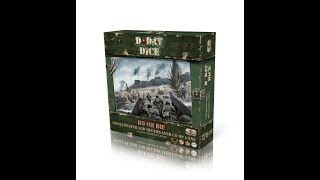





D-Day Dice Deep Dive
What the Community Thinks About D-Day Dice
Reviewers and solo players tend to describe D-Day Dice as a fun, light war game about a serious subject. Several videos point out that it works well as a solo experience, and one reviewer spent a single evening running through several scenarios. The praise most often centers on the balance of timing, luck, and tactical decisions. Some viewers note that the game can be lucky, but many feel the dice leave enough room to plan. Fans of war themes who want something quicker than a traditional wargame often mention it as an accessible starting point.
Core Mechanics That Define D-Day Dice
Rolling, Locking, and Re-rolling
Each turn begins with six dice, two each in red, blue, and white. Players roll all six, lock two, and then re-roll the rest up to two more times. The faces produce soldiers, stars for buying specialists, courage medals for advancing and buying awards, tool faces for item points, and skulls that cancel another die. Matching red, white, and blue faces and straights trigger bonuses listed on the player aid, so deciding which dice to keep is central to every turn.
Resources, Specialists, Items, and Movement
Soldiers are the unit's life total, and the game is lost if the unit runs out or is forced to move and cannot. Stars buy specialists such as a corporal who lets players re-roll one die or a medic who reduces losses, and specialists count toward the unit total when casualties are taken. Items are bought with item points and played for effects, such as a bazooka that lowers sector defense or a flamethrower that cuts bunker defense. Unit markers track how long a unit has stayed in a sector, and once the marker reaches the red arrow the unit must move. Units can advance or move sideways but cannot return to a sector they have left or drop back a level. Some sectors require a specific specialist or a courage payment to enter, and landmines and machine gun fire add casualties after every move.
The D-Day Dice Experience
A Turn in Practice
In a solo tutorial on the first map, the player starts with four soldiers and rolls up to three times per turn, with each choice shaping the next roll. The typical rhythm is to roll, count the bonuses during upkeep, buy a specialist or item when affordable, and then decide whether to hold position or push forward. Turns that go well can add a large block of soldiers in one upkeep, while a bad roll can leave the unit thin right before the bunker. Reviewers warn that the final assault can cost twenty soldiers before any other losses, so the approach to the bunker needs planning.
Solo Play and Scenarios
The game supports one to four players, though many of the videos play it solo. Each scenario defines which special items join the pool, and the map, number of countries, and difficulty all change from one battle to the next. Reviewers describe the solo mode as a deep and satisfying way to play, and they note that each map brings different terrain costs and specialist requirements. The first map is often recommended as a practice run, with the harder maps saved for later.
What Makes D-Day Dice Stand Out
Dice Choices Matter Every Turn
Many reviewers focus on how re-rolls and special items let players shape outcomes. Because specialists and items can modify results, a player who keeps a particular face or saves courage for a later advance can often steer the turn. Reviewers say these decisions are the real core of the game, even though the dice supply the randomness, and that a player can build patterns over time to plan for certain scenarios.
A Serious Theme With a Light Touch
The subject is the Normandy landings, yet the game is quick to teach and easy to play on a single table. One reviewer felt uneasy about turning a deadly assault into a game of collecting soldiers, while still finding the play engaging. Historical game fans also note that it is built around dice rather than card play, which sets it apart from many games in the genre while still capturing the feel of storming a beach.
Potential Drawbacks
Luck and Lost Turns
Because the core system depends on dice, a run of skulls or missed faces can cost a unit many soldiers in a single turn. Reviewers note that tight scenarios leave little room to recover, and a streak of poor rolls can end a game quickly. Players who dislike high variance may find the outcomes frustrating, especially when the bunker assault is close.
Tracking and Setup Overhead
The game asks players to track soldiers, stars, courage, item points, unit markers, and special effects at the same time. One reviewer admitted to forgetting a medic's bonus during play, and the setup involves sorting special items from regular ones for each scenario. The player aid and the symbol guides in the scenario book help, and new players are advised to keep those guides close during their first few games.
If You Enjoy D-Day Dice
Players who like tactical dice games with a historical setting may enjoy Memoir '44, which also focuses on line of sight and unit control across a battlefield. Fort Sumter is another option for players who want a card-driven Civil War game with a simple, quick structure. Anyone drawn to dice-based push-your-luck decisions and steadily building resources is likely to find the core loop satisfying.
What Reviewers Are Saying
"i think the d-day dice is super fun i get a huge kick out of it"
— Beyond Solitaire
"I enjoy the dice rolling so I'm always looking forward to playing something along those lines"
— Rolling Dice & Taking Names
"if you want to die because you die a lot in this game"
— Board Games UnLocked