


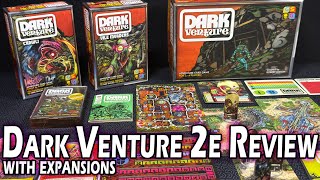

Dark Venture Deep Dive
What the Community Thinks About Dark Venture
Reviewers keep returning to the same idea: Dark Venture is a large, strange sandbox that fits into a surprisingly small box. Daniel of Dungeon Dive describes a wide post-apocalyptic world full of creatures, locations, items, and characters, and reports having a lot of fun with the second edition. Daniel concludes that the game is better than ever, with faster turns and a world that fills with interesting things more quickly.
Enthusiasm also comes through in more casual coverage. CCK praises the hand-drawn art of the Dark Venture line and calls its related title, Battle of the Agents, one of the most unique indie games the host has ever played. Board Games UnLocked, previewing the game in an anticipated-games roundup, was drawn in by its retro, VHS-style artwork and its promise of a story-driven exploration card game. That reviewer was not yet sure which mode would take center stage, cooperative, competitive, or solo.
Core Mechanics That Define Dark Venture
Card-Driven Narrative Exploration
Players hold a hand of location, item, and character cards, and each location attaches to the map and triggers a numbered entry in a location guide. Those entries turn every new tile into a small story beat. Daniel plays Haglor's Haunted Curve, which brings a ghostly whisper, changes Daniel's fate, and allows an extra card draw. Darvin's Fork is less forgiving: a dark curse deals 1d6 damage to any character without the ghost faction or the right blade, and again each turn that character stays in the location.
Board Games UnLocked described the same appeal before release, calling it a retro story-based adventure card game where players construct a twisting narrative to explore a dystopian future. The comparisons come quickly. That reviewer placed the game beside Folklore, Gloomhaven, and 7th Continent, suggesting that Dark Venture might keep the grandiose storytelling feel of those titles in a smaller package. The tile-laying exploration also reminded that reviewer of Posthuman.
Action Point Resource Management
Each turn is built around a small budget of action points. In the second edition, every player can play one location and one character for free, so the table fills quickly before action points are spent on extra cards, movement, or combat. A dead horse can supply a free movement action, and an aggressive creature forces combat without an action cost, while a non-aggressive one requires an action to engage. Spending all of a turn's action tokens also advances a timer that eventually unlocks an additional heroic quest, which keeps the pressure on how each action is spent.
The Dark Venture Experience
A Sandbox That Fills Itself Through Play
Daniel stresses that the game does not populate the world on its own. Players bring creatures, characters, and locations into play from their hands, so a slow opening can leave the map empty for too long. The second edition addresses this with the free play each turn, and Daniel's solo house rules add a second draw from a different deck while raising the hand size from six to seven. Together these changes make the game faster and let the sense of a grand adventure arrive earlier in a session.
Combat Built on Initiative and Quests
Combat avoids a traditional attack roll. Players roll 2d6 plus speed and any first-strike bonus to set the attacking order, then roll 2d6 plus power and attack bonus, minus the target's armor, to determine damage. Daniel's fight against the Eggman Wizard shows the rhythm: a mounted first strike wins initiative, one of the wizard's spell attempts fails, and the wizard falls, granting five quest points and the wizard's spellbook. Quests drive the scoring. In competitive play, the player with the most quest points wins, while solo players compete against their own high score and are ranked by an adventurer title at the end of the game.
What Makes Dark Venture Stand Out
A Big World in a Small Box
Daniel is consistently struck by how much the game holds for its footprint, noting that nearly everything added to the base game still fits inside the main box. The art draws equal praise. CCK says all of the artwork is hand-done by the designer, and Daniel says Rob Lemon's art places the game near the top of a personal list of games with the best art. Board Games UnLocked connected the look to 1990s cartoons and VHS-era packaging, describing a style that feels like a game that would have come out in that decade.
Expansions That Add Without Rewriting the Rules
Daniel's favorite add-ons share a common trait: they add content without much new rulebook. Vile Invaders brings new items, characters, locations, and heroes, along with crafting components that can build a smelting kiln, hammer, and anvil for upgrading equipment. Beasts and Monsters and The Alder King add variety in the same spirit, and The Alder King is a memorable case because the character is not aggressive and can be avoided. Daniel also incorporated the Layer of the Rake Void, a small expansion packaged with a backer soundtrack cassette, by scanning its map onto sticker paper, mounting it on chipboard, and placing it on the table, and would welcome more locations of that size.
Potential Drawbacks
Out of Print and Unused Gear
Daniel points out that the base game is currently out of print, and has asked the designer about a reprint, so prospective buyers may need to wait or look for used copies. Owners of the first edition can buy a second edition upgrade kit priced at around $16. The in-game gripe is unwanted gear: because there is no currency and nothing to buy or sell, extra swords can only be discarded, which Daniel finds unsatisfying. Daniel suggests borrowing the merchant trading from the Crawl expansion as a house rule.
Heavy Setup in Crawl and Crag Pit Arena
Daniel rarely plays the Crawl expansion. It replaces the location and action guides with tokens, sets up 16 locations for one player or 22 for two, and sorts enemies into tiers before play begins. Its ancient god ending is a strong hook, but the setup is heavy enough that Daniel is more interested in the full-world exploration mode. Crag Pit Arena adds a gladiatorial skirmish system borrowed from Battle of the Agents, with traps and audience interactions that bring a lot of rules to remember. Daniel still wants to borrow its hit location chart for regular games.
If You Enjoy Dark Venture
Players who like story-driven exploration will find familiar ground in Gloomhaven, 7th Continent, and Folklore, the bigger and grander relatives that Board Games UnLocked named as points of comparison. Dark Venture offers a smaller footprint with a similar sense of discovery. Daniel's comparison to Gamer World fits fans of weird, post-apocalyptic sandboxes full of creatures to fight and places to discover. Those who enjoy the creative team's work should also look at Dark Venture: Battle of the Agents, which CCK calls one of the most unique and well-designed indie games played on the channel, and Posthuman, which shares the tile-laying exploration that Board Games UnLocked highlighted.
What Reviewers Are Saying
"I think they do a really good job of speeding up the game because this is a game that really does rely on having interesting things on the table, interesting locations, and interesting characters."
— Dungeon Dive
"all of the artwork is hand done by the designer and creator of this"
— CCK
"I think the idea of an exploration card game is awesome"
— Board Games UnLocked