


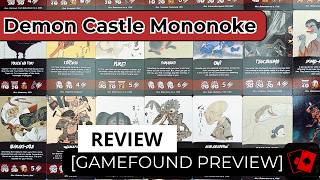
Demon Castle Mononoke Deep Dive
What the Community Thinks About Demon Castle Mononoke
Reviewers agree that Demon Castle Mononoke is a demanding cooperative game with a striking theme, but they disagree about how much of its appeal comes from its pop-up presentation. Cardboard Revolution is the publisher named in the reviews by Bower's Game Corner and The Dice Tower, and the project was running on Gamefound when these videos were made. Sir Thecos played a hand-built prototype solo and came away enthusiastic, describing the game as very unique and very challenging, with a fantastic theme, a strong visual identity, and a lot of tension throughout.
Bower's Game Corner approached the project as a Kickstarter-style critique rather than a playtest. The reviewer praised the art and the pop-up centerpiece but questioned the campaign itself, focusing on a goal of roughly $40,000, the structure of its stretch goals, and a campaign page that leaned heavily on dense text. Bower's Game Corner also noted that the physical prototype looked mostly blank, so the pop-up book's role in the finished game was hard to judge from the preview alone.
The Dice Tower, which reviews projects as a crowd-funded showcase, took a more cautious line. The hosts found the theme appealing in principle but did not feel pulled in by the gameplay. Their main concern was that the gimmick and the artwork were carrying much of the pitch, and that the mechanics were not compelling enough on their own. The game reads as ambitious and well themed, with its strongest recommendation aimed at players who want a hard co-op experience.
Core Mechanics That Define Demon Castle Mononoke
Broken Gates and the Mononoke Finale
Sir Thecos described the castle as a structure that the heroes must hold together over several rounds. Each broken gate strengthens the final boss, so the players know from the start that every gate they lose will make the climax harder. Sir Thecos also noted that players can sometimes break gates deliberately to gain particular effects, which turns the gate track into a set of strategic choices rather than only a list of losses. The reviewer summarized the structure as five rounds of fending off Yokai before the Mononoke itself appears, and praised that structure as a very cool finale. The Dice Tower's description of the Mononoke as a large final boss that the players eventually face on the pop-up board supports the same picture of a build-up that ends in a single, dramatic confrontation.
Focus Tokens and Shared Cooperation
Each hero starts with the same basic values but carries different focus tokens, which gives each one a distinct way of playing. Sir Thecos explained that the cooperation is built into the decisions: when a character loses focus, the group has to decide whether to heal that character, grant them strength, or rest. Because the actions available to each character are limited, Sir Thecos found it easy to keep an overview of what each one could do. The Dice Tower's hosts focused on the same focus abilities, observing that the characters use them and then face attacks in return. Their criticism of the system, discussed below, is that the mechanism was not compelling enough on its own, but both perspectives describe focus as the central resource that shapes the group's choices.
The Demon Castle Mononoke Experience
Tension From Scarce Resources
Sir Thecos described a game in which the players never have all the resources they want and never fend off everything perfectly. The reviewer framed the central feeling as making difficult choices and accepting that characters will be injured because they are not strong enough to prevent everything. Even so, Sir Thecos said the game rarely feels unfair and that it always seems possible to make it through, even with limited resources. That sense of a narrow but reachable win is what makes the tension feel like a challenge rather than a punishment.
Folklore Atmosphere Through the Pop-Up Book
The Japanese folklore theme is the other feeling reviewers repeatedly return to. Sir Thecos said the theme speaks to them directly because of an existing interest in Japanese folklore and mythology, and described the pop-up book on the table as a diorama that adds a lot of atmosphere. Bower's Game Corner described the pop-up elements as a cool gimmick, and The Dice Tower acknowledged that the book is the most interesting part of the design even while calling it very gimmicky. The atmosphere, then, comes from the physical space the book creates on the table, and reviewers judged the game partly by how well that space worked.
What Makes Demon Castle Mononoke Stand Out
The Pop-Up Book of Dungeons
Sir Thecos singled out the Book of Dungeons as one of the most enjoyable parts of the prototype, saying that the idea works very well even in a hand-crafted version. Bower's Game Corner also treated the pop-up as a centerpiece worth showcasing, arguing that the main image should zoom in on it because it is a big gimmick. Reviewers expect the final version to add more Mononoke pop-up pages, which Sir Thecos said would be a full three-dimensional page for each of six to eight Mononoke if stretch goals are met.
Art and Visual Identity
Sir Thecos described the art style as fantastic and hoped that the final production would keep the same look or something very close to it. Bower's Game Corner said the reviewer really liked the look of the game, and the reviewers agreed the visual identity is one of the project's strongest assets. The Dice Tower was less enthusiastic, saying the artwork was interesting but not really their style, which shows that the look is a strength for some audiences but not all.
Potential Drawbacks
Swingy Randomness and No True Solo Mode
Sir Thecos raised two concerns that are fair to weigh. The first is randomness: some attacks can be extremely strong, and players sometimes have to roll to see how many attack cards they draw or how strong an attack becomes. That can lead to characters being downed very quickly, although Sir Thecos noted that being downed is not a loss condition in itself. The second concern is that the game cannot be played true solo, since the player always controls at least two characters. Sir Thecos did not find this a problem because the action set is limited, but players who dislike managing more than one character should take it into account.
Campaign Presentation and Pricing
Bower's Game Corner was the most critical of how the project was presented. The reviewer felt that the campaign page relied on long blocks of text, that the main image did not show the game clearly, and that the reasons behind a roughly $40,000 goal were not clear, especially with a $55 base price and large stretch goals. The reviewer also noted that the rulebook was hard to follow in places, with the video how-to-play doing more of the explaining. The Dice Tower raised a related concern about substance, saying that the theme seemed to be doing most of the work and that the gameplay did not speak to them as strongly. Players who are evaluating the campaign should expect a theme-forward design and look closely at the final rules and component list.
If You Enjoy Demon Castle Mononoke
Players who enjoy the pop-up board in Demon Castle Mononoke will find a related experience in Mist. Bower's Game Corner recalled Mist as a game with a similar gimmick in which the board popped open, which made it a natural point of comparison for the reviewer. The Dice Tower's hosts reached for a different comparison, agreeing that the focus-and-attack loop reminded them most of Forbidden Sky, another cooperative game built around a physical gimmick, in that case a circuit that lights up as the team completes it. Players drawn to Demon Castle Mononoke's broken gates and the buildup to its final fight should look to either title for the same mix of a tactile centerpiece and a shared countdown toward one climactic moment.
What Reviewers Are Saying
"Another thing I really like is the build-up towards the final fight. The anticipation is handled very well. You know that every broken gate will increase the power of the final boss."
— Sir Thecos
"Interesting. I would zoom in on that on some sort of perspective so I can see that on the main image cuz that's a big gimmick. That's a cool gimmick."
— Bower's Game Corner
"The gameplay itself wasn't terribly compelling to me as far as using these focus abilities, and then they're going to attack back. It seemed like something that the theme would have to do a lot of heavy lifting."
— The Dice Tower