





DIE in the Dungeon! Deep Dive
What the Community Thinks About DIE in the Dungeon!
Board game reviewers who have encountered DIE in the Dungeon! consistently express surprise and delight at how much strategic depth the designers have packed into this compact solo adventure game. The consensus across the community is that this is a lean, efficient design that delivers on the promise of its video game source material while standing on its own as a board game experience. BoardGameCo's Professor Mag praised the game as an elegantly designed roguelike that invites experimentation with character building. Mike from One Stop Co-op Shop noted that while the game can feel information-heavy on first exposure, the core system is exceptionally well-crafted. Bower's Game Corner observers highlight the game's accessible presentation and strong Kickstarter execution, appreciating how clearly it communicates what players should expect. Reviewers consistently note that DIE in the Dungeon! succeeds in translating the video game's mechanical essence while respecting the constraints and possibilities of the board game medium.
Core Mechanics That Define DIE in the Dungeon!
Dice Bag Deck Building
At its heart, DIE in the Dungeon! is fundamentally a deck-building game where your deck is composed of dice instead of cards. Players manage a codex of dice that they draw from a bag during combat, with each die representing a character action (attack, block, heal, or boost). As you progress through the dungeon, you gain the ability to upgrade existing dice, add new ones to your collection, and remove dice that no longer serve your strategy. This creates a satisfying feedback loop where each victory brings meaningful customization choices. Unlike traditional deck builders where you thin your deck by removing weak cards, here you're actively curating a pool of power-ups and synergies. What makes this system sing is the flexibility it offers: the same starting dice can be transformed into entirely different tools through properties and upgrades that the publisher Rumiz Games has layered throughout the game.
Spatial Dice Placement Combat
Combat takes place on a grid where the physical placement of your dice matters significantly. When you draw your dice each round, you have a limited energy pool to spend placing them on the board. Positioning isn't just flavor, though; it's integral to the tactics. Boost dice can enhance adjacent or distant dice depending on their value. Some dice trigger effects based on where they sit relative to others. Enemies themselves can restrict certain board spaces or benefit from specific placements. This creates a puzzle-like quality to every combat turn: you're not just deciding which dice to use, but where they go and how they interact. Early combats feel straightforward, but by the mid-game, you're chaining together spatial bonuses and managing restricted spaces in a way that recalls the best moments of Slay the Spire, except you're also solving a physical puzzle on the board.
The DIE in the Dungeon! Experience
Roguelike Progression and Discovery
DIE in the Dungeon! captures the essence of roguelike games by offering players branching paths through a single area (or up to three areas in extended campaigns). Each run feels unique because the dungeon layout is randomized, the enemies appear in different combinations, and your dice upgrades branch in different directions based on what the game offers you. You might win a run with one approach and lose another run despite a stronger-looking dice pool, because the enemy combinations and board spaces forced you to adapt. This creates genuine tension and replay value. Reviewers noted that there's always something new to discover: a synergy you hadn't considered, a relic ability that transforms your strategy, an enemy modifier that forces you to rethink your approach entirely. The game respects the player's intelligence by offering meaningful choices at each decision point without requiring a rulebook consultation to move forward.
Satisfying Puzzle Moments and Tactical Depth
Beyond the roguelike wrapper sits a deeply tactile puzzle: where do these seven dice go on a five-by-five grid given the available energy constraints, the enemy's board modifications, and the spatial interactions in play? Reviewers describe moments of genuine puzzle satisfaction, where you suddenly realize a cascade of bonuses that lets you eliminate an elite enemy or survive an impossible-seeming attack. One reviewer noted they kept playing through even difficult losses because the moment-to-moment decisions felt intentional and rewarding. The game creates this through properties like boost multipliers that care about distance, relics that reward specific positioning patterns, and enemies that lock down certain spaces. It's a game where you're not overwhelmed by options on each turn; instead, you have a constrained set of tools and the joy comes from using them efficiently and creatively. This combines the planning aspect of classic dungeon crawls with the spatial reasoning of puzzle games.
What Makes DIE in the Dungeon! Stand Out
Elegant Design Philosophy
DIE in the Dungeon! demonstrates remarkable restraint for a game with so much on offer. Reviewers frequently note that the game doesn't require learning pages of special rules to make progress. Instead, each die's properties are printed on it; each relic's ability is on the card. The spatial grid system sounds complex in explanation but feels intuitive in practice because distance and adjacency are visually clear. The designers have resisted the urge to add endless exception cases or modifier stacks. One reviewer specifically highlighted how the game scales smoothly from a simple first combat (where you're essentially following a tutorial) to genuinely challenging encounters in acts two and three, without ever feeling like the system has suddenly become opaque. This design clarity is rare in games that offer this much strategic depth.
Component Quality and Presentation
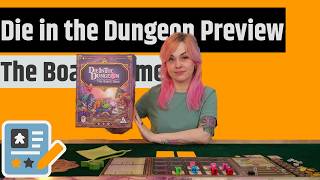
The physicality of the game contributes meaningfully to the experience. Drawing dice from a bag creates a tactile randomness that card draws don't quite match. The grid board uses sliders rather than individual card slots, which reviewers appreciated for both ease of use and the satisfying tactile feedback. The dice themselves are readable at a glance due to clear color coding and printed values. Relics and potions are laid out clearly so you can see your options without hunting through text. The Kickstarter campaign demonstrated a professional approach to presentation, with clear pledge tiers and straightforward component descriptions. While the game is compact, nothing about it feels cheap or cramped. The magnetic closure box is sturdy. Reviewers emphasized that the game respects your table space while still delivering substantial content.
Potential Drawbacks
Information Density and Learning Curve
One reviewer described their first encounter with the game as somewhat overwhelming, noting that they grasped 60 percent of what was happening immediately but needed multiple plays to internalize all the spatial interactions and property effects. While the game never requires you to hold up play to consult the rulebook, there are enough mechanical layers that new players benefit from playing slowly their first time through and accepting that they might not optimize their decisions perfectly. By the second or third area, this overwhelm dissipates, but for players who prefer minimal cognitive load, the learning investment required is real. The reviewer ultimately concluded this wasn't a flaw, just a characteristic of a game with this much content, but it's worth acknowledging that DIE in the Dungeon! is designed for players who enjoy puzzle-solving alongside their roguelike progression.
Limited Variety in Quest Design
Several reviewers expressed a desire for more variety in the encounter types and quest structure itself. While the dice, enemies, and spatial challenges create enormous variety in how individual combats play out, the broader progression loop (explore dungeon, find treasure, face enemies, fight boss) follows a similar structure between runs. This is explicitly framed as a minor note rather than a critical flaw, especially given the game's small box constraints. It's the kind of critique that suggests expansion potential rather than indicating a broken design. For players who primarily care about the tactical combat and dice optimization, this limitation is unlikely to register as a problem.
If You Enjoy DIE in the Dungeon!
If DIE in the Dungeon! resonates with you, several board games offer a related blend of roguelike structure and build customization. Too Many Bones delivers a similar build-your-character-as-you-go satisfaction, swapping dice pools for customizable tyrant trays but keeping the escalating challenge and branching build paths. Aeon's End channels a related deck-shaping tension, rewarding players for strengthening a personal arsenal against scaling bosses rather than leaning on pure luck. For solo dungeon crawling with a comparable grid-based puzzle feel, Gloomhaven: Jaws of the Lion offers a slower-burning but similarly rewarding sense of character growth across a campaign. Players drawn to DIE in the Dungeon!'s mix of spatial dice placement and roguelike progression will likely find each of these scratches a related itch.
What Reviewers Are Saying
"Die in the Dungeon is going to be a game for players who enjoy a cooperative dungeon crawling experience while also building out their codex of dice that they have available to them."
— BoardGameCo
"If I add that to a card, then whenever I draw that die, I get to draw it again. So it will just let me draw more dice every turn, which is freaking great."
— One Stop Co-op Shop
"The characters, you know, the board game truly captures the spirit of the source material and adds a co-op spin to it. Collecting dice, upgrading them, and modifying them, and collecting relics so cool how your build synergizes."
— Bower's Game Corner