/pic2571301.jpg)
/pic5375937.jpg)
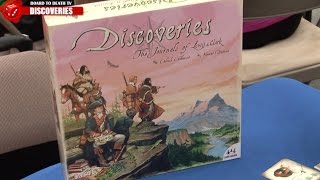
The Lewis and Clark Expedition, which was commissioned in 1803 and ended in 1806, was the first party of men that went through the North American continent, then returned. During these three years, the leaders Meriwether Lewis and William Clark, along with Sergeant Gass and Sergeant Ordway, wrote page after page about their trip, describing the new plants and animals species they discovered and drawing the maps of unknown areas.
In Discoveries, you play one of the Expedition members: Lewis, Clark, Gass or Ordway. Your goal is to compile as much knowledge as possible in your journal, and in this way advance science thanks to your discoveries.
The Tribe/Discoveries cards you gain during the game score discovery points at the end. To get these cards, you have to perform exploration actions, and to do this you use dice. On your turn, you either:
Play the dice in your action area or on the game board; by doing this, you prepare or perform the exploration, change your dice, or get new possible actions.
Get dice back from the game board or from your opponents' action areas.
Part of the Lewis & Clark family — see Lewis & Clark: The Expedition for the combined view.
/pic2571301.jpg)

Discoveries Review
- More accessible than Lewis and Clark
- Historical feel
- Educational rulebook
- Exploration
- America
- Lewis and Clark
Mechanics (from transcript analysis)
- Area Majority — Collecting American Indian cards with different numbers of tribes, whoever has the most of these is going to get more points at the end of the game.
- Dice action — You roll your dice and it goes into your action zone, and then you use your dice to execute different actions.
- Set Collection — Collect different sets of flora and fauna, which are going to be points for you at the end of the game.
Video topics + discussion points
Quotes (from this video)
- if you're not careful you just might learn something
References (from this video)

- planning-oriented depth and engine-building potential
- interactive dice pool mechanics (taking opponents' dice)
- thematic integration with expedition and indigenous help
- potentially complex; relies on multi-step planning
- some thematic and mechanic density may slow initial play
- exploration and discovery with indigenous help
- America exploration expedition
- planning-oriented, multi-turn planning with dice-based actions
- Lewis and Clark
Mechanics (from transcript analysis)
- coordinated expedition / loyalty mechanics — expedition members are loyal to you or opponents but operate with the whole expedition; they can be recalled, affecting plans
- dice pool management / dice drafting — players roll colored dice; dice move to a general pool; players may take all their own dice or all dice in one half of the pool; opponents' dice can be used until recalled
- engine-building via character/location cards — cards grant unique bonuses that build a personal engine cascade over the game
- face manipulation of dice — on a turn, a player can change dice faces to achieve desired effects; some faces enable engine-building actions
- sequence planning / delayed resolution — dice are collected and resolved over several turns; players place dice on a tableau for future use
Video topics + discussion points
Quotes (from this video)
- by far in a way the most important life-altering thing that's happened to me in the last month is that I proposed to my then girlfriend now fiance Jessica
- I'm getting married
- I am pretty excited that I just finished recording my first question and answer Vlog
- the last one was in Alien Frontiers
- Welcome to the dungeon is a great idea
- it's gorgeous but it's not the most engaging thing ever
- I prefer this over Race for the Galaxy
- it's a cool pyramid building engine building out the Wazoo game with an auction mechanic that seems a bit thrown on
References (from this video)
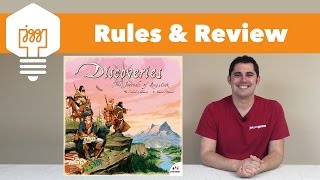
- Fresh take on dice games; players plan turns rather than rolling every turn.
- American Indian cards enable engine-building and dice manipulation.
- Theme integration with exploration and negotiation; not exploitative in portrayal of American Indians.
- Tension from dice recall and competition for opponent dice.
- Replayability via variable card draws and card effects.
- Potential 'rich-get-richer' dynamic in mid-to-late game due to bonus turns and double-exploration.
- Downtime at four players; requires planning ahead.
- Replayability could be limited as most exploration cards are rivers/mountains; want more variety.
- Expansion aversion by some players; expansion may change dynamics.
- Exploration with negotiation with American Indians; engine-building using Native American cards
- The Lewis and Clark expedition across the American Midwest
Mechanics (from transcript analysis)
- American Indian cards — Provide negotiation options and dice manipulation; some change dice to specific faces; support traversal and engine-building.
- Bonus turns with double Explorer — If you explore both a card in front of you and a central board card, you get a bonus turn and can reuse the dice.
- Card-driven action slots — Cards can be acquired from American Indian negotiations and general rows; slots determine actions and card effects.
- Dice Rolling — Players roll dice and evaluate actions by selecting one of four die faces; actions may be immediate or resolved later depending on the card.
- Dice rolling with variable face outcomes — Players roll dice and evaluate actions by selecting one of four die faces; actions may be immediate or resolved later depending on the card.
- Die recall by opponents — Other players can pull dice from your area, including those saved on explore slots.
- End Game Bonuses — End game triggers when a player takes a card not present; scoring combines points from explored cards, set collection by symbol, and TP icons on American Indian cards.
- end-game trigger and scoring — End game triggers when a player takes a card not present; scoring combines points from explored cards, set collection by symbol, and TP icons on American Indian cards.
- Explore and river/mountain balancing — Explore by moving rivers and mountains on cards; must follow order; can burn excess mountains; add new cards to area.
- Journal dice and delayed evaluation — Some actions are evaluated immediately while others use a journal die and are resolved later.
- Set collection and scoring by symbols — Points are awarded for each set of icons (TPS) and for the points on explored cards; VP on exploration cards plus TPS across the board.
Video topics + discussion points
Quotes (from this video)
- Discoveries has a bit of a breath of fresh air into the dice game genre
- I really like the way the game portrayed the American Indians on these cards
- it's a bunch of really refreshing aspects to a dice game
- you are not rolling your dice every single turn you are rolling them and then strategizing out several turns in advance
- that massive re-roll and you get to go in with a bunch more stuff
- I really enjoyed playing this game
- I want to play this game pretty much as often as I can
References (from this video)
- described as fantastic
- top tier artwork
- dice placement and set collection
- Just Lewis and Clark
Mechanics (from transcript analysis)
- Dice Placement — The host describes it as a 'dice placement kind of set collection game'.
Video topics + discussion points
Quotes (from this video)
- Ticket to Ride Legacy, it's not designed to be played hundreds of times.
- I personally find the more thematic the game the lower the replayability and the more abstract the game the higher the replayability.
- I've recently played White Castle 50 times this year.
- The White Castle remains one of my all-time bangers.
- Not many. I would say Castle Burgundy I've played over 100 times.
- This is a dice placement kind of set collection game. It's quick, it's fast, the artwork is just top tier.
- Shakespeare. Oh, Shakespeare. What a fantastic game.
- Arboritum. One of my favorite card games that exists. It's been remade. The second edition is equally beautiful.
- Nippon, big economic game, but truly a beautiful system.
- Viticulture Essential Edition came out in 2015. Viticulture was my favorite game of all time for a very long time. I love Viticulture.
- Seven Wonders Duel came out in 2015.
- a wild card because that's a little game called Daxu.
- Blood Rage, Code Names, Pandemic Legacy Season 1.
- This is a sequel to Just Lewis and Clark, I think it was called.
- Is it playing Carcasson in Carcasson? You know, going to Gen Con?
References (from this video)
- Educational and thematic
- Engaging dice-driven exploration
- Some players may find the pacing slower
- exploration and expedition
- early 1800s North America
- diary/journal-inspired
Mechanics (from transcript analysis)
- Dice-based progression — dice influence expedition choices and routes
- set collection / route exploration — collect routes and negotiate outcomes with encounters
Video topics + discussion points
Quotes (from this video)
- it's a beautiful game
- dice are mean
- you gotta feed your birds
- travel with it
- it's a quintessential dice rolling game
References (from this video)

- Interesting dice mitigation mechanics
- Quicker play time
- Thematic exploration gameplay
- Unique special ability system
- Potential for card scoring randomness
- Complexity in learning initial mechanics
- Historical exploration and journal writing
- Lewis and Clark Expedition
- Dice-based expedition management
- Lewis and Clark
Mechanics (from transcript analysis)
- action selection — Players choose actions based on dice rolled and special ability cards
- Dice Rolling — Players roll dice to take actions and move across routes
- Set Collection — Collecting unique animal and feature sets for end-game scoring
Video topics + discussion points
Quotes (from this video)
- I'm kind of perpetually on this quest to find new and interesting ways to play with dice
- Build up, build up, build up and then explode
References (from this video)
- expedition narrative and route discovery
- early American exploration and mapping
Mechanics (from transcript analysis)
- card-driven / exploration tokens — players use cards to guide discoveries and progress along a map
Video topics + discussion points
Quotes (from this video)
- number 10 pallet swapped illustrations
- palette swaps of one color to another
- sexy but space wasting insert
- it's just demeaning
- big floppy rulebooks
- overly homogenized or equitable values
- implicit rather than explicit rules or really just not having clearly defined rules in your freaking rule book
- squared corners on cards
- lack of color blind accessibility options
- once someone puts six stars out then their turn is the last turn and there's no ability for anyone else to recover from that