





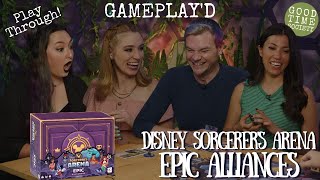
Disney Sorcerer's Arena: Epic Alliances Core Set Deep Dive
What the Community Thinks About Disney Sorcerer's Arena: Epic Alliances Core Set
Reviewers generally treat Disney Sorcerer's Arena: Epic Alliances Core Set as a light, approachable skirmish game built on a familiar Disney and Pixar roster. The tone across the discussions is positive but measured. Commentators tend to judge the game against its mass market goals rather than against deeper card-driven games such as Unmatched, Marvel Champions, or Disney Villainous. Several reviewers note that the game draws on a mobile app of the same name, and that the physical version offers a far fuller experience than the app's grinding loop. The general verdict is that the core game is a decent, quick skirmish that can be recommended to fans of the license and to players who want something short and light.
Core Mechanics That Define Disney Sorcerer's Arena: Epic Alliances Core Set
Damage Based Combat and Knockouts
Combat is built around a hit point dial for each character. A standard attack deals the damage printed on the character's ability card, and a player can discard an attack card to add one more point of damage. Some game effects reduce or prevent that damage, so the dial is a running tally of how close each character is to falling. When a character reaches zero hit points, it is knocked out and removed from the board, and the rival summoner collects victory point tokens equal to that character's knockout value. Knocked out characters return at their starting health on a back row space on either side of the arena, which keeps every fight alive. Reviewers describe the damage dials as a clever piece of design that is slightly fiddly to pull on and off the track.
Variable Phase Order Within a Turn
Each turn is divided into a starting phase, a main phase, and an ending phase. The main phase is where the action happens. The active character can take up to three sub phases: movement, action, and skill. The summoner can take some or all of these in any order, but each sub phase can only be used once per main phase. Movement can be standard or made with a movement card, and the action phase offers a standard attack or an action card. Turn order is determined before play begins, when each summoner secretly stacks character tiles and the initiative values decide placement. This flexibility means the sequencing of moves and attacks becomes the main strategic decision each turn.
The Disney Sorcerer's Arena: Epic Alliances Core Set Experience
Tension, Comebacks, and Status Effects
Reviewers highlight how knockouts keep the game unpredictable. Because fallen characters return quickly, a trailing player rarely feels fully out of the fight. Status effect markers add another layer, and they lock into the initiative track so that their timing is easy to see at a glance. Rounds can swing sharply in either direction, and golden victory point spaces give each side a reason to contest the center of the board. Players who enjoy tactical movement and positional pressure tend to find the flow rewarding, even if the strategy stays fairly light.
Table Presence and a Chapter-Based Teaching Path
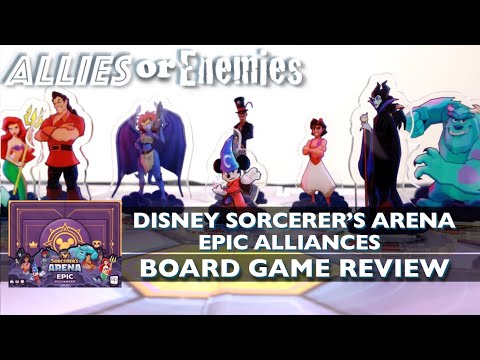
The physical presentation is a major part of the appeal. The transparent character standees are the most eye-catching component, and reviewers note that protective stickers keep them clean on the board. Ryan and Bethany Board Game Reviews praises the chapter-based rulebook, which teaches the game in stages rather than all at once, so new players absorb the rules gradually instead of facing the full ruleset on turn one. A four-player team variant lets each summoner control two characters and adds more mayhem to a fuller board. Reviewers consider this a welcome option, though most describe the one-on-one format as the way the game is meant to be played.
What Makes Disney Sorcerer's Arena: Epic Alliances Core Set Stand Out
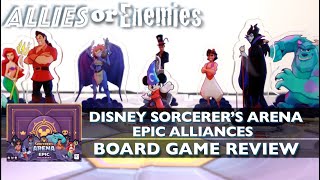
The clearest strength is character variety. Allies or Enemies calls the character variety the biggest selling point of the game, since every character plays differently and real thought went into giving each one a distinct personality on the table, from Mickey's magic broom to Dr. Facilier's curses to Sulley's tanking and Demona's aerial attacks. The roster mixes well-known heroes and villains with deeper cuts, and the inclusion of the gargoyles alongside bigger names such as Aladdin and Ariel is often singled out as a pleasant surprise. The expansion Turning the Tide adds new characters and new mechanics, which hints at a broader keyword system for team building down the line. The rules also reward reading the ability cards closely, since each summoner's choices of action and skill order shape how a turn develops.
Potential Drawbacks
The most common criticism concerns the components. The character cards are basic card stock, and Allies or Enemies recommends sleeving them if the game will be played often, calling the component mix a bit of a mixed bag that still lands more good than bad for a game with clear mass market intentions. The tokens, coins, and status markers are decent, but reviewers note there are only just enough of them for a full game. The standee bases can loosen over time, and the core box initially shipped without the standees, a problem the publisher corrected quickly with replacements. Ryan and Bethany Board Game Reviews also points out that the chapter-based rulebook, while great for first learning the game, becomes harder to use as a reference once a player needs to look up a specific rule after the fact, since it is not always clear which chapter first introduced a given mechanism. Reviewers also note that the expansions are likely to add up quickly, and that the game is clearly built around branding, which will matter to some buyers more than others.
If You Enjoy Disney Sorcerer's Arena: Epic Alliances Core Set
Reviewers suggest the game will suit players who want a quick, light skirmish with recognizable characters.
- Fans of Disney and Pixar properties who want to build a team of favorite characters.
- Players who enjoy card-driven skirmish games but want something lighter than Unmatched.
- Families and newer players who can start with the chapter-based tutorial rules and grow into the full game.
- Groups drawn to the team variant for a fuller, more social board.
Players who want deep strategic depth or long campaign play may find the core set too straightforward, and those who dislike heavy branding may prefer a different skirmish title.
What Reviewers Are Saying
"the biggest selling point for this game will be the character variety every character plays differently a lot of thoughts gone into bringing out these individual personalities."
— Allies or Enemies
"the components here are a bit of a mixed bag although for a game that clearly has mass market intentions it is more good than bad the cards are fine but basic no linen or anything and you'd certainly want to sleeve these if you plan on playing a lot."
— Allies or Enemies
"the rule book has really kind of a neat learning system where you're kind of going through these chapters and it kind of teaches you aspects about the game in order in these chapters so chapter one is you know teaches you some very basics chapter two you're not going until chapter four and then you kind of basically learn the entire game so the spoon feeds you in a very easy to digest way how to play this game."
— Ryan and Bethany Board Game Reviews