







Don't Go In There Deep Dive
What the Community Thinks About Don't Go In There
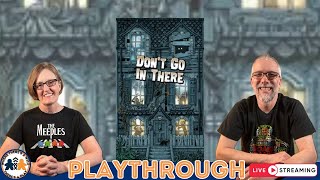
Don't Go In There is a push-your-luck and set collection game from Road to Infamy, first released in 2022. Players place their meeples into a haunted house, then compete to collect the fewest curses by the time the curse cards run out. It plays with two to five players, runs about thirty minutes, and is recommended for ages 14 and up. The community has been consistent in praising its theme and components, while still raising fair questions about the rulebook and replayability. Across the reviews, the overall verdict is warm. Reviewers describe the game as easy to teach, quick to set up, and fun to play with a group. Much of the praise centers on how the physical production supports the haunted house theme, and on the way the game turns a simple placement system into a tense series of decisions. Criticism tends to focus on the rulebook presentation and on a few design choices that can feel uneven with certain player counts.
Core Mechanics That Define Don't Go In There
Room Placement and Ghost Dice
The core loop is a form of worker placement. Players put their meeples on the rooms of the house, and once enough spots are filled, the house resolves. Each room is resolved by rolling ghost dice equal to the dice symbols shown on that room card. Flashlights can subtract ghosts from the total, so a player who goes deeper into a room risks more ghosts but gains the advantage of choosing first from the cards available there. Reviewers describe this trade-off as the heart of the design, since the position a player takes in the house decides both their exposure to ghosts and their access to the best cards.
Curse Drafting and Card Choice
Cards are drawn from the resolved room, and players pick from them in order of placement. Reviewers point out that the cards are often ones nobody particularly wants. The strategy comes from selecting the least harmful option, or the one that sets up a better outcome later. Ghosts accumulate across the game, and the player with the most ghosts gains one curse for every two ghosts. The game ends when the curse cards run out, and the player with the fewest curses wins. This structure gives the game a secondary push-your-luck layer that reviewers found satisfying once the rules were internalized.
The Don't Go In There Experience
Atmosphere and Artwork
The theme comes through clearly in the illustrations and the curse designs. Reviewers mention the cat, the portrait, the raven, the clock, the skull, and the twins as examples of curses that feel distinct at the table. Some curses reward or punish players in specific ways, so holding a particular curse can change how a player evaluates the next draft. Reviewers say the artwork does a lot to sell the spooky tone without leaning on heavy text.
Easy Setup and Quick Turns
The game is frequently described as easy to play and quick to get going. Reviewers often note that a session can wrap up in around twenty to twenty-five minutes once everyone knows the flow. The setup for a two-player game uses a curated selection of curse types, with a portion of the deck removed so players do not know exactly which curses remain. That hidden information keeps each game feeling fresh and gives players a reason to pay attention to what has already been taken.
What Makes Don't Go In There Stand Out
The Dice Tower Box
The most frequently praised component is the box itself. It opens up and becomes a dice tower, which suits the game because every room resolution involves rolling ghost dice. The ghost dice are glow-in-the-dark, which reviewers say adds to the atmosphere when the lights go down. A magnetic tray stores the rest of the components, so teardown is simple. Reviewers consistently call this one of the strongest parts of the production.
Curse Variety in the Deluxe Edition
Reviewers who own the deluxe edition highlight the additional curse types as a major reason to keep returning. Each game uses only some of the curses, so the set in play changes from session to session. The limited-edition extras also include a wooden planchette, which reviewers mention as a nice touch. Reviewers who want to return to the game often point to the variety, since the experience shifts depending on which curses are in play.
Potential Drawbacks
Rulebook Presentation
The rulebook draws the most consistent criticism. Reviewers find the rules functional and complete, with setup, turn order, and objectives all clearly covered, but several describe the layout and print quality as less polished than the rest of the game. The rules get the job done, and they sit comfortably alongside the theme, but they do not match the quality of the components.
Limited Room Variety and Two-Player Balance
Some reviewers wish the base game offered more room cards, since the house can feel repetitive over multiple sessions. Two-player games also draw comment. Reviewers note that the ghost leader can be harder to contest with only two players, and a suggested variant has a third player block dice to create more tension. These points are not deal breakers for most groups, but they are worth knowing before a first game. Players who approach the game with heavy planning sometimes find that overthinking hurts them, since the draft is partly random and the cards on offer rarely match a plan exactly. The more successful approach seems to be keeping options open, reading the table, and adjusting to whatever the house provides.
If You Enjoy Don't Go In There
Players who enjoy the blend of placement, push-your-luck, and card drafting may want to explore these related titles:
- Canvas
- Fromage
- Globe Trotting
- Pop Art
What Reviewers Are Saying
"It was really fun. I thought it was awesome. The production's really cool. The box kind of opens up and becomes a dice tower because when you resolve a location, you have to roll these ghost dice, and you're collecting ghosts, and you kind of don't want to be the one with the most. It was just a super cute, fun game."
— The Brothers Murph
"The rule book sticks with the theme, sticks. It's kind of chintzy to me personally, but it works. It tells you everything. It's an easy to learn game. It tells you the setup, it tells you how to play, it tells you the objective of the game, how to haunt a house, and what happens when the game ends."
— Where There's A Wilz
"Easy to play. Quick to play. I mean, even with being live like 20 minutes, 25 minutes. And there's 12 different curses in the base game. And if you get the limited edition, there's five extra curses."
— Where There's A Wilz