


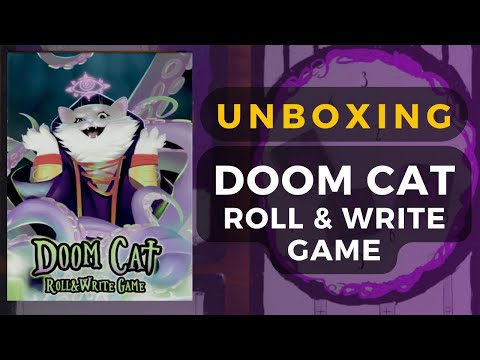



Doom Cat Deep Dive
What the Community Thinks About Doom Cat
Doom Cat has garnered enthusiasm from the board gaming community for its elegant blend of simplicity and strategic depth. Reviewers consistently highlight the game's accessibility for newcomers alongside satisfying decision-making for experienced players. The witchy theme centered on a mischievous cat sabotaging your spell-casting resonates particularly well during spooky season. One reviewer praised it as a fantastic addition to a seasonal collection, noting its portability and quick playtime make it a viable travel companion. Another pointed to the game's ability to deliver compelling gameplay that rewards thoughtful choices within its compact footprint. The variety of goal cards ensures that no two playthroughs feel identical, keeping players returning to the table.
Core Mechanics That Define Doom Cat
Flip and Write with Dice
At its heart, Doom Cat operates as a roll-and-write game where players roll three shared dice each turn. A single player rolls the dice, and every player must assign the three numbers to actions on their personal sigil card. You write one number in an available space at the top of the card, then draw a line connecting the other two numbers on the candle grid below. Finally, you cross off the candle whose value matches the number you wrote at the top. This shared-input mechanic creates moments of both opportunity and constraint as players navigate the same random results through their own unique board state. The puzzle deepens when you cannot connect two numbers on your grid; in such cases, all three dice become wild, granting creative flexibility at the cost of losing the structured path.
Variable Scoring Through Goal Cards
Before the game begins, players draw three goal cards that dictate how they will score points once their sigil cards fill up. One goal might reward completing closed enclosures (3 victory points each), while another scores based on the variety of different numbers written across your top row (4 points per distinct number). A third might give points for unused candles or reward specific geometric patterns. This layered scoring system creates genuine strategic tension because the goal cards you draw shape which numbers and patterns matter most to you. A reviewer noted that every play feels unique because the variable scoring cards are awesome, keeping players coming back for more as they explore different scoring combinations and build new strategies around them.
The Doom Cat Experience
Each Turn Is A Little Puzzle
Reviewers consistently describe Doom Cat as offering a satisfying puzzle experience on every single turn. The moment you see the three dice rolled, you face real decisions: which number should anchor your sigil card this turn, and can you connect the remaining two numbers in a way that builds toward your goal cards. The puzzle nature means that even with a small number of possible actions, the decision space feels meaningful. One player noted great replayability because each turn presents a different puzzle depending on what numbers appear and what goal cards are in play. The strategic depth emerges not from overwhelming complexity but from the interplay between random results and your own accumulating choices on the board.
Portable and Quick to Set Up
A standout quality reviewers highlight is how Doom Cat demands minimal physical space and setup time. The game requires only three dice, dry erase markers, and small sigil cards per player. One reviewer emphasized that Doom Cat is extremely portable with a compact footprint suitable for travel, fitting neatly into a small box that takes seconds to set from storage to table. The game concludes after only 14 dice rolls, making a full game wrap up in roughly 30 minutes. This speed and minimal footprint make it accessible for casual players and perfect for impromptu gaming at restaurants, coffee shops, or during travel. The accessibility extends beyond setup: the game is simple enough for ages eight and up to grasp quickly, yet the strategic depth satisfies players who love optimizing their choices.
What Makes Doom Cat Stand Out
A Witchy Theme That Fits Perfectly
The witch-casting-spells flavor of Doom Cat integrates seamlessly with its mechanics. You are a witch attempting to craft spell circles and bind demons, but your cat keeps knocking over candles and disrupting your plans. The witchy aesthetic, paired with the thematic artwork and component design, creates a cohesive experience without feeling forced. The familiar theme also makes the game an ideal fit for spooky season, appealing to players who relish thematic board games. Reviewers noted that while the theme is well-integrated, the real draw is the gameplay underneath, suggesting that players primarily motivated by mechanical puzzles can enjoy Doom Cat equally to those seeking thematic immersion.
Scalability Across Player Counts and Skill Levels
Doom Cat ships in three expandable boxes, apprentice, adept, and archmage, allowing players to scale from two to six players simply by purchasing additional sets and combining them. This modular design is elegant and economical. Beyond player count, the game scales in difficulty and decision complexity through the goal cards included in each box. Reviewers noted the game includes both a solo campaign log and a multiplayer campaign log, making it accessible whether a player wants to challenge themselves solo or gather a group. The game works equally well for casual family play and for experienced board gamers seeking a tight puzzle. The ability to mix and match goal cards and create unique spell circles ensures that both newcomers discovering the game for the first time and seasoned players can find fresh challenges.
Potential Drawbacks
Theme May Not Resonate with All Players
While the witch-and-cat theme works beautifully for many players, reviewers acknowledged that the witchy aesthetic may not appeal to everyone. Some players seeking deep thematic gameplay might feel that the theme sits lightly atop the mechanics without driving them. The magical flavor is window dressing rather than the core design philosophy, which is perfectly fine for those chasing puzzles but potentially underwhelming for players who prioritize narrative immersion or choose games primarily based on setting. A reviewer noted that while the theme fits the spooky season perfectly, some players might not find the magical motif enjoyable, suggesting that theme preference is genuinely variable among the community.
Limited Depth for Certain Solo Players
One reviewer who plays Doom Cat solo reported reaching a plateau where they consistently achieved high scores and felt they had exhausted the strategic space. After multiple playthroughs, the puzzles became predictable and optimization straightforward. While this speaks to the game's accessibility, easy to grasp, quick to master, it also suggests that solo players seeking unlimited replayability or escalating challenge may eventually see diminishing returns. The solo campaign log helps structure repeated plays, but the core puzzle loop itself is bounded. This drawback primarily affects solo enthusiasts who prefer games offering deeper long-term challenge; casual players and groups will likely find more lasting appeal.
If You Enjoy Doom Cat
Players drawn to Doom Cat should explore other roll-and-write games that emphasize puzzle-solving and tight decision-making. Cascadia and similar tile-placement roll-and-writes offer similar satisfying moments where players optimize limited resources toward scoring goals. If you love the variable goal-card system, Sprawlopolis and Suburbia offer comparable variety and replayability through modular scoring. For those seeking the witchy, whimsical aesthetic combined with strategic play, Flamecraft brings a cozy fantasy theme with engaging decision points, though at a heavier weight. If Doom Cat's portability is key, similar compact games like Tangerine and Nestlings deliver puzzle satisfaction in tiny packages. Reviewers who enjoy light games with hidden depth frequently mention loving both Doom Cat and titles in the Point Salad family, where simple rules mask satisfying card-drafting strategy.
What Reviewers Are Saying
"While Doomcat is easy to learn, it's full of interesting decisions. Choosing which number to write and how to connect the others impacts the rest of the game."
— Let's Table It
"You can mix and match goal cards, craft unique spell circles and list replayability. Every turn is a little puzzle."
— DaniCha
"Doomcat is a fantastic addition to a spooky season collection. It's portable, quick, and strategic in all the right ways. I can see this being a travel staple as well as a seasonal favorite for spooky nights at the table."
— Let's Table It