/pic2401338.jpg)
Game description from the publisher:
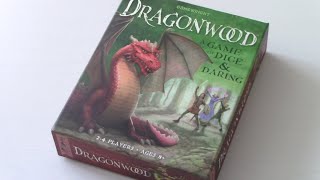
Dare to enter Dragonwood! Deep in the heart of this mythical forest lurk angry ogres, giggling goblins, and even the famed and fearsome fire-breathers themselves!
In Dragonwood, you collect sets of adventurer cards to earn dice, which you then use to roll against your foes. Stomp on some fire ants, scream at a grumpy troll, or strike the menacing orange dragon with a magical silver sword. Choose your strategy carefully because the landscape of Dragonwood is ever-changing. Only the bravest will overcome the odds to emerge victorious!
Gameplay:
On their turn, players either draw a card or attempt to capture a creature or enhancement. Players draw from the Adventurer deck that contains cards of 5 different colors all numbered 1-12. With these cards players form combinations to attempt a Strike (cards in a row of any color), a Stomp (cards of the same number) or a Scream (cards of the same color). To capture, players roll a number of dice equal to the number of cards they have of the particular combination. Each creature has different minimum values of a Strike, Stomp or Scream needed to capture it, and a Victory Point amount.
The game includes six, six-sided dice with sides 1, 2, 2, 3, 3, and 4 to reduce extremely lucky outcomes. The Dragonwood deck has 42 cards, 5 of which are displayed in the landscape at any time. In addition to creatures, this deck also has enhancements that are captured in the same way as creatures which assist players in capturing creatures, and contains events that also impact play. When both dragons have been defeated, the game is over and the player with the most victory points wins!
Is the best strategy to go for several smaller creatures or save up for larger attacks? Should you grab some enhancements hoping they will pay off, or go immediately for creatures? Do you take chances on some rolls or go for sure things? Every time you play Dragonwood the deck is different, so no two games are the same!

Dragonwood
- Nice little game.
- Easy family game.
- Breaks you out of the run-of-the-mill roll and move type game.
- Involved enough to be engaging to any family.
- Very easy to hit the table.
- Generally tends to like heavier games, implying this is light.
Mechanics (from transcript analysis)
- Boss battling — The game involves battling monsters, some of which are bosses.
- Dice Rolling — Players roll dice to battle monsters and capture them for points.
- Point scoring — Players score points by capturing monsters.
- Set Collection — Collecting sets of dice that correspond to types of monsters to determine how many dice can be rolled.
Video topics + discussion points
Quotes (from this video)
- It's not to say that they're bad games. It's just that if I'm going to put something in a top 100 list, I think it ought to be something that is a little bit more representative of what I do and play than just becau just a side mention that I own the game.
- The premise is pretty much the same. Uh the the biggest difference is the the hidden roles, but uh it's fallen on my list a little bit, but uh that's simply because I'm not a huge party game person.
- It's a game that's old, old old and it's just a game that has some really unique strategy to it, but like most abstract games, it can start falling flat because it's sy.
- And because of that, Athell is my number 98 game.
- The art on this is amazing. It is beautiful, beautiful art.
- Sometimes we get discouraged on our failures, about how we're not living up to what we expect, some madeup standard that we're not achieving. But you know what? Sometimes we need to fail. Even if we tried our best to succeed, sometimes we need to fail so that we can succeed down the road so that we can learn the lessons that we need to learn to pass future tests.
References (from this video)

- Parents might be playing for the kids rather than with them.
Mechanics (from transcript analysis)
- Dice Rolling — Basically rolling dice to collect cards.
Video topics + discussion points
Quotes (from this video)
- So today i'm going to share with you the best viewer recommended family board games and a few of my thoughts as i piece together my top 10 for 2022.
- The first category is games that just aren't worth mentioning.
- The next category are games that i think are worth taking a look at but not necessarily games that i've bought yet.
- And then finally there's the category of games that as soon as i looked at them i knew for sure that i was going to buy them.
- The game is juicy fruits which is a very colorful and very fun looking game.
- It's basically bs you know where you're playing a card and you're saying I'm playing three queens and someone says you know that's bs and you flip it over and it's three queens and they were wrong.
- It plays a lot like the trading card game android netrunner.
- It kind of reminds me a little of zombie kids although you're not attacking any zombies.
- It kind of has a retro 80s video game feel to it.
- It seems to be based out of england i guess but the game is called astronauts.
- Boomerang is a lot like sushi go a card drafting game where players are passing the cards to each other.
- One key fixes that flaw.
- The game looks like it's independently published.
- It's really really fun objective for a dice rolling game.
- Santorini is an abstract strategic game that would be way too hard for my young kids to be able to compete with the older kids or adults in the family so I can't play Santorini with my children but this game I can play.
- Explorers is a game where all players are playing at the same time.
- Which of the ones that i've mentioned are your favorite family board game or i'll change the question is there something new that's recently come out that i don't know about yet?
References (from this video)

- Enjoyable explorer movement and digging.
- Interesting puzzle.
- Enjoyment of resources and cave building.
- Dragons, exploration, tunnels
- Wingspan
- Pinsspan
Mechanics (from transcript analysis)
- action selection — Players choose actions like 'Build the caves, excavate the caves'.
- Area Movement — The explorer moves around the board.
- Resource Management — Players manage 'resources'.
Video topics + discussion points
Quotes (from this video)
- If I wanted to play the same game but be really stressed, Silver Frost would be my go-to.
- I argue I'd almost argue that it's the best artwork of any of the Everdale games.
- Whereas normal Everdale, you can kind of chill and just be like, 'Yeah, let's build these fun things and look at my little critters.'
- the landlord's game was the basic blueprint for Monopoly.
- and arguably the best game ever made. So really what we've ranked is completely wrong.
- that is quite dull. Let's say you're rolling. The only so I feel like the boring bit about it is that you're just rolling dice and you land where the dice tells you.
- Monopoly Legacy.
- The board state changes. Buildings go into disrepair and crumble around you.
- There are elections. Hire one of you becomes a mayor of the city. You can control other people's turns and what properties they're going to buy.
- How do you improve Cludo Legacy?
- Well, just dying over and over again.
References (from this video)

- Integrates learning into a fun game.
- Reinforces math concepts.
- Capturing various creatures.
Mechanics (from transcript analysis)
- Dice Rolling — Players roll dice to capture creatures.
- discarding cards — Players discard cards to make runs, sets, or matches.
Video topics + discussion points
Quotes (from this video)
- So, it's using a lot of like core basic math skills that I think are great for kids to learn, but I also think they're great for adults to continue to do a little bit.
- I think it's good for our minds to try to go through that math and not always pull out our calculators.
- One of the ways I think this game sneakily teaches geography is that you have to say the names of the cities a lot.
- Wingspan was just such a beautifully done in in teaching about birds without a very sneakily.
- Wingspan is really good at helping us notice the world that has always been around us but see it in a new way or see it more clearly.
- So, Let's Go to Japan does a fantastic job of teaching about a specific country's geography and culture.
- I can see it used in great ways for language arts but also for second language learning.
- And, whenever the design of the card really ties the theme of that of of the card into like how tall of a tree you can make or how much soil you can put on it or the habitat that it belongs in, that helps it like that kind of anchors it in my memory a little bit more than than otherwise would happen.
- The combination of math and um and flora and fauna and just my love of the game is what what made me pick it as not my number one.
References (from this video)

- dragon theme is appealing and approachable
- quick play makes it suitable for casual sessions
- not explicitly discussed beyond the quick appeal; potential for predictability in repeated plays
- dragon-themed dice game with quick rounds
- fantasy forest quest with dragons
- light and adventurous
Mechanics (from transcript analysis)
- Dice Rolling — dice-based resolution with quick play and thematic dragon flavor.
- dice_rolling — dice-based resolution with quick play and thematic dragon flavor.
Video topics + discussion points
Quotes (from this video)
- it's a new release for us and so really at GenCon is the first time people are getting their hands on the game and getting to play it and getting to see it
- you're trying to grab the most amount of points and there's awesome little guys in there like doughnut holes
- bacon promo card available at GenCon if you push if you purchase go nuts for donuts here
- it's small its portable
- you can build your own deck and the customized way that you can play is really a next level from sushi go
- it's got a point track system it's got little shocky bottles love it yeah yeah
- imagine is a visual charades game so you can't talk during it but you've got these transparent cards that are just gorgeous
- it's fast it's fun it's another one that's a huge hit for us
- dragon wood yeah yeah it's a dice game it's got a dragon theme it's just it's a good quick play everyone's really having a great time with it
References (from this video)
- Accessible fantasy fight game
- Relatively quick and easy to teach
- Theme may feel light for some players
- Can be luck-influenced due to dice
- adventure/fantasy creatures
- Fantasy dungeon-adventure with dice combat
- light, fast-paced, approachable
Mechanics (from transcript analysis)
- Combat Actions — stump, scream, or strike foes
- Dice Rolling — dice combat against foes using Adventurer cards
- set collection / hand management — collect Adventurer cards to earn dice and effects
Video topics + discussion points
Quotes (from this video)
- Splendor duel really is a great game and I love that it's really its own entity
- it's not hard to learn to play, you don't have to know how to play Splendor to play this
- it's a fun game and we played it four times
- thematic, very thematic on how you shift your gears and that determines the number of cards you can get
- No Thanks is the top one with 15 plays
- Ticket to Ride on SNL is crazy and mainstream now
References (from this video)
- Family-friendly with accessible rules that scale well for both kids and adults.
- Thematic and whimsical art and presentation create an inviting fantasy atmosphere.
- Functions as a strong gateway to more complex hobby games without sacrificing engagement.
- The dice mechanism provides a satisfying risk-reward loop, especially as dice pools grow with pattern complexity.
- Enhancements add meaningful variability and opportunities for strategic depth across sessions.
- Not tailored for heavy euro or highly strategic players seeking rigorous optimization.
- Playtime length can vary with player count and deck composition, potentially stretching for younger players.
- Luck plays a nontrivial role due to dice and event cards, which may frustrate some players seeking consistent outcomes.
- Balancing of events and enhancements can feel uneven across different sessions or player counts; some runs may feel luck-driven.
- Fantasy adventure with lighthearted, family-friendly fantasy motifs; humorous monsters and enchanted items provide a playful backdrop for card-dice interactions.
- In Dragonwood, players explore a whimsical, magical forest called Dragonwood, where adventurers encounter cartoonish creatures, collect magical enhancements, and face dragons—blue and orange—as central adversaries.
- Light, humorous, and accessible; designed to invite younger players into hobby games while keeping the experience breezy and social.
Mechanics (from transcript analysis)
- Deck interaction and enhancements — The game uses a Dragonwood deck with encounters and enhancements; players can defeat enhancements (e.g., bucket of spinach, lucky mushroom) to gain ongoing or one-time abilities. Enhancements are stored in a player area and can affect subsequent turns, shaping long-term strategy. Events during exploration (thunderstorms, sunny days, quicksand) add variability and excitement.
- Dice pool / push-your-luck — Dice are rolled to attempt to meet a target value (e.g., strike requires a high total; stomp requires a certain threshold; scream requires a higher total). The more dice you can roll, the better your odds, but dice count increases only through successful pattern-building, which adds tension and excitement to decisions on your turn.
- Hand Management — Players hold a hand of adventurer cards representing potential actions; on a turn they choose one of several patterns to play, then draw back into their hand. Card color/number combinations influence the possible dice outcomes.
- Pattern matching with colors and numbers — Each card has a color and a number; players build patterns (three of a kind by color, or sequences by color or by number) to determine how many dice they can roll and what actions they can take (strike, stomp, scream). This mechanic is described in the video as the core driver for dice allocation and action resolution.
- Sequence-based actions — Players can form sequences of cards that meet specific criteria (e.g., consecutive numbers or same colors) to enable different actions, particularly to gain dice or to strike against wood creatures.
Video topics + discussion points
Quotes (from this video)
- "We’ve really enjoyed Dragonwood, it’s a good game that feels like a hobby game but it’s really simple for young ones to play and play quickly and everyone can have a lot of laughs and a lot of fun"
- "It’s primarily a card game, but it does have some dice too"
- "Nice family-friendly fantasy theme with cute art"
- "The winner at the end of the game is the one who has the most victory points"
References (from this video)
- fast-paced
- family-friendly
- luck factor can be high
- lightweight fantasy adventure
- fantastical forest with creatures
Mechanics (from transcript analysis)
- dice-rolling — roll dice to attempt action cards against monsters
- hand-management — play cards strategically to enable stronger actions
- set-collection — collect sets of cards to upgrade capabilities
Video topics + discussion points
Quotes (from this video)
- we are live from cardboard caucus in des moines iowa
- we're trying to get on the road to twenty thousand subscribers
- the community is getting everybody together all those people that we know are out there to come in and play games together
- by the end of this year our goal is twenty thousand
- you don't have to fight for space
- we are a community we love each other we love y'all