/pic97630.jpg)
/pic482348.jpg)
Dungeon Twister is a 2-player high level strategy game where 2 teams of adventurers with various powers are trapped in a dungeon. The board is composed of 8 rooms that can be moved and rotated by the players. Each turn, a player is able to spend actions to move around the dungeon, pick up and use items, battle with the opponents team, or turn and move the rooms of the dungeon.
The goal is to reach 5 victory points. Points are collected by moving adventurers out of the dungeon or by killing an opponent's adventurer. Objects are disseminated across the whole dungeon and will bring the adventurers well-needed powers.
Each player has the same characters, each with different powers. Some run fast, some fight or disarm traps. The cleric heals, magician burns everything in sight, and the goblin is so weak that the simple fact of getting him out will bring you two victory points.
Combat and actions are managed via cards. To move, fight, heal, or turn a room, you must manage action points obtained by playing cards. Those cards are not drawn but selected from a set of cards by both players. Both players have access to the same panel of cards at the beginning of the game, so the game is really about managing the resources and adapting to the changing environment.
Dungeon Twister is the original game in the Dungeon Twister series
This page includes videos and mentions from the whole Dungeon Twister family. Drill into a specific game below.
/pic97630.jpg)

Dungeon Twister Video Review

- Almost no randomness
- Lots of strategy involved
- Great for beginners
- Comes with a screen that has everything you need to know about your characters
- Expansions are great, coming with new characters, abilities, and tiles
- Flimsy cardboard characters that are hard to move around with an item
- Unwanted rips can occur when removing boards from the cardboard initially
- New characters from expansions do not come with the cool screen
- Fantasy
- dungeon
Mechanics (from transcript analysis)
- Action Point Allowance — Players take turns using action cards, with the first player putting down two action cards to perform two actions.
- Hidden Information — Characters and items are placed face down on the board before the game starts, and characters are also placed face down on the starting line.
- Modular Board — The boards are placed randomly face down at the start and can be flipped over to reveal parts of the dungeon.
- tile manipulation — Players can use mechanisms in each tile to turn the tile in the direction of an arrow, making it possible to free characters.
- Variable player powers — Players choose four out of eight characters as their starting team, with characters like Warrior, cleric, troll, wizard, Goblin, and Thief.
Video topics + discussion points
Quotes (from this video)
- It feels like a chess game only much better
- I really like the fact that in this game you don't ever draw cards at random and you never roll a dice it's a lot of strategy and not much Randomness
- this game gets a solid eight for me
- I'm going to have to give it an eight as well
References (from this video)
Mechanics (from transcript analysis)
Video topics + discussion points
Quotes (from this video)
- It's a race to spot the differences on your own card before your opponents spot the differences on theirs.
- The classic children's puzzle of spot the difference packaged as a competitive card game and that is the hook.
- Difference is a calm, almost cerebral game.
- Difference is essentially a collection of oversized premium art cards, and the production leans heavily into that strength.
- Competitive spot the difference in a world of Asterix, presented on the lavish oversized cards, and building on Gigamic's long-running Difference line.
References (from this video)
- deep strategic depth and ongoing mind games
- distinct, varied character abilities and interactions
- dynamic dungeon twist mechanics that keep decisions fresh
- strong tactical combat due to card-driven elements
- high quality minis and thematic presentation
- high potential for analysis paralysis due to complex planning
- unforgiving design with little to no catch-up mechanism
- miniatures can slide on the board in top-down view; tokens mitigate this but can reduce tactile feel
- not a traditional dungeon delve; it is more of a race/competition with placement tension
- competitive, puzzle-oriented dungeon crawl where players race to exit or defeat opponents
- fantasy dungeon environment with twisting corridors and enemy encounters
- head-to-head competition with dynamic, tile-based dungeon layout
Mechanics (from transcript analysis)
- Action Point System — players select a set of actions (2–5) each turn from their hand of cards
- Action Points — players select a set of actions (2–5) each turn from their hand of cards
- combat card resolution — combat outcomes are influenced by playing specific combat cards with variable bonuses
- competitive exit objective — points are primarily earned by exiting the dungeon with characters or by eliminating opponents'
- tile flipping — flip tiles to reveal paths and items, influencing movement and strategy
- Tile/Map Shifting — flip tiles to reveal paths and items, influencing movement and strategy
- token placement and deployment — after tiles are flipped, opposing players place their characters and items to create tactical tensions
- twisting dungeon — a tile-twist action can reconfigure the dungeon layout during play
Video topics + discussion points
Quotes (from this video)
- this is one of the thinkest games I've ever played
- it's chess-like
- not a dungeon delve this is a race
- I love the Mind Games that go into it as you're playing it
- it's an amazing managerie of abilities that you have that you're able to deal with
- you'll win by getting a set number of points often that is five
- this is a head-to-head game where each player is taking control of an identical team of characters
- the dungeon is twisting and turning in changing the paths
- it's a very unforgiving game
References (from this video)

- Deep two-player strategy; compact yet heavy
- Complexity and older design can be intimidating
- puzzle-like fights with tactical movement
- dungeon exploration and capture in a two-player strategic duel
- understated, highly strategic dungeon crawl
- Dungeon Twister 2 Prison
- Dungeon Twister: The Card Game
Mechanics (from transcript analysis)
- special abilities and pathfinding — Individual character abilities affect movement and combat.
- Tile-based dungeon construction — Tiles are flipped to reveal walls and doors as players move.
- two-player strategic combat — Characters with abilities interact to defeat opponents and score points.
- Unique Player Powers — Individual character abilities affect movement and combat.
Video topics + discussion points
Quotes (from this video)
- this was the game that put cooperative games on the map because I played this I played Lord of the Rings from Knizia, but this was the game that did it and also added that traitor aspect which was so interesting.
- I really enjoyed playing it.
- the cleanest version of Carcassonne I think
- Mystery of the Abbey is fantastic.
- It's a game of pure logic until it's not.
References (from this video)
- tight, non-random tactical play
- counterplay and strategy are central
- takes a while to set up
- steep learning curve
- clever, tactical interplay without luck
- dungeon-themed abstract strategy
- thematic but abstract
- Rise and Fall
Mechanics (from transcript analysis)
- card-driven timing and movement — Play cards to move and interact with dungeon pieces; timing is critical.
- piece placement / trap interactions — Placement and movement of pieces creates a tactical grid with traps/pitfalls.
- Real-Time — Play cards to move and interact with dungeon pieces; timing is critical.
- Tile Placement — Placement and movement of pieces creates a tactical grid with traps/pitfalls.
Video topics + discussion points
Quotes (from this video)
- Seven giant heavy games. Good grief.
- The ideas are cool, but there's just something missing from Space Bureau.
- This is not a bad game. My rating for Antiquities is a 6 out of 10.
- frankly the new version is a lot better.
References (from this video)
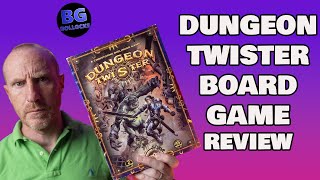
- The ability to turn the tiles around adds an interesting dynamic and differentiates it from standard dungeon crawlers.
- The game ends immediately once five victory points are reached, which is a nice touch.
- Most characters have useful special abilities, leading to agonizing choices when selecting a team.
- Component quality is shocking, with thin cardboard standees and tiles.
- The initial placement of items can feel like a waste of time.
- There is not enough content in the box to make it feel like a full game, leading to repetitive playthroughs without expansions.
- dungeon crawling
- dungeon
Mechanics (from transcript analysis)
- Action Point Allowance — Players use action points to perform actions like revealing rooms, rotating rooms, moving characters, initiating combat, and using special abilities.
- Combat — Combat is initiated when adjacent to an opponent, using combat cards and character strength, with the winner wounding the opponent.
- Modular Board — Room tiles can be rotated on their gears.
- Set Collection — Victory points are earned by moving adventurers, goblins, or treasure chests over the opponent's finish line.
- Tile Placement — The map is laid out in a 4x2 grid of face-down tiles.
- Variable player powers — Each of the eight characters has a unique special ability.
Video topics + discussion points
Quotes (from this video)
- Dungeon Twister is definitely showing its age but that doesn't mean it's a terrible game and it can be quite fun hunting down or evading your opponents whilst running for the Finish Line with that treasure chest or that half dead Goblin however the length of time it takes for the game to reach a satisfactory conclusion and the repetitive nature of subsequent playthroughs without one of the gazillion and one expansions renders this game rather lifeless until you invest in additional content.
References (from this video)

- deep tactical play
- cool setups
- heavy setup
- dungeon crawl realism
- dueling dungeon combat
- competitive, tactical
Mechanics (from transcript analysis)
- Card-driven combat — 8 characters per side with card-based actions; low luck beyond setup
- Combat: Deck/Hand — 8 characters per side with card-based actions; low luck beyond setup
Video topics + discussion points
Quotes (from this video)
- One of the greatest experiences I've ever had playing a board game ever.
- It's all about board games, but especially the people who play them.
- This is Look Back, a series that I do where I talk about games that I reviewed one year ago, 5 years ago, 10 years ago, and 20 years ago during this time frame.
References (from this video)
- Fun two-player game
- Fantasy escape
- Dungeon
Mechanics (from transcript analysis)
- Two-player focused — Designed as a competitive two-player experience
Video topics + discussion points
Quotes (from this video)
- This is easily on this shelf. The most checked out game. Wonderlands War I see played every time.
- Foundations of Rome despite how big this game is. It gets checked out all the time.
- Everyone's really upset with Grimlord Games cuz they never delivered their last Kickstarter, but another company has picked it up.
- I don't I still don't understand why companies can't put names on the sides of their boxes. Come on now.
- Frostpunk, the board game if you're ready to have a depressing day.
- I think Mosaic is a fantastic civilization game. So fast and easy to play.
- People love Smashup. I have almost everything for Smashup, but it just barely gets played.
- Probably Twilight Imperium is my favorite of all these here, even though I don't play it that much.
- Last Kingdom is a kind of a really fun game from Games based on said TV series. Uh but pretty good. Think Game of Thrones style.
References (from this video)
- Elegant two-player head-to-head design with deep tactical depth
- Dynamic dungeon manipulation through room rotation and revealed rooms
- Hidden information and simultaneous combat create tense, strategic play
- Clear objective paths to victory with multiple VP sources
- Rules complexity may be intimidating for casual players
- Limited player count (primarily designed for two players) may impact long-term replayability without expansions
- Balance concerns can arise due to card removal after use and channeled combat resources
- fantasy dungeon exploration, competitive tactical combat
- A perilous dungeon assembled from eight randomly placed rooms, where two players guide adventurers to escape or outmaneuver each other.
- procedural puzzle with adversarial elements
Mechanics (from transcript analysis)
- Action point pool and hand management — Each turn, a player uses four action cards; when depleted, they redraw into their deck.
- character-specific abilities — Each character has unique abilities that can be activated with action points.
- Combat with simultaneous reveal — Combat uses combat cards; both players reveal and add values; higher total wins and the loser is wounded.
- Combat: Damage Based — Wounded characters can't take actions; their attack value drops to zero, but they can defend.
- Door interactions — Doors can be opened by thieves or broken down by warriors; blocked paths influence route choices.
- Escape victory and scoring — Victory points can be earned by moving allies, defeating adversaries, grabbing treasure, and escaping with certain pieces.
- Hidden Deployment — Players keep their starting tiles and their hand of 16 cards hidden from opponents.
- Hidden information and fog of war — Players keep their starting tiles and their hand of 16 cards hidden from opponents.
- Hidden Victory Points — Victory points can be earned by moving allies, defeating adversaries, grabbing treasure, and escaping with certain pieces.
- Movement and speed — Movement is governed by character speed and action points; characters can move multiple times if points allow.
- Neighbor Interaction — Doors can be opened by thieves or broken down by warriors; blocked paths influence route choices.
- Objects, items, and special abilities — Characters can use objects and items; wounded characters count as movable objects; treasures and goblins grant points.
- Room rotation — Players can rotate rooms on rotating tiles, affecting positioning and movement options.
- Simultaneous Reveal — Combat uses combat cards; both players reveal and add values; higher total wins and the loser is wounded.
- Tile-based dungeon setup — The dungeon is composed of eight randomly placed tiles; tiles are revealed and can be manipulated during play.
- Wounded state and consequences — Wounded characters can't take actions; their attack value drops to zero, but they can defend.
Video topics + discussion points
Quotes (from this video)
- This classic is being remade and offered again.
- It's a great two-player game with plenty of expansions to come.
- as a two-player game the game is over when a player earns his fifth Victory point
- the dungeon is made up of eight randomly placed tiles
- you can reveal a room adjacent to one of your characters
- each player will choose one of their combat cards and reveal at the same time
- the highest player wins the battle and the loser becomes wounded
References (from this video)

- Shows a breadth of Christophe's design experience
- Demonstrates how different games inform Living Planet and Archipelago design language
- Not deeply explored in the interview; used as a touchpoint rather than a focal point
- tactics and spatial reasoning in a squad-based conflict
- puzzle-like dungeon environment
- casual reference within broader design philosophy
- Archipelago
- Living Planet
Mechanics (from transcript analysis)
- cooperative-to-competitive play — players may cooperate in the moment while pursuing personal victory
- tile-based dungeon navigation — players navigate a tiled dungeon with changing layouts.
Video topics + discussion points
Quotes (from this video)
- Archipelago is one of the few games I play that actually attempts to comment on the ethics and outcomes of colonialism through some of the mechanics.
- I would change the color of the meeples.
- the planet fights back through Cataclysm.
- the CGS is the best thing in the game for me.
- it's a race between the shaman me and the publisher; this is a designer ego moment about speed and quality.