/pic8792960.png)








Earth: Animal Kingdom Deep Dive
What the Community Thinks About Earth: Animal Kingdom
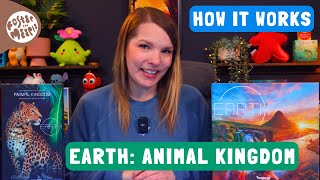
Earth: Animal Kingdom arrives as a confident expansion to an already-beloved engine builder, bringing living fauna into what was previously an ecosystem of plants and terrain. Reviewers from Foster the Meeple to Broken Meeple agree on a single point: the expansion does not overwhelm the base game, but rather enriches it with new strategic pathways and asymmetric powers that reward careful planning. The consensus leans decisively positive, with many reviewers noting that the expansion's greatest strength is its restraint. Rather than overcomplicating Earth, Animal Kingdom offers players a choice: integrate the animals fully into your strategy, or leave them out entirely. This flexibility has resonated across the community, from casual players discovering Earth for the first time to veterans seeking fresh decision trees. Some reviewers, particularly those who have invested in the base game and the Abundance expansion, approach the costlier add-on options with skepticism, but the core expansion itself draws widespread praise.
Core Mechanics That Define Earth: Animal Kingdom
Resource Management Through Animal Activation
Earth's resource economy already asks players to balance leaves, sprouts, growth, and cards. Animal Kingdom deepens this tension by tying animal activation to leaf usage. When a player spends a leaf to claim a fauna objective or complete their tableau, they unlock the ability to move their personal animal across their grid and trigger its ability. This creates a new dimension to the classic Earth decision: pursue that objective now, or wait until conditions are perfect for your animal? Each animal's power is distinct, from creatures that produce resources to ones that convert sprouts into points to those that activate other abilities on the board. Designer Maxim Tardiff distributes these powers across 36 unique cards, ensuring no two games feel identical. The trade-off between claiming objectives and activating animals becomes the expansion's central tension.
Spatial Movement and Tableau Interaction
The physical centerpiece of Animal Kingdom is its animal meeples: clever wooden tokens representing creatures from polar bears to platypuses. These pieces move across players' tableaus following specific rules printed on each animal card. Some animals drift freely up to a certain number of spaces; others must land on specific card types or colors. A Capybara family swells with each activation, creating multiple pieces that work together. The White Rhino's movement restrictions become more permissive over successive activations as it grows stronger. This spatial puzzle layer rewards tableau-building decisions made turns in advance. Players find themselves asking not just "what cards should I play?" but "where should I place this card so my White Rhino can move through it?" The movement rules transform the 4x4 grid from a static scoring surface into a landscape where spatial relationships matter.
The Earth: Animal Kingdom Experience
Discovering Asymmetric Power Combos
What makes Animal Kingdom feel fresh is the draft at game start: each player draws four animal cards and selects one or two depending on difficulty. This means every game brings a different constellation of powers into play. A player might draft a Common Loon that collects sprouts on a specific card, then discover mid-game that pairing it with the global ability of a Red Panda creates a synergy neither player anticipated. Reviewers repeatedly describe the moment of realizing a combo works. The feeling is one of discovery and clever engine assembly, watching a well-built tableau suddenly unlock new possibilities when the right animal is activated at the right moment. In advanced mode with two personal animals, these combos multiply, creating chains of effects that reward foresight.
Thematic Engagement Without Complexity Creep
The expansion integrates its animal theme into mechanics rather than grafting it on top. A Beaver's ability to carve trees into soil directly mirrors beaver ecology. A Jaguar's movement across flora with animals in their names feels right, not arbitrary. Reviewers note that even newcomers grasping the mechanical flow of Earth can intuitively understand what a given animal does because the abilities stay true to the theme. This thematic grounding keeps complexity manageable. The animals arrive as a natural evolution of Earth's fauna objective cards, which are already central to the base game. Rather than learning new subsystems, players expand the levers they already control.
What Makes Earth: Animal Kingdom Stand Out
36 Unique Animals Ensure Endless Variation
The sheer roster of animals in this expansion is remarkable. Each card represents not just a power but an identity: the Mountain Goat, the Eurasian Hoopoe, the Reindeer, the Snow Goose, the Siberian Chipmunk. In a four-player game, only three or four animals see play as personal powers, plus one global ability. This means most of the deck will remain face-down until the next session. Reviewers consistently highlight replayability as a direct result. The variety ensures that back-to-back plays of Earth feel distinct. One game features a Quokka combo strategy; the next might hinge on exploiting a Komodo Dragon's ability to activate other cards. The expansion essentially offers dozens of viable strategies, not just one optimal path.
Adorable and Tactile Physical Components
From the moment players open the box, the animal meeples command attention. These are not abstract tokens: they are recognizable, often endearing miniatures. The polar bear, the red panda, the highland cow, each rendered in wood with care. Reviewers praise the "fun physical element" these bring to the table. The act of moving a tangible creature across your grid creates satisfaction absent from many tableau builders. Even players who barely interact with their animal during a session find pleasure in its presence on the table. This physical engagement, paired with the variety of designs, gives Animal Kingdom a charm that purely mechanical expansions lack. The meeples become talking points between turns and memory hooks that help players recall earlier games.
Potential Drawbacks
Limited Activation Windows May Frustrate Some Players
Animals activate only when a player uses a leaf token: either by claiming a fauna objective, finishing their tableau, or discarding a leaf to mitigate luck. In a typical game, this caps activations at five times per player. A new player who completes few objectives may trigger their animal only twice, barely exploring its power. Reviewers note that this gate can feel restrictive, especially in beginner mode where players draft only one animal each. The expansion introduces abundance compatibility: players can discard a leaf for a seed instead, providing an alternative activation route. Even with this workaround, some reviewers wish the activation mechanic were more liberal, allowing animals to reward strategic play earlier in the game's arc.
Expansion Requires Strategic Buy-In to Shine
Animal Kingdom is optional in a way that feels genuinely optional. A player can remove the animals entirely and have a full Earth experience. Reviewers describe it as sitting somewhere between the base game and Abundance in terms of necessity. Abundance mitigates the luck factor in card draw, which many players feel improves Earth. Animal Kingdom, by contrast, does not fix any existing friction in the base game. It simply adds a new type of decision. For players content with Earth as-is, the expansion offers modest value. It does not change the feel of the game dramatically; it does not accelerate play; it does not simplify strategy. What it does offer is novelty and a fresh layer of strategic expression for those who have played Earth many times.
If You Enjoy Earth: Animal Kingdom
The obvious companion is Earth: Abundance, the first expansion. Meeple University points out that the two are compatible and that Abundance's seeds also trigger when you spend leaf tokens, which makes leaves even more powerful alongside animals, and a couple of Animal Kingdom's animals specifically need Abundance to shine. The Broken Meeple found Abundance decent rather than great at first, though it grew on him as a way to soften the luck of finding the right cards. For a sense of what kind of expansion Animal Kingdom is, The Broken Meeple compared it to the Americas expansion for Wingspan: a genuinely good addition that you would not miss if it were gone. Players who love that style of polished, add-something-cool expansion will know exactly what to expect here.
What Reviewers Are Saying
"It expands the original game without overwhelming it, like the greenhouse in spring, more layers, more flavor, more opportunities for a sneaky goat placement."
— Stella, Meeple University
"The two of them combined together whenever I get to activate both of them gets me turn one dirt into six points. So that is huge. That is a very nice combo."
— Rahdo Runs Through
"It's good fun to play with this expansion. You know, you've got all the variety in the world. It's nice to have all these great pictures of animals and a big polar bear on your thing and they do a good variety of different things so you're never going to get bored seeing the same thing twice."
— Luke, The Broken Meeple