



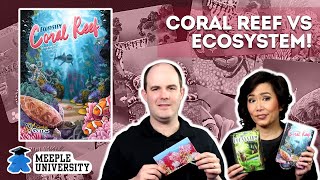

Ecosystem: Coral Reef Deep Dive
What the Community Thinks About Ecosystem: Coral Reef
Reviewers see Ecosystem: Coral Reef as a streamlined follow-up to the original Ecosystem rather than a new design. Meeple University describes it as a standalone sequel that keeps the same drafting and grid-building engine but swaps in different animals, a different set of scoring rules, and a new way of rewarding balance. Their verdict is warm: it is a quick, easy-to-teach filler that works well as a gateway game, and they name the reference cards as something everyone should have at the table. Techas, who played a solo game against the AI opponent Mocha, found the gameplay close to identical to the original and enjoyed the scoring puzzle, though the many card types made the final count feel demanding. The two channels agree that the game is more approachable than its predecessor, even if their personal preferences between the two titles differ.
Core Mechanics That Define Ecosystem: Coral Reef
Drafting and Grid Building
Each player receives a hand of ten cards, keeps one, and passes the rest to the next player. Meeple University explains that the drafting direction then reverses for a second set of ten, so every player ends up with twenty cards to place in a four by five grid. Techas describes the placement rule as a connected build: the first card can go anywhere, but each card after that must sit orthogonally next to a card already in the grid, with no diagonal placements. In a solo game the grid for Mocha is filled in a different order, starting in the top left corner and completing a row of five cards at a time. That means every choice a player makes also affects the rows and columns that are still open for the opponent.
The Food Web Bonus
Scoring is built around three broad groups of cards. Meeple University describes producers such as coral, krill, and plankton, prey that eat the smaller creatures, and predators such as eels, sharks, and whales that eat prey. Each card type scores in its own way, with coral worth points on the bottom row and krill scoring for small adjacent sets. The distinctive part is the food web bonus, which totals the points from each of the three groups and then doubles the lowest total. Techas notes how much of the scoring depends on what sits next to a card, so a whale can be worth a lot if it is placed well and very little if it is isolated. Because the bonus rewards balance, a player who focuses on only one group can still score well, but the lagging group will cap the result.
The Ecosystem: Coral Reef Experience
A Light, Quick Filler
Much of the praise centers on how simple the game is to start and finish. Meeple University calls it a quick game with really simple rules, noting that the basic flow of drafting ten cards, drafting another ten, and then scoring can be taught in a few minutes. The reviewers describe it as an easy game to bring to the table, particularly with new players, and they suggest it could even be a holiday game with family. Techas also points to the quick pace, observing that the setup is very simple and that the rounds move along faster than expected. The overall sensation is of a light, social filler that still offers enough decisions to feel satisfying.
Tension Across the Draft
Because players are passing cards to one another, the draft carries a layer of prediction that reviewers enjoy. Meeple University describes the choice as more than picking the most valuable card, since a player also has to judge whether the next person will take a card they want. The pair notes that drafting at lower player counts makes it easier to anticipate what will come back around, which adds a sense of reading the table. Techas captures a similar feeling while playing solo, where each choice for the player‘s own grid has to be weighed against the card that will go to Mocha. The result is a small but steady stream of tough decisions rather than a long stretch of heavy thinking.
What Makes Ecosystem: Coral Reef Stand Out
Clearer Categories That Teach the Game
The most frequently praised change from the original is the split into producers, prey, and predators. Meeple University argues that this categorization makes the game easier to understand because players can see at a glance which cards are meant to be near which others. The reviewers explain that the original game had streams and other cards that scored in more complicated ways, which made it harder to track which combinations mattered. The new framework gives players a simple mental model: the big animals generally eat the small ones, and the scoring follows from that relationship. Meeple University concludes that this clarity is the main reason they prefer the newer version as an entry point.
Two-Player Drafting and a Solo Opponent
Meeple University highlights the two-player variant, which uses a fake third player that the two players draft together. The reviewers say this matters because two players otherwise do not see enough animals to make good choices. Techas shows the solo mode in detail, with Mocha building a second grid and the player trying to finish ahead by a margin that depends on difficulty. Techas explains that the easy setting requires a 55 point lead, while medium and hard raise that bar to 70 and 80 points. The two options give the game more reach than a simple multiplayer draft, and Techas describes the solo play as a clear way to learn how the scoring works.
Potential Drawbacks
Scoring Demands Careful Tracking
Techas finds that the scoring asks a lot of attention, pointing out that the game has many different card types that score differently depending on placement and on the cards around them. During the solo game Techas made several small mistakes, including miscounting the cards drawn and forgetting to turn over an adjacent card before scoring. Techas also was not sure how the rule for turning cards over applied when two whales were involved, which shows that some edge cases are not obvious at the table. For players who want a simple evening, this detail can slow the final count, even though the reviewers agree that the core rules are easy to learn.
Weak Draws and Lower-Count Competition
Some of the frustration described by reviewers comes from the luck of the draw and from how drafting behaves at different player counts. Techas reached a point in the solo game where the available cards all seemed poor for the player‘s grid, saying the choices were not great, and ended the session feeling unhappy with the result. Meeple University recommends higher player counts over lower ones, in line with other drafting games, because the table has more cards moving and fewer chances to predict an exact outcome. Meeple University also notes that a player who focuses on one card type can still do well, but the same focus can lead to direct competition for those cards at smaller tables. The reviewers are candid that the experience changes noticeably depending on how many people are seated.
If You Enjoy Ecosystem: Coral Reef
- Ecosystem: Meeple University describes Coral Reef as the same game with different animals and a different set of scoring, so the original is the closest comparison. The reviewers note that the original used a diversity bonus that penalized players for each scoring animal type they failed to score, while Coral Reef rewards evenly balanced scoring instead.
Techas also mentions a third, savannah-themed entry in the series that was releasing around the same time, saying other players have called it the best of the set, though Techas had not yet played it to confirm that firsthand.
What Reviewers Are Saying
"Both are very similar like the gameplay is pretty much identical but they have like different themes of course and also different scoring mechanisms for these specific cards."
— Techas
"this one is an easier entry point. And what makes it an easier entry point is that it ha- these categorizations make it easier to organize your thoughts on what card needs to be near what."
— Meeple University
"I actually won the first ecosystem that I recorded here, but this one I will definitely lose."
— Techas