


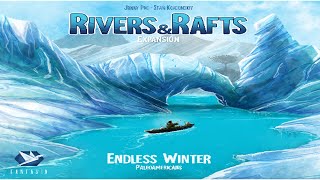

Endless Winter: Rivers & Rafts Deep Dive
What the Community Thinks About Endless Winter: Rivers & Rafts
Reviewers treat Endless Winter: Rivers & Rafts as a clean, well-judged expansion rather than an oversized add-on. The most detailed review available, from Board Games UnLocked, gives it a nine out of ten and calls it the best expansion for the base game. The host's central point is restraint. The expansion reshapes the terrain board and adds new scoring, yet it asks players to learn only a few new rules, and the host credits the expansion line for never losing focus on what the core game is about.
Unboxing coverage from other channels is more enthusiastic than analytical. The Meeple Mountain unboxing centers on the upgraded components and the play mat, with the presenter eager to return to the table. Because the most substantive judgments on this expansion come from one long-form critique, the praise and criticism below reflect that reviewer's assessment, supported by first impressions from the unboxings.
Core Mechanics That Define Endless Winter: Rivers & Rafts
Raft Movement and River Control
The expansion's central system gives each player a raft on the river. According to the Board Games UnLocked host, movement is cheap and flexible: for a single movement point, a raft can travel down the river as far as its owner wants, which makes positioning a deliberate choice. Players can place camps where their raft sits or in their starting zone, so the raft effectively extends their reach across the river network. River control matters because whoever has the most influence at each river spot takes a randomized fish token. The host describes the rewards as food, megaliths, card draws, or points, and notes that controlling every spot on the river can deliver straight points. Published by Fantasia Games, the expansion uses this system to turn what was a side area of the base game into a meaningful part of the plan.
Landmark Scoring in the Eclipse Phase
Much of the scoring is concentrated in the Eclipse phase. Players earn points for whoever sits closest to the end of the river where it opens into the ocean, along with points for each camp on the river itself. Landmark tiles add further targets, and players can use one, two, or three of the five included. The host's examples include a point for each tent inside the hexagon, a point for each tent outside it, and two points for each village touching a river tile. A stone tablet adds two points for each settlement touching a landmark. The host's analysis of the trade-offs is that concentrating all five tents in the middle secures a five-point landmark, while spreading tents out pays off along the river, so the two approaches balance out well.
The Endless Winter: Rivers & Rafts Experience
Clean, Focused Strategy
The dominant feeling in the reviews is that the game stays tidy even as it grows. The host describes the expansion as succinct and clean, and points out that the four eras pass quickly, so a large pile of landmarks would not suit the game's length. Keeping the landmark count at five feels right to the host, who suggests that playing with three landmarks makes scoring easier and sparks more contention. That flexibility lets a group tune how sharp each session feels. The result is a game that rewards planning without turning into a bookkeeping exercise.
Light Contested Territory
Area control on the terrain board creates steady pressure rather than open conflict. The host observes that in the base game, once a player's tent holds a spot, rivals can only add more tents to contest it. The Warrior changes that by letting a player move tents during the Eclipse phase, including opponents' tents, pushing them toward less useful spots. The host stresses that the interaction stays restrained. Warriors cannot move tents back onto their starting spot or into the starting area, and playing many of them can win turn order but leaves fewer Warriors for the Eclipse phase, where they are most valuable. The host compares this to the familiar practice of placing camps to steal influence, which makes the tension feel natural rather than hostile.
What Makes Endless Winter: Rivers & Rafts Stand Out
A Terrain Board That Changes Every Game
The most praised element is how the layout is built. The first tile always sits at the center, but it can be flipped, and the host notes that this changes how the river runs, which in turn shapes how the remaining tiles fill out. In the host's game, activity congealed on one side of the board while a lone food tile on the far side was not worth pursuing. Combined with the landmarks, these arrangements make each setup feel distinct, and the host says the different combinations of layout and landmarks vastly change the game.
An Expansion That Stays Lean
Reviewers repeatedly praise how much the set adds without weighing the game down. The Board Games UnLocked review argues that the best quality of the whole line is that everything can be modified. A player who dislikes one element can swap in a replacement from another expansion, add the rivers for more area control, or bring in new animals. The host says this breadth never feels like Kickstarter bloat. The Warrior illustrates the same philosophy, since he can be shuffled into the base game without the expansion, where he replaces the Pathfinder, gives a labor, and grants a tool when a player visits the mountain spot.
Potential Drawbacks
The Randomness of the Fish Tokens
The host identifies the fish tokens as the element that many players may not enjoy, since the benefits are drawn at random from a shuffled pool. The Stellar Sea Cow, which can be added to the deck and tapped for two fish, offers a more reliable route to the river's rewards. The host nonetheless finds the tokens balanced, pointing out that the pool holds multiple megaliths, food, tools, and card draws, and that a single lucky draw deciding a close game is something the host doubts. The concern is real, but the host judges it less significant than the expansion's gains in layout and strategy.
An Untouched Offering Track
The host's clearest criticism is that the offering track, which is described as the weakest aspect of the game, was left unchanged. Offering tracks are easy to climb, offer several ways to advance, and exist mainly for points. The host finds it strange that the rest of the expansion received new animals, actions, cards, and area control, while the offering track gained nothing creative. It is the one area where the host feels the expansion missed an opportunity, despite otherwise strong praise.
If You Enjoy Endless Winter: Rivers & Rafts
Players who enjoy the terrain board's flexible layout and the lean way the expansion layers onto the core should start with the base Endless Winter, since the expansion builds directly on its systems. Players who are drawn to the research track that the host uses as a point of comparison will find similar satisfaction in Lost Ruins of Arnak. The host notes that Endless Winter's terrain plays a role similar to Lost Ruins of Arnak's research track, but that the research track was a majority of that game, while the terrain board is one optional area within Endless Winter. Players who want a central engine built around a track will find Lost Ruins of Arnak more focused, while Endless Winter offers the broader mix of deck building, animals, and area control.
What Reviewers Are Saying
"I think that this is the best expansion for this game. I really really enjoyed it, and just like the cave paintings expansion they managed to do a lot with so little, which is something that most companies and most expansions don't bring to a game a lot of times."
— Board Games UnLocked
"It's light competition. It's no more mean than someone putting in a bunch of camps into a spot to steal influence from you."
— Board Games UnLocked
"The one thing I wish that they added, and it's very shocking to me that they didn't, is the offering tracks. That is probably still, I think, the weakest aspect of the game."
— Board Games UnLocked