


Erune Deep Dive
What the Community Thinks About Erune
Erune, published by Arkada Studio, is consistently described as an app-driven dungeon crawler that rewards players who learn where the app takes over and where the table takes over. Meeple University opens its teaching video with exactly that point, explaining that the app drives the scenario, the story, the map, and the randomized effects, while combat is usually resolved with dice. Board Game Coach covers the game from three angles: an unboxing by Alex Radcliffe, a sponsored preview by Professor Meg, and a full scenario played by Alex and Meg.
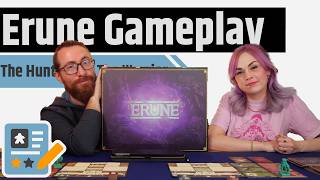
Reviewers largely agree on where Erune is strong. Its theme, its character progression, and its components come up again and again. They disagree mainly about how heavy the rules feel. Alex Radcliffe describes the rulebook as long on paper but manageable in practice, since much of it covers optional material. The gameplay video, by contrast, shows the pair pausing repeatedly to check edge cases. Professor Meg frames the game primarily as a thematic puzzle, while Alex Radcliffe focuses more on how deep the hero building goes.
Core Mechanics That Define Erune
Persistent Character Progression
Meeple University stresses that whichever side a player takes, their character persists between scenarios and levels up. Adventurers gain skills, equipment, experience, and level ups, which are tracked on a physical character sheet and in the app. The app stores each character's level, the stats tied to that level, experience points, and a tech tree of skills. Leveling happens at the end of a scenario or at a campfire rest, where the app walks players through new stats and skill choices. Unused stamina converts to experience at a one-to-one rate. Alex Radcliffe reads the class sheets as branching paths, noting that a warrior can become an assassin, berserker, or knight. Professor Meg says the experience points let players build their heroes the way they want. The rules are the work of designers Quentin de Lo and Adrian Smith, as Meeple University introduces them.
Split Resolution Between Dice and the App
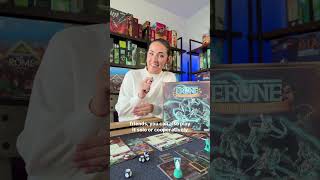
The second defining mechanic is how Erune divides its work. In one-versus-many play, combat is resolved at the table. Players roll attack dice, skulls count as hits, shields block, and stamina grants a stamina token. Monsters defend with their own dice, and the app records the outcome, experience, and rewards. Searching furniture, opening doors, triggering traps, and most events are resolved by the app, which narrates each result and shows it on the map. In solo co-op, the app takes over the Master of Shadows role. Professor Meg describes the app rolling defense for monsters and deciding their movement under a few fixed rules, such as avoiding danger and keeping ranged units at a distance. Meeple University treats knowing this boundary as the central skill for new players.
The Erune Experience
Exploration Through an Unfolding Map
Professor Meg describes the map as one that builds itself. Players start in a single room, open doors, and place new tiles as the app populates each space with enemies, chests, and interaction points. Meg calls the game surprising for this reason, since players know the overall objective but not the route or how to open certain areas. The scenario in the gameplay video matches that description. When the pair reached a locked room, an imprisoned character offered to reveal either a secret passage or a locked door, and the choice opened a new section of the board. The sense of discovery comes from the app and the table working together, with each door a small reveal.
Tense, Swingy Tactical Combat
The gameplay video conveys combat that feels tight and sometimes volatile. Alex and Meg spend much of each turn on positioning, deciding whether to attack, move, repair a broken crossbow, or save consumables for a stronger foe. Bad rolls carry real consequences. A critical fail breaks a crossbow and forces an action to repair it, and failed defense rolls send the party into damage races that cost health and mana. Good turns feel rewarding, as when a backstab or a well-timed reroll finishes off an enemy that looked safe. Alex Radcliffe calls the rules straightforward for an app-assisted game, and the monster phases in the video show enemies closing distance in waves, which keeps the pressure steady from one round to the next.
What Makes Erune Stand Out
Miniatures and Components
Alex Radcliffe spends a large part of the unboxing on the miniatures, describing the sculpts as fantastic, with characterful poses, a good range of size contrast between enemies, and terrain pieces such as a forge, a weapons rack, pillars, and a trapdoor hatch. Alex also finds the dice pleasing, with a subtle marbled finish. Professor Meg highlights the deluxe components in the current campaign, including detailed doors that open when played and interaction tokens that look good on the board. Alex adds a caveat that miniatures alone do not make a good game, but the production quality is a consistent point of praise across the videos.
Freedom in Hero Building and Roles
Professor Meg argues that Erune gives players several distinct ways to engage. One player may focus on hunting monsters, another on exploring every corner of the map, and another on the story. Any player can also take the Master of Shadows role and run the enemy side against the group. Hero building is deep. Each class has its own abilities, passive skills, and skill lines, archers and wizards draw from spell fields, and weapon and defense ranks limit what a hero can equip. The gameplay video shows the payoff. Professor Meg's demon huntress switches between a multi-shot crossbow and a whip, while Alex Radcliffe's warrior relies on backstab, positioning, and group attack, so the same turn can look different depending on the build.
Potential Drawbacks
Rules Density and Edge Cases
Alex Radcliffe raises a design concern in the unboxing. Rules such as lightning attacks work differently from lightning defense, and each added exception is one more thing players must learn, even when the payoff is interesting nuance. In the scenario video, the pair stopped repeatedly to check rules, including whether disarming a trap counts as a free action, whether a double disarm still pays out experience, and how a particular ability should be reported. Reviewers do not dismiss the depth, but they acknowledge the cost in table time and in reference lookups, particularly for first-time players.
Solo Play Means Controlling Two Heroes
Alex Radcliffe notes that solo play requires controlling two heroes, which some players will see as a negative. Alex personally prefers at least two characters even in games designed for solo play, citing the balancing of skills, abilities, and movement as the source of interest. Meeple University presents the solo co-op mode as one where the app controls the Master of Shadows and the players form a single team. That mode suits players who want a cooperative experience, but it is not the one-versus-many design the game is built around. Players who expect a single-hero dungeon crawl should expect to manage two characters.
If You Enjoy Erune
- Players who enjoy Erune's persistent heroes and campaign-style progression will find similar satisfaction in Descent: Legends of the Dark, which Alex Radcliffe mentions as a comparison point.
- Players who want a more app-heavy scenario flow than Erune offers can look to Bad Karma, which Alex Radcliffe places above Erune on that scale.
- Players who like Erune's exploration but want to play a dungeon crawl alone will find Too Many Bones a useful reference, since Alex Radcliffe names it as the one game where true solo play feels comfortable.
- Players who enjoy handling two heroes at once will find Primal Legends a useful comparison, since Alex Radcliffe prefers two-handed solo play in that game.
What Reviewers Are Saying
"Whichever side you're on, you will have a persistent character. That is, one who levels up between scenarios."
— Meeple University
"If you're playing in solo, you do have to control two heroes, which for some people is a negative. For me, even when I'm playing games that are true solo friendly, I usually prefer having at least two characters."
— Board Game Coach
"A Rune is going to be a dungeon crawler that provides a very thematic challenge for players because you are going to have this challenging puzzle of these maps building out and the monsters that are spawning in, different things that are happening as you spend your time in these different quests. But, you're also going to be able to truly customize your different heroes."
— Board Game Coach