



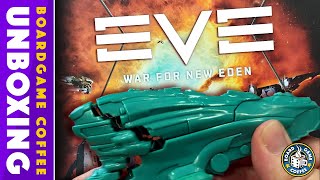
EVE: War for New Eden Deep Dive
What the Community Thinks About EVE: War for New Eden
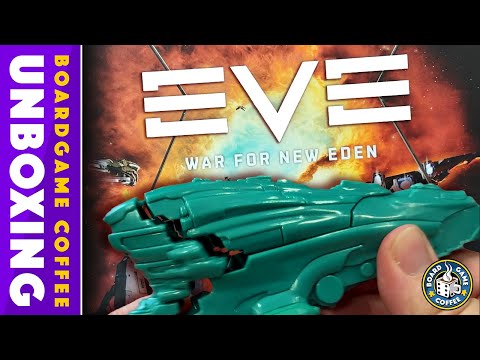
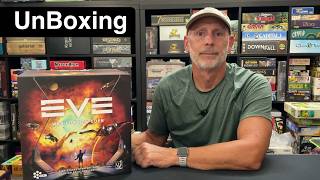
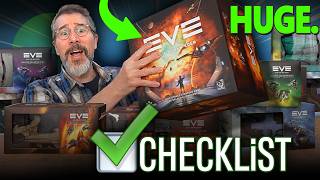
The board gaming community sees EVE: War for New Eden as an ambitious and production-rich adaptation of the EVE Online universe. Reviewers consistently praise the game's manufacturing and component quality, from its massive cube-shaped box to the detailed faction boards and custom miniatures. Grant Lyon calls it "a heavyweight game" that brings "some Twilight Imperium sort of feel," while Board Game Coffee's unboxing emphasizes the attention to organizational detail and beautiful card stock. The Discriminating Gamer remarks that "the production of this game has just been outstanding." Across all channels, reviewers highlight the game's promise of boundless possibilities grounded in diplomacy, deception, and direct warfare. However, they also note potential accessibility barriers: the rulebook text is described as "uber tiny," requiring magnification to read comfortably, and the 90-150 minute playtime signals a heavyweight strategic commitment.
Core Mechanics That Define EVE: War for New Eden
Resource Management
Resources sit at the heart of every meaningful action in EVE: War for New Eden. Reviewers describe players acquiring and converting minerals, components, and rare goods to fuel expansion, fleet construction, and diplomatic maneuvering. Grant Lyon's expansions commentary notes that "resource allocation and careful planning" is critical when constructing colossal Titan ships. Board Game Coffee's unboxing reveals mineral cards and structured resource decks that players draw from, making resources tangible and scarce. The economy is not a side system but instead "crucial" to victory, forcing players to constantly decide whether to spend resources on military buildup, technological advancement through research tokens, or economic positioning through trade. This scarcity ensures every allocation forecloses other options, creating the tension that defines strategic play.
Faction Development and Hidden Technology
Each faction maintains a secret research tree, represented as faction development cards that players reveal only when their plans are complete. Game Night Picks describes the mechanic directly: "keep your plans hidden and reveal the advancements that you've completed only when the time is right to catch your enemies and perhaps even your would-be allies a little bit off guard." Board Game Coffee's unboxing shows that "each race will have its own or faction will have its own developments that you can improve on and increase," allowing players to invest research tokens on a tech tree unique to their faction. This creates asymmetrical play paths where victory can come through manufacturing dominance, trade and economic control, military conquest, or a hybrid strategy, a design philosophy Grant Lyon compares to "Civilization where you can have like a holy victory or science victory or war victory." The hidden element means opponents cannot fully predict rivals' strategies until it is too late.
The EVE: War for New Eden Experience
A Grand Game of Cosmic Chess
Multiple reviewers invoke chess when describing the feel of play. Game Night Picks frames it as engaging "your rivals in a grand game of cosmic chess," echoing Grant Lyon's language. This captures the blend of tactical calculation with psychological warfare: players move fleets, position resources, and plan research tracks while negotiating with opponents, deceiving them about their true intentions, and preparing hidden ambushes. Early game skirmishes in unexplored space gradually escalate into monumental fleet battles, described as "quick early clashes soon transform into monumental fleet-sized battles" by Game Night Picks. The pacing from exploration to conflict mirrors the game's 4X DNA.
Epic Ambition and Unbounded Possibility
Game Night Picks opens with "A galaxy of discovery awaits players in EVE: War for New Eden" and emphasizes that the game "presents players with boundless possibilities." Board Game Coffee's reviewer, after seeing the artwork and learning about the multiple paths to victory, says "I'm I'm interested. I want to play this." The experience captures the feeling of carving an empire from an uncharted cosmos, where players claim entire solar systems, construct distinctive structures, build rare-component economies, and command fleets of uniquely designed faction-specific ships. The sheer volume of content and expansions available signals that the game promises not just one campaign but an evolving series of galactic adventures.
What Makes EVE: War for New Eden Stand Out
Uncompromising Production and Organization
Reviewers single out the physical package as exceptional for a 2024 board game release. The Discriminating Gamer notes the detail in organization: an included storage guide that explains "how everything is going to store all the way from the extra tray up at the very very top all the way to your ship trays," praising it with "Why do more companies not do this?" Board Game Coffee extends this: "I appreciate these. These aren't all taped... I do like when games get the little organizational thing." The faction boards feature embossed logos and indented slots for tokens, custom dice with tailored symbols, and component trays that feel built for usability, not just aesthetics. Grant Lyon catalogs dozens of optional upgrade packs, collector boxes with 200% scale miniatures, visual upgrade packs with 80 intricate minis for resources, and structure sets with 32 building miniatures, all designed to deepen the visual spectacle of the board state.
Multiple Paths to Victory Preserving Agency and Replayability
Game Night Picks emphasizes that "the trail that you blaze to victory is very much your own" and "exactly how you get them is totally up to you," even though all players race to 10 victory points. Board Game Coffee's discussion with Chris reveals that factions can specialize in "all manufacturing and production or you can focus on trade and economics," echoing Civilization's victory diversity. Each faction's unique development cards, combined with strategy cards and hidden research choices, mean that no two games play identically. The Discriminating Gamer notes that "each one of these factions is going to play a little bit different," suggesting asymmetry baked into the core experience. This variety, combined with abundant expansions that introduce new leaders, pirate factions, and capital ships, keeps the game fresh across repeated plays.
Potential Drawbacks
Accessibility Barriers: Text Density and Component Depth
The Discriminating Gamer's most repeated concern is readability: "this text is uber tiny... this game really should have come with a magnifying glass." Rules and ship info cards require close reading and focus, and even on a large monitor in Board Game Coffee's unboxing, the production team struggles to legibly display card text. The 34-page rulebook and rules for two and three player variants signal a game that demands careful study. For players with vision challenges or those seeking a casual experience, these barriers are real.
Heavyweight Complexity and Time Investment
Grant Lyon classifies the game as "heavyweight," and play duration ranges from 90 to 180 minutes across all sources. Board Game Coffee jokingly notes the rules commitment: "you got to read a 33 page rule book" before even attempting to teach someone else. The depth of faction development, the number of discrete actions available each turn (movement, trading, researching, building structures, engaging in combat), and the array of cards to parse create a game that demands full cognitive engagement throughout its entire runtime. Casual players or those with limited attention spans may find the experience exhausting rather than rewarding.
If You Enjoy EVE: War for New Eden
Grant Lyon explicitly recommends Twilight Imperium as a comparable experience: "there's certainly some Twilight Imperium sort of feel to this game," particularly in how diplomacy and negotiation intertwine with spatial conflict. Fans of heavy 4X games like Civilization (especially those who value multiple victory paths) will recognize EVE's design philosophy. For those seeking the deeper economic dimension without the science-fiction skin, Terraforming Mars offers similar resource-management tension and multiple pathways to dominance. Too Many Bones and Gaia Project also represent the upper bound of component richness and strategic depth that EVE's design inhabits.
What Reviewers Are Saying
"You're going to be using diplomacy, deception, and direct warfare to engage your rivals in a grand game of cosmic chess. If you like space themed games, if you like some diplomacy and negotiation in your games, if you like epic feeling games, or if you like the IP Eve War for New Eden, then that might be a reason to check this one out."
— Grant Lyon
"The trail that you blaze to victory is very much your own. Keep your plans hidden and reveal the advancements that you've completed only when the time is right to catch your enemies and perhaps even your would-be allies a little bit off guard. The economy in the game is crucial."
— Game Night Picks - Pair Of Dice Paradise
"It looks really clean from an aesthetic point. Like I like the art the text reads really clear. I get kind of a Dune vibe from looking at this and the Dune game is awesome."
— Board Game Coffee