






Fives Deep Dive
What the Community Thinks About Fives
Fives has captured the attention of trick-taking enthusiasts who see it as something special: a game that feels like a classic, yet introduces enough innovation to feel fresh and engaging. Reviewers consistently praise it as a clever balancing act that respects what makes trick-taking games work while adding layers of strategic depth. The consensus is that Fives is a game people want to return to repeatedly, a sign of a design that delivers satisfying gameplay night after night.
Core Mechanics That Define Fives
Trick-Taking with Magenta Innovation
At its heart, Fives follows the familiar architecture of classic trick-taking: one player leads a card, others must follow suit if possible, and the highest card of the led suit (or trump) wins the trick. Silver is the trump suit, which separates it from standard Hearts or Spades where players might expect the magenta suit to hold special power. What makes Fives distinctive is that every card in the deck can be played face down as a magenta five, giving players a hidden option when leading magenta or when they lack cards of the led suit. Only one magenta five can be played per trick, creating moments of real tension as players decide when to deploy this strategic tool.
The 25 Economy
The brilliance of Fives lies not just in the trick-taking, but in its scoring structure. When you win a trick, the card you won with goes in front of you face up. Your goal is to have all your winning cards sum as close to 25 as possible without going over. Go bust, and you score zero points for the hand. The player closest to 25 gets 3 points; second place gets 2; third gets 1. Anyone who busts gives 1 point to whoever was closest, creating an economy where even your failure can benefit opponents. Hit exactly 25, and you get a bonus point for 4 total. This scoring system forces a constant negotiation between winning tricks and managing the value of cards you collect, turning a familiar mechanic into something that demands constant calculation and risk assessment.
The Fives Experience
Tension and Clever Restraint
Fives delivers moments of genuine dramatic tension. You can sit confidently at 25, confident you won't take another trick, only to find yourself forced to win one more and bust. Reviewers describe the feeling as exhilarating: the game creates natural "grand moments" where decisions matter and the outcome feels personal. This tension comes not from overwhelming complexity, but from elegant simplicity. You are always managing a single resource: staying as close to 25 as possible. Every card you play carries weight because it either gets you closer to that sweet spot or pushes you toward disaster.
Nostalgic Yet New
What players appreciate most is how Fives walks a line between familiarity and innovation. Reviewers note that anyone who has played Hearts or Spades will instantly recognize the trick-taking structure and the "must follow suit" rule. Yet the magenta five mechanic, the goal of hitting 25, and the way the scoring economy creates interesting decisions make the game feel like something that shouldn't have taken this long to exist. Players who grew up with classic card games find themselves saying, "Why didn't this already exist?" That blend of nostalgia and freshness gives Fives staying power: it satisfies players seeking something new while honoring something timeless.
What Makes Fives Stand Out
Elegant Design in Service of Play
Fives does not overwhelm with moving parts or layers of exception handling. The rules can be explained in minutes. What matters is that every rule serves the core tension: getting close to 25 without busting. The magenta five mechanism keeps information hidden, adding bluffing and mind-reading to the mix without adding bookkeeping. Players describe the design as a "spectacular balancing act" that maintains the comfort of a traditional card game while introducing pretty sharp twists. This elegance means the game scales beautifully across play counts and stays quick. A hand resolves in under five minutes, making it perfect for consecutive plays.
Play-It-Again Appeal
The defining characteristic of Fives in the community is its replayability. Reviewers report playing the game multiple times in a single session without tiring of it. Each hand reshuffles the situation, and the pressure to manage your total keeps everyone engaged throughout. Unlike games that feel like they need to be played once and set aside, Fives invites immediate rematches. This reflects a design principle some call "the 80-year-old test": would you still want to play this game decades from now? Fives reviewers believe they would, suggesting a classic in the making.
Potential Drawbacks
Production Concerns
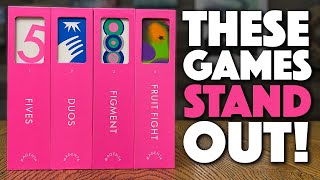
The oversized magenta box is divisive among reviewers. CMYK's design choices prioritize visual impact and shelf presence over practical storage. The box is large relative to the game's contents, which may pose challenges for players with limited shelf space. More significantly, some reviewers raised concerns about the card printing: colors are printed solid to the card edges, which can make suits visible to players sitting at an angle even when they shouldn't be able to see what's in someone else's hand. For a game built on hidden information and the uncertainty of what others hold, this production choice undermines a strategic layer. Reviewers who play trick-taking games regularly noted this as a basic oversight in card design.
Card Design Limitations
While the gameplay mechanics are praised, the card design choices create friction for competitive play. The visibility of suits to peripheral players means that even with good intentions, information leaks in a way the designer likely did not intend. Some reviewers felt that the core mechanics were sufficiently interesting that the production misstep didn't ruin the game, but they acknowledged it was a missed opportunity to deliver a perfect execution of an already-excellent design.
If You Enjoy Fives
If Fives hooks you, you might explore other modern trick-taking games that challenge the genre's conventions. Hearts and Spades remain excellent classics to return to if you want to see where Fives drew inspiration. Some reviewers mentioned "Five Cucumbers / Five Pickles" as a game in the same family. For players seeking similar blend of simplicity and clever depth, other CMYK games in the Magenta line may scratch the same itch, though Fives stands out as the most immediately satisfying of the series. The game works best with 3 to 4 players, so gather a group and be prepared to play multiple hands.
What Reviewers Are Saying
"It is a thinker for sure. Not an overwhelming trick-taking game with tons of overhead and moving parts. It has a few clever elements where every card in the game can be played as a five of the magenta suit, all while trying to make sure the values of your trick winning cards don't go over 25 and bust. Fives is a really spectacular balancing act of feeling like a traditional card game, something you'd play with a deck of 52 cards. There's a lot of sense of familiarity there, but while at the same time introducing some pretty sharp twists."
— Board Game Animal
"This truly feels like a classic trick taking game. Like this feels like it could be a spade a heart. It's one of those things where you're like how come this didn't exist before kind of thing. And like when am I going to play this in my 80s, right? Because that's you just want to play this again and again each and every night."
— kovray
"You can be so confident that you're not going to take another trick and you're sitting at 25 and bam, you did. You've busted. And that is fives. My number five and number one. Fives is really clever because it is simple trick taking where you're trying to meet a certain number 25 with the tricks that you win. But there's a twist where each of the cards in your hand is also magenta 5."
— kovray