







Flip City Deep Dive
What the Community Thinks About Flip City
Reviewers agree on the central hook of Flip City from Tasty Minstrel Games: a deck-building game in which the cards in your deck are double-sided, so flipping a building to its other face matters as much as buying new ones. The host of Getting Games called it "really cool" and "really interesting" after a few plays, and the same channel's full two-player playthrough, also from Getting Games, showed how the flipping and push-your-luck systems interact over a long game. Tom Vasel of The Dice Tower described it as an unusual push-your-luck game that works well and deserves to be copied only with care. The Dice Tower's shelf tour summarized it briefly as a weird deck-building game built around flipping cards.
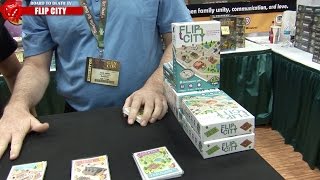
Board Game Sanctuary was enthusiastic about the idea of pushing your luck to build a card-based city, even though the host's own rating left it only average on their four-point scale. Rodney Smith of Watch It Played approached it as a rules guide and spent much of the video on how the double-sided deck is set up and maintained. At Gen Con 2015, Board to Death TV spoke with the publisher's representative about replayability, which is the most common point of skepticism. Going Analog treated Flip City as a historical reference point, describing its blackjack-style deck building as the idea that inspired the designer's own Mystic Veil.
The consensus is strongly positive about the mechanism and more mixed about long-term depth. Reviewers rarely dispute that the flipping system is novel. The debate concerns whether a small card pool and a tight decision space can sustain repeat play.
Core Mechanics That Define Flip City
Double-Sided Cards and Flipping
Each building in Flip City has a front and a back, and the back is usually a different building with different powers. A Residential Area flips into an Apartment, and a Convenience Store flips into a Shopping Mall. Flipping costs money, shown by a purple arrow on the card, and any card in your discard pile can be flipped there. The Getting Games playthrough highlighted how a Station or Church can make flipping cheaper or give extra flips in a turn, which turns the discard pile into a second source of value. Reviewers singled out this flipping system as the reason the game stands apart from other deck builders, because most deck builders only add cards to a deck and never change the cards already in it.
Push-Your-Luck Busting
Many buildings carry unhappiness symbols, and the turn ends in a bust when a player accumulates too many of them. Residential Areas are the main source of risk: when one sits on top of your deck, you must play it. Rodney Smith explained that once a player has two of these unhappy faces in front of them, they begin to hesitate before playing a strong building that might hide another Residential Area beneath it. Hospitals and Churches raise the unhappiness limit or cancel symbols, which gives players a way to keep pressing their luck. Reviewers consistently described the resulting tension as the emotional center of the game.
The Flip City Experience
Push-Your-Luck Tension
Players rarely feel safe for long. On a typical turn, the question is whether the next card might be a forced Residential Area, and the answer determines whether to keep playing or stop and spend the buying power already collected. The Getting Games playthrough showed turns where a player stopped with a modest buying budget rather than risk a third unhappy face, and other turns where a player shuffled a nearly empty discard pile back into the deck and hoped for a strong reshuffle. Reviewers described this as the feeling that makes the game engaging, and the shuffling decisions in particular were presented as the moments that define a session.
Racing Toward a Win
Flip City offers two routes to victory: accumulating eight victory points in a single turn, or playing eighteen cards in one turn with a Convenience Store in play. Board Game Sanctuary pointed to these two win conditions as a notable strength, since they give players different goals to pursue. The Getting Games playthrough showed both players racing toward the card-count win while building point sources, which gives the game a sprinting quality in its later turns. Because a single turn can end the game, reviewers said players constantly weigh whether a big turn is worth the risk.
What Makes Flip City Stand Out
Replayability From Choices Rather Than Card Variety
The most common objection to Flip City is that the buy row offers only four building types, which seems limited for a deck builder. At Gen Con, Board to Death TV recorded a defense of the design: the game is not trying to be Dominion, and its replayability comes from pressure and decisions rather than from a large variety of cards. Each building can be bought, flipped, or developed, and deciding which cards to upgrade and which to ignore produces different games even when the supply is the same. Reviewers who accept this framing tend to praise the design for making a small supply feel deep.
A Built-In Expansion in the Base Box
The Office building, which many players treat as an add-on, is included in the base game. The Getting Games playthrough noted that the Office comes in the base box and is worth using from the start. It lets a player shuffle the discard pile in with the deck early or add buying power without risking a bust. The Gen Con interview also noted that an optional fifth deck is part of the box and that further expansion is planned. Reviewers appreciated that the base game already offers a meaningful alternative to its core cards.
Potential Drawbacks
Double-Sided Setup and Shuffle Care
The double-sided deck makes setup and shuffling more demanding than in a typical card game. Rodney Smith acknowledged that most players are not used to handling a double-sided deck, and recommended shuffling with the front side facing up and keeping the top card hidden during shuffles. The Getting Games playthrough warned that a shuffle that disturbs card orientation has to be corrected by flipping the affected cards back, which is an easy mistake to make. Reviewers said the habit becomes natural after a few rounds, but new tables should expect a learning curve.
Limited Buildings and Early Decisiveness
The Getting Games host said they wished the game had more buildings, though they also acknowledged that it is meant to be a smallish game. In the same playthrough, the eventual winner built a strong engine early, and the trailing player never recovered, so the outcome seemed largely settled several turns before the end. Reviewers who raised this concern did not call it a flaw in the rules. They treated it as a reason the game may feel less dynamic for players who want a comeback path.
If You Enjoy Flip City
Players who enjoy Flip City's blended approach to deck building and push-your-luck will find the clearest lineage in Mystic Veil. Going Analog's guests explained that Flip City's blackjack-style busting directly inspired Mystic Veil, and that the designer later built the sequel Mystic Lands around card crafting rather than flipping. Mystic Veil is therefore the natural next step for a player who wants the busting tension with a different kind of card transformation.
Players who want to compare the deck-building approach should look at Dominion. Board to Death TV framed Flip City as a deliberate contrast to Dominion, emphasizing that its replayability comes from pressure and choices rather than a wide card supply. Readers who want a city-building theme may enjoy Suburbia, which Board Game Sanctuary described as one of the first city-building Euros that drew the host into the hobby. No reviewer compared Flip City directly to Suburbia, so that pairing reflects the shared theme rather than a stated comparison.
What Reviewers Are Saying
"I really like that flipping mechanic. I can't think of another game that I've seen that in and it works really well."
— Getting Games
"I think it works well, but it shouldn't be copied if that makes sense. It's a cool mechanism. This is the game that should have it."
— The Dice Tower
"I just love the idea that you can kind of push your luck in this game to build this card-based city with different abilities and scoring."
— Board Game Sanctuary