/pic5415675.png)
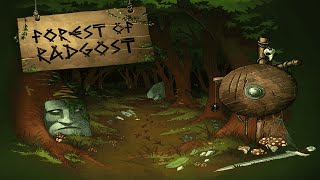
Detailed miniatures, immersive storytelling, and rich mythology await you in Forest of Radgost, a cooperative storytelling tabletop game that brings Slavic mythology to life.
When a boy and a girl disappear from their village somewhere in IX century Europe, the village druid dispatches a search party to find the children and escort them back to safety. As one of the members of that search party, you will need to trespass into the sacred forest and cross the boundary that separates the realm of humans from the realm of the Slavic deity Radgost.
Inhabiting the forest are strange beings such as the Psoglav, Lesnik, or Todorci, none of which take kindly to human intruders.
You'll need to use all your skills, wisdom, and instincts to survive the numerous encounters with these strange creatures.
Along the way you will develop your character, collect items, gain skills, separate and rejoin with other members of the search party, and, possibly, discover the secret reason why the druid chose you to join the search party.
Forest of Radgost is a role-playing game where each player controls a character with a fleshed-out backstory, motivation, and skill-set. Players navigate the web of interconnected forest footpaths with a pair of dice that determine the distance and direction of their movement, evoking the feeling of being lost in the woods, with creatures lurking at each crossroad.
At each encounter, players must decide whether to run, hide, flee, or communicate, without knowing which creature they are about to face. Depending on their choices, the encounters are resolved according to the numerous scenarios provided in the accompanying book of encounters.
Nine decks of cards add an open-world dimension, allowing players to explore the rich game world based on four years of research into Slavic mythology. Numerous scenarios, map details, and cards interact to weave a unique storyline ensuring that players will never have the same adventure twice.
—description from the designer

- The Slavic lore and its research are a major strength.
- The art and production quality are excellent.
- The game can be educational and introduces players to Slavic mythology.
- There are a lot of cards and potential for replayability through different encounters.
- The inclusion of a guide for parents and clear target audience in the rulebook is praised.
- The idea of the bag system for components and character attributes is liked conceptually.
- Gameplay is described as stale, random, and frustrating, comparing unfavorably to Candyland or Tales of Arabian Nights.
- The core mechanics like roll-and-move are considered archaic and don't translate theme into good gameplay.
- Interaction choices are often made without full information, leading to poor outcomes.
- The component design, particularly the character bags, is clunky and hinders usability.
- The writing can be inconsistent and repetitive, and pronunciation of names is not always intuitive.
- The game is considered to have a very niche appeal, making it not for everyone.
- The price point might be a barrier for the intended family audience.
- The game mechanics often work against the immersion of the lore.
- The lack of a proper in-game map and the reliance on the rulebook for locations is inconvenient.
- Slavic lore
- Forests
- Choice-based, story-based
- Tales of Arabian Nights
- Candyland
- Snakes and Ladders
Mechanics (from transcript analysis)
- Character specific abilities/slots — Characters have specific abilities and slots for companions and upgrades.
- Choice-based Narrative — Players make choices on how to interact with encounters before knowing the full details of the encounter.
- Encounter book — A book of encounters provides narrative text and options for different situations.
- roll and move — Movement is determined by a dice roll, with directional dice also influencing path choices.
- Set Collection — Players need to achieve a certain number of successful encounters to win.
Video topics + discussion points
Quotes (from this video)
- The Slavic lore part of this game is definitely its strength.
- The gameplay feels like a slightly more advanced but no more strategic version of Candyland.
- My biggest complaint with this game is the fact of like for you for them to make a game around it they're like oh okay you get to choose to it's an interactive storytelling game you get to choose how you deal with it or how you interact with it well yeah but you might as well flip a coin like because
- The role to move does not make any sense.
- The gameplay worked against the interests of the lore unfortunately.
- it's a game that makes you want to learn more about the Legends and the myths.
- I don't know who it's for.
- The lore is like yeah you don't want to fight those.
- For gamers you know hey actually now you try and do all these different tasks instead of just go find the kids.
- I really really think it was a massive misstep.