



Snakes and Ladders Deep Dive
What the Community Thinks About Snakes and Ladders
Snakes and Ladders occupies a unique place in gaming culture. Reviewers recognize it as a ubiquitous childhood classic, yet they approach it with a blend of affection and satirical humor. The game is everywhere in popular culture and household collections, yet its very omnipresence means it often goes unexamined. Board gaming content creators describe it with candor: it is a game of pure chance, stripped of meaningful player agency, and yet it has survived for centuries as a beloved family pastime. Some reviewers embrace house-rule modifications and drinking-game variants to reinvent the experience. Others examine it through a lens of game design criticism, using Snakes and Ladders as a reference point for discussing what happens when luck completely overwhelms player decision-making. Despite these critiques, or perhaps because of them, Snakes and Ladders remains a foundational touchstone that reviewers return to when discussing game mechanics, accessibility, and cultural reach.
Core Mechanics That Define Snakes and Ladders
Roll and Move
The fundamental mechanic of Snakes and Ladders is roll-and-move in its purest form. On each turn, a player rolls a die and advances their token along a numbered track by the result. The roll determines everything about your turn. Whether you move two spaces or six, whether you land on a safe square or one with a ladder or snake, is decided entirely by the randomness of the die. This mechanic has no decision tree, no strategy layer, and no opportunity for a player to exercise choice once the die is cast. Modern racing games evolved partly by adding complexity to this core action, but Snakes and Ladders preserves it in its original, unadorned form. Reviewers note that this simplicity is both its strength (anyone can play immediately) and its weakness (nothing a player does influences the outcome).
Landing Space Consequences
The second defining system is the landing space rule: where your token stops determines what happens next. Most squares are safe; you simply end your turn. But squares marked with a ladder allow you to climb immediately to a higher square, jumping ahead in the race. Squares marked with a snake force you backward, sliding down to a lower position. There are no decisions about accepting or refusing these consequences. You land on the square, and the rule executes automatically. This binary good-or-bad outcome, combined with the randomness of the die roll, creates the game's core emotional beat: the hope of the roll, the immediate verdict of the landing, the cascade of ups and downs that make progress feel chaotic.
The Snakes and Ladders Experience
Nostalgic Chaos
Reviewers describe Snakes and Ladders with a tone of nostalgic chaos. Many played it as children and recall it as a formative gaming experience, even if they did not fully understand why luck dictated everything. There is an affection here for the simple pleasures of moving around a board, watching tokens advance and retreat, and experiencing the tension of not knowing what the die will bring. The game triggers memories of family game nights, rainy afternoons, and the thrill of rolling high on a crucial turn. Some reviewers explicitly credit games like Snakes and Ladders with their early exposure to board gaming, making it a cultural artifact of childhood even for modern hobby gamers. The nostalgia is tempered by humor and critical distance, but it is genuine.
Frustration with Powerlessness
Conversely, reviewers emphasize the frustration of having zero control. In Snakes and Ladders, a player cannot influence the outcome through strategy, positioning, or clever play. The game removes agency entirely; your success or failure is the die's responsibility, not yours. This can feel alienating to modern players accustomed to games where skill matters. A player might find themselves stuck on a low-numbered square for several turns despite rolling repeatedly, cascading down snakes while an opponent climbs ladders in sequence. The lack of any mechanism to mitigate bad luck creates moments of pure helplessness. Reviewers cite this as the key difference between Snakes and Ladders and genuinely strategic games, where even a bad roll can be managed by player decision-making.
What Makes Snakes and Ladders Stand Out
Absolute Accessibility and Universal Presence
One reviewer describes Snakes and Ladders as a game whose center is everywhere and circumference is nowhere. It is that pervasive. Reviewers note that nearly every household contains a copy, every person has encountered it, and almost no one is confused by the rules after a 30-second explanation. This universal accessibility is remarkable. The game needs no setup beyond shuffling, no learning curve beyond understanding that you move by the die result, and no hidden information or judgment calls. It is the gateway drug of board gaming, the game that teaches people they can sit down and play something together. In cultures around the world, variants of Snakes and Ladders appear, adapted to local contexts but following the same core template. No designer owns the game, no publisher guards it jealously, and no community of experts gatekeeps it. That combination of ubiquity and democratization is unique.
Satirical Reinvention Through House Rules
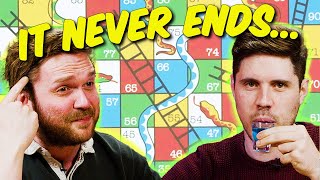
Several reviewers discuss how Snakes and Ladders can be transformed through deliberate house-rule modification. One well-known variant removes all ladders and replaces them with additional snakes, creating a game designed to never end and frustrate all players equally. Another variant pairs the game with a drinking mechanic, making the experience social and playfully punishing. These reinventions acknowledge that the base game is structurally limited, but they flip that limitation into a feature. By exaggerating the chaos, removing agency even further, or layering on house rules that create absurdist humor, players can reclaim ownership of the experience. The game becomes a vehicle for comedy or social ritual rather than a serious race. This flexibility is itself noteworthy; Snakes and Ladders is simple enough to support radical modification without breaking.
Potential Drawbacks
Absence of Meaningful Player Choice
The most consistent critique from reviewers is that Snakes and Ladders offers zero meaningful choices. Once you roll the die, your action is determined. You cannot opt for a different move, accept or refuse a ladder, mitigate a snake's damage, or plan ahead. This is not a flaw in execution; it is fundamental to the design. Modern board gaming is built on the premise that player choices matter, that skill and decision-making create differentiation between players. Snakes and Ladders rejects this entirely. For audiences raised on Catan, Ticket to Ride, and Euro games with deep decision trees, this absence of agency can feel hollow. A player cannot point to their clever play as the reason they won, nor can they regret their poor strategy if they lose. The game does not grant that kind of narrative ownership.
Outcome Determined by Luck Alone
Reviewers emphasize that the outcome is determined almost exclusively by the randomness of die rolls across multiple turns. In a game with 100 squares, a player must roll enough times to cover the distance, landing on various snakes and ladders that either accelerate or delay progress. Some players will simply roll higher numbers more often and win; others will land on more snakes. There is no mechanism to compensate for unlucky rolls, no skill that can overcome a bad streak of results, and no strategy that guarantees success. This makes the game predictable in structure but unpredictable in outcome. For players who find meaning in earning victory through clever play, Snakes and Ladders offers none of that satisfaction. The winner may feel it was luck, not prowess. The loser has no one to blame but chance.
If You Enjoy Snakes and Ladders
If Snakes and Ladders appeals to you, reviewers suggest exploring games that share either its simplicity or its thematic charm, but add layers of decision-making. Candy Land offers a similar experience for young children but uses card draw instead of dice, though it retains the pure-luck element. Connect Four introduces simple tactics: you can block your opponent's winning moves while pursuing your own. Chess sits at the opposite end of the spectrum, offering pure skill with no luck whatsoever, giving you complete agency over every move. For those who enjoy the race mechanic with more player control, modern racing games like Formula D or Flamme Rouge layer in hand management and tactical positioning while preserving the excitement of a head-to-head race. Ticket to Ride channels a similar collecting-and-claiming energy but adds meaningful route-planning choices that let your decisions shape the outcome.
What Reviewers Are Saying
"This is a game with sublime skill and nuance, and the winning strategies in this game fall into two major categories. First of all, you can be lucky, bless, or charmed into winning. If you win a game, that has proof that the divine entity watching over you has truly blessed you. The second strategy, and the one I employ, is a technical and mental mastery of telekinesis. I manipulate the diets of my mind in order to win."
— Watch Review
"So, in games like Snakes and Ladders, the actions that you take are purely reliant on the luck of the die roll and where you move on the board and whether you get to the bottom of the ladder to scoot up and skip a few rows, or whether you're going down a snake and falling behind the other players. I really didn't have much agency over how well I succeeded in a game of Snakes and Ladders because it really just depended on what I rolled."
— Board Game Sanctuary
"It's on you going to a shopping mall, it's like often on the floor somewhere. It's in loads of kids books. It's everywhere. Most houses of a copy. Who do you go to, to talk about it, who knows the history? It's everyone plays it, no one's the boss of it, no one has responsibility for it, and I think that's the weird thing. It's like a circle whose center is everywhere and circumference is nowhere."
— Beyond Solitaire