/pic519914.jpg)
/pic168167.jpg)
/pic519914.jpg)
























Formula D Deep Dive
What the Community Thinks About Formula D
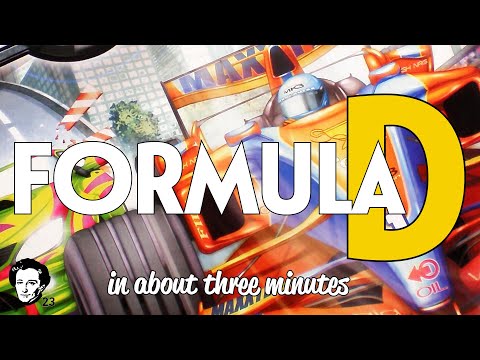
Formula D stands as a remarkable exception in the modern board gaming landscape. Despite being rooted in a mechanic, roll and move, that has fallen out of favor over the past two decades, reviewers consistently praise it as one of the most elegant implementations of the genre. The game has remained in print through multiple editions and expansions since its original 1991 release (then called Formula Day), a testament to its enduring appeal among both casual families and experienced gamers.
Core Mechanics That Define Formula D
The Gear-Based Dice System
Formula D's genius lies in how it weaponizes the roll-and-move mechanic through a custom dice system. Players start in first gear rolling a four-sided die, then progress through six gears, each with progressively larger dice. Second gear uses a six-sided die, third uses an eight-sided, and by sixth gear you're rolling a massive thirty-sided die. These dice aren't standard distributions; they're weighted toward higher values, guaranteeing forward momentum while maintaining suspense about exactly how far you'll move. This elegant escalation transforms a random roll into a meaningful risk calculation that mirrors actual racing strategy.
Push Your Luck and Damage Management
Every corner on the track has a designated stop zone. Overshoot it by even one space and your car takes damage. Push too hard and you'll accumulate wear across your tires, brakes, and engine. The interplay between the temptation to go faster and the penalty for recklessness creates genuine tension. Do you downshift to play it safe and lose time, or maintain high gear and risk crashing out entirely? This mechanic elevates roll-and-move from pure randomness into a game about calculated risk and resource management.
The Formula D Experience
Satisfying Drama and Narrative Arc
What makes Formula D memorable isn't just the mechanical elegance, it's the story that emerges at the table. Players narrate their own racing journey as they shift gears, squeak through corners, and either recover or catastrophically lose control. The game generates natural moments of tension: will you clear that hairpin? Can you catch the leader before the finish line? The satisfaction of successfully navigating a tricky section after aggressive gear management feels earned, not lucky. Multiple editions exist, including a more compact Formula D Mini for groups with limited time, and an overwhelming selection of different race tracks means the experience stays fresh across plays.
Accessibility Without Sacrificing Depth
Formula D works as a family game, straightforward rules, intuitive rolling mechanics, quick player turns. Yet it doesn't collapse into mindlessness. The advanced rules introduce specific car damage types, tire degradation mechanics, and weather conditions that add layers without becoming tedious. You don't need to be a Formula One fan to enjoy the game; the theme is window dressing for a solid push-your-luck racing system. The core experience, gearing up, slowing down for corners, managing damage, resonates whether you care about real motorsports or not.
What Makes Formula D Stand Out
Redemption for Roll and Move
Formula D arrived at a historical moment when roll-and-move had become unfashionable in hobby gaming. Yet reviewers argue it proves the mechanic isn't inherently broken, just often poorly implemented. In Formula D, rolling dice doesn't remove player agency; it feeds into meaningful decisions about gear selection and risk management. The randomness of the roll tempts you to take risks, but odds are calculable enough that skilled play matters. This game single-handedly demonstrates that roll-and-move can create excitement and meaningful choices when paired with thoughtful design.
Elegant Systems That Reward Mastery
While the basic rules are simple enough for newcomers, experienced players develop genuine strategy around timing, gear transitions, and damage mitigation. The game doesn't punish you for understanding it; it rewards clever play. You can deliberately take calculated damage on early laps to position yourself better for the finish, or play conservatively and hope your steadier approach holds up. Different cars and drivers create subtle asymmetries that invite repeat plays and experimentation.
Potential Drawbacks
Component Scale and Rules Complexity
The original big-box version suffers from oversized components relative to the actual play space. The cars are small, the tracks can feel fiddly with many players, and the advanced ruleset layers on additional complexity that doesn't always feel essential. A ten-player race, while thematic, becomes unwieldy in practice. The sheer number of expansion maps, many long out of print and expensive to acquire, creates a barrier for new players seeking variety without significant financial investment. This explains why the more compact Formula D Mini version appeals to some groups.
Length and Downtime Dynamics
With maximum player counts, Formula D can drag. One turn itself moves quickly, but with ten players waiting between actions, downtime accumulates. Advanced rules add overhead that slows pacing. The game's length, while manageable with two to four players, becomes a liability in larger groups. Some players find that the sound and excitement of a conceptual ten-car race exceeds the reality of actually playing it, particularly if you end up eliminated mid-race through aggressive corner management.
If You Enjoy Formula D
Fans of push-your-luck racing games should explore Steampunk Rally for a diceless, card-driven racing experience with similar risk-management themes. Those seeking quicker racing action might consider Heat, a modern design that strips away the roll-and-move foundation while preserving strategic tension. For players who love the gear-shifting concept but want something lighter, Marrakech offers a simpler roll-and-move implementation with its own elegant dice mechanics. Thunder Alley provides deep head-to-head racing strategy, while Power Grid offers comparable depth through turn-order management rather than movement dice. Dominion shows how to make push-your-luck feel fresh through deck management. Finally, games like Monza offer family-friendly racing for younger players, and Camel Up delivers wild, chaotic racing through animal stacking mechanics.
What Reviewers Are Saying
Formula D is a roll and move game that is players roll dice and move a corresponding number of spaces on the racetrack but the clever twist is that players start off rolling a four-sided die in first gear and move on to progressively larger dice, six-sided, eight-sided, twelve-sided, twenty-sided, and a massive thirty-sided die in sixth gear. The clever part is that each corner of the track has an allocated section where each car must land; if cars bypass these sections by driving at reckless speed, their car starts to deteriorate. The first car to cross the finish line wins the game.
— Adam in Wales
Roll and move can be fun and there's something entirely charming about the risk management and drama in Formula D's dice-as-gears system. Formula D has a great roll and move mechanism which I haven't seen replicated in any other game. This is a racing car game where the push your luck aspect and roll and move complement each other nicely, the randomness of a dice roll tempts you to take risks but the odds aren't hard to calculate, creating an engaging dynamic between slow-and-steady and high-risk big-reward behaviors.
— Adam in Wales
Formula D might feel dated when you look at it, but you know what, roll and move can be fun. The best thing about this game is it's roll and move done well. However, the cars are pretty damn small and the tracks can get a bit fiddly at times, and the sound of a 10-car race is a lot more fun than the reality of playing it.
— 3 Minute Board Games