
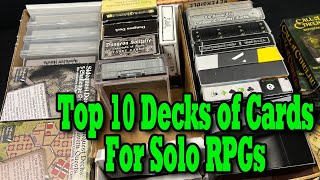


The Game Master's Apprentice Deep Dive
What the Community Thinks About The Game Master's Apprentice
Reviewers who make solo and fantasy content treat The Game Master's Apprentice as a long-standing, dependable oracle deck rather than a novelty. Daniel of The Dungeon Dive counts it among the channel's go-to generators, describing it as one of the older decks that many players still rely on and one that remains among the best. Daniel's praise is practical: the deck gathers a basic oracle, die rolls, a compass, icons, words, sensory lines, and names into one set, so a single deck can answer many different questions during play.
Jessica, one of the hosts of Gaming with Edo & Jessica, approaches the deck from the solo player's chair. Jessica uses it as an example of a text-based oracle, the kind that turns a solo RPG from a writing exercise into a game with surprises. The two reviewers agree on the core value: the deck produces results the player did not choose. They differ mainly in emphasis. Daniel focuses on the deck's breadth and its usefulness for fantasy game masters, while Jessica focuses on how the player interprets each draw and how that interpretation carries the story forward.
Core Mechanics That Define The Game Master's Apprentice
Double-Sided Prompt Cards
The deck's central mechanic is its double-sided card layout. Jessica points out that each card is double-sided and that each side carries different material, so shuffling the deck produces many combinations from a fairly compact set. Daniel describes the same structure from the other direction, listing what a single draw can supply: a sensory line, an NPC trait, a name, a virtue or vice, or a short action word such as "avenge," "feral," or "pain." Because the prompts are mostly text rather than art, they give the player a sentence or two to build on instead of a picture to decode. This is what makes the cards useful when a game master needs a shopkeeper's mood, a location's atmosphere, or a rumor's core detail on short notice.
Yes/No Oracle, Die Rolls, and the Compass
The second mechanic is the deck's built-in answer system. Daniel points to the basic oracle along with the die rolls and a small compass printed on the cards, which together let a player resolve an uncertain question without a separate rulebook. Jessica explains why this matters for solo play: a simple yes or no is often too thin, and the better oracles return answers such as "yes, but" or "no, and," which move the scene forward instead of ending it. Used this way, the deck becomes a source of complications as well as direct answers, which is the reason Jessica treats oracles as the engine of solo play rather than a side tool.
The Game Master's Apprentice Experience
Surprise and Interpretation
Jessica describes the emotional core of the experience as interpretation. A draw that does not match what the player expected forces a choice about what it means, and that moment is where the story starts to feel authored by someone other than the player. Jessica's example of a shopkeeper who was expected to be friendly but turns out to be aggressive shows how a single unexpected draw can open a side plot the player never planned. The feeling is one of discovery, with the tension coming from wondering how the character will react to something no one chose in advance.
Playful Unease and Humor
Daniel's reading of the sensory lines shows a second feeling, one of playful unease mixed with humor. Daniel reads out lines such as "You can smell the stench of death" and "You can smell jasmine flowers," then reacts aloud to a deliberately unpleasant prompt before moving on. The deck's tone is closer to a tabletop game master's bag of tricks than to a serious literary prompt, which keeps sessions light even when a draw is grim. The effect is a steady stream of small surprises rather than any single dramatic twist.
What Makes The Game Master's Apprentice Stand Out
Breadth in a Single Deck
Daniel's most consistent praise is for how much the deck covers. Describing it as a deck that "contains all kinds of different things," Daniel lists the basic oracle, the die rolls, the compass, the icons for elements and magic, the sensory lines, and the names and traits for characters. That range lets one deck handle questions that would otherwise require several separate tools. Daniel also calls the middle section especially useful for establishing a sense of space, which shows how the cards are designed to help with scene-setting as well as with decisions.
Thematic Packs and Setting Flexibility
Jessica highlights the deck's ability to adapt to different settings. The deck has thematic packs that can be paired with different campaigns, and Jessica presents that flexibility as a reason the cards remain useful across play styles. The prompts are written with enough neutrality that a player can apply them to a fantasy dungeon or a modern mystery, which gives the deck more staying power than a deck built for a single setting. This is the reason Jessica recommends understanding what tools you already own before buying new ones, since a flexible generator can often replace several specialized decks.
Potential Drawbacks
A Fantasy Lean
Daniel is clear that the deck is at its strongest for fantasy. The basic set is described as "really good for fantasy," and the sample prompts, from the smell of a dungeon to the mood of a village, reflect that focus. Players who want to run science fiction, cyberpunk, or modern settings will need to supply more of the flavor themselves or pair the deck with other tools. Daniel's own collection leans fantasy for the same reason, which suggests that the deck's best fit is for players who already want a fantasy setting.
Interpretation Takes Effort, and Some Draws Fall Flat
Jessica acknowledges that an oracle does not always produce a usable result. In the shopkeeper example, the player has to work out how a hot meal, a locked keyhole, and an empty basket connect to the scene, and a draw can produce nothing workable at all. Jessica notes that a player can reroll or redraw, but also says that choosing whether to push through a weak result can be its own challenge. For players who want quick answers instead of interpretive work, this approach may feel slow, and the deck rewards those who enjoy building meaning from fragments.
If You Enjoy The Game Master's Apprentice
Players who enjoy The Game Master's Apprentice's interpretive draws will find similar satisfaction in Rory's Story Cubes, which Jessica uses as a visual oracle. Jessica rolls three dice and builds a meaning from the images that appear, a process that rewards the same kind of creative reading that the Game Master's Apprentice demands from its text. Players who like the deck's sense of connected detail may also enjoy Story World, which Jessica describes as a series of large cards whose art and characters tie together across the set, so that a single card can suggest an entire adventure. For players who prefer tables to cards, Jessica points to Mythic, the game emulator, as a text-based option for generating specific details when the question needs a more tailored answer.
What Reviewers Are Saying
"This is just the basic one and it's really good for fantasy. And this is one of the older decks. You know, this is a deck that a lot of people use and it's still one of the best."
— Daniel, The Dungeon Dive
"So the most interesting part about an oracle is that this is something that you are going to interpret. So I love this part of solo RPGs."
— Jessica, Gaming with Edo & Jessica
"You're playing, you're not just writing a story, you're actually playing where twists come at you. There's a surprise over here. How do you react and how do you actually interpret that and add it to your story?"
— Jessica, Gaming with Edo & Jessica