







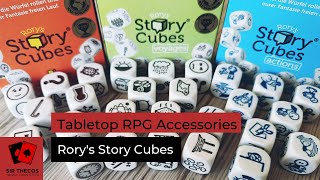
Rory's Story Cubes Deep Dive
What the Community Thinks About Rory's Story Cubes
Reviewers mostly treat Rory's Story Cubes as a creative tool rather than a conventional board game, and most of them value it for that reason. Sir Thecos uses the nine dice as a tabletop roleplaying aid. Rolling three cubes gives a fast character hook for a minor nonplayer character, while larger roles get a more deliberate build from separate character decks. Adam in Wales takes a broader view. Adam in Wales presents the set as the engine behind cooperative storytelling in Untold Adventures Await and describes its images as abstract enough to be read in several ways.
The skeptics are not dismissive. BoardGameBollocks says plainly that the cubes are "more of an activity" than a game, and notes that the same job could be done with tokens in a bag. They still recommend the set for children, and they point out that a storytelling prompt like this depends heavily on whether the players are willing to play the story out. Across these perspectives, the shared view is that the product's value comes from the players who use it, not from rules or win conditions.
Core Mechanics That Define Rory's Story Cubes
Storytelling
Storytelling is the central mechanic. Players roll the cubes and must turn the resulting images into a narrative, and reviewers describe the challenge as one of interpretation rather than recall. Sir Thecos suggests a simple party structure: one player rolls a set of cubes and arranges them in order, and another must tell a story that passes through those symbols in sequence. Adam in Wales frames the same idea as a way of building meaning from ambiguity. Because some images are abstract, one player may read a picture as one thing while another sees something entirely different. Adam in Wales also draws a connection to a background in improvisational theater, saying the set gave a way to exercise those storytelling instincts again.
Dice Rolling and Symbol Combination
The second mechanic is the random generator that feeds the storytelling: rolling nine dice that each carry six distinct faces, for 54 possible symbols in a single set. Sir Thecos counts out the dice directly, noting how many symbols the set produces and how rarely the same image repeats across a roll. Adam in Wales describes the moment when two cubes land side by side as the real engine of the system, because the pairing suggests a combination that no single image would have produced on its own. Reviewers treat this combinatorial math, far more pairings than dice, as the reason the set stays useful after repeated rolls rather than becoming predictable.
The Rory's Story Cubes Experience
Playful Improvisation
Most reviewers describe a light, playful atmosphere. The pleasure comes from being handed an unexpected prompt and having to justify it on the spot. Sir Thecos describes rolling a set of cubes for a city and finding that a "very good doctor" or a "biggest artillery range in the country" can emerge from random symbols, which makes the activity feel like a quick brainstorming session with a sense of humor. Adam in Wales describes a similar feeling of surprise when a symbol that looks unrelated suddenly fits the story being told. The mood is closer to a warm-up game or a family activity than to tension or competition.
Creative Freedom in Solo Play
For solo players, the experience shifts toward discovery. Gaming with Edo & Jessica uses the cubes as a visual oracle during solo roleplaying. Jessica rolls three dice, interprets the picture in the context of a scene, and lets the result change the direction of the adventure. Jessica's description of a shopkeeper who turns out to be hostile, followed by a hidden story about a locked-away object or a missing child, shows how the cubes produce plot twists that the player did not choose. Jessica frames the appeal as the freedom to be surprised by one's own story, and stresses that the results do not need to be publishable to be enjoyable.
What Makes Rory's Story Cubes Stand Out
Art and Component Quality
Reviewers consistently praise the physical product. Sir Thecos calls the dice "really well made" and "really well drawn," and notes that they are large enough to handle comfortably. Adam in Wales describes the set as among the most appealing components found in any game, with each cube carrying distinct artwork. This matters because the images are the entire game, so the quality of the illustrations directly affects how readily a player can see a story in them.
Versatility Across Uses
The second standout is how many different jobs the same dice can do. Sir Thecos uses them for city building, nonplayer characters, backstory, and action-based character generation with the Actions and Voyages sets. Jessica uses them as an oracle, and Adam in Wales uses them as a creative prompt in cooperative play. Reviewers agree that the 54 symbols across the nine dice give enough variety that repeated play does not feel exhausted, and that the set is inexpensive for the range of uses it supports.
Potential Drawbacks
Not Quite a Game
The most common criticism is that the cubes provide structure without much game. BoardGameBollocks argues that the set is basically an activity, and that a group must already be willing to play along for the experience to work. When players do not engage with the role or the story, the activity can fall flat. The critics acknowledge that the cubes are fun for children and families, but they do not treat them as a replacement for games with clear goals or scoring.
Some Images Feel Out of Place
Sir Thecos points out that some symbols look too modern for a fantasy setting, and has to explain them away. A few icons can be read as contemporary objects, which can break immersion for players running a medieval or fantasy adventure. Sir Thecos still considers the set useful for fantasy games because most images can be reinterpreted, but the mismatch is a real limitation for players who want strict period flavor.
If You Enjoy Rory's Story Cubes
Players who enjoy the open-ended prompts of the cubes will find similar satisfaction in Once Upon a Time, which Jessica praises for its art and for card categories covering characters, locations, events, and things that fit almost any setting. Players who value the unexpected interpretation of a single picture may prefer Story World, whose oversized cards contain enough detail that Jessica says a story can be written from one card. The Game Master's Apprentice offers a text-based version of the same surprise, useful for players who want a richer prompt than a bare symbol. River and Stone Playing Cards and Dixit provide illustrated prompts that encourage interpretation in a similar way. For players who want a pitch-style storytelling game, Snake Oil offers a more structured prompt, while Funemployment brings the same improvised energy into a party format, although BoardGameBollocks warns that it also depends on the group committing to the role.
What Reviewers Are Saying
"There are lots of different symbols on these, and no symbols are the same, right? So you have nine dice, and each die has six different, different faces, right? So you have your 54 different symbols in one of these sets, which is quite a lot."
— Sir Thecos
"Each cube has six different images on it, and they're all different, every, every cube is different. And some of these pictures are just abstract enough that you might be able to read it as one thing if it's one way, or one thing if it's the other way, or one player might look at it and see something which you don't see. And when you put two of them together, then that creates some unique combination that you hadn't thought of previously."
— Adam in Wales
"It's almost like you get many writing prompts all along the way where yes, I do need to come up with my own story most of the time, but I still get to create it, but I don't know what's going to happen."
— Jessica, Gaming with Edo & Jessica