



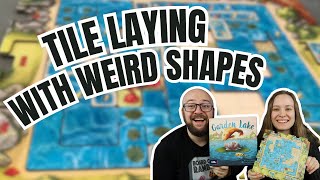









Garden Lake Deep Dive
What the Community Thinks About Garden Lake
Reviewers universally praise Garden Lake as a masterclass in accessible puzzle design. The game generates consistent enthusiasm across the board gaming community, with creators noting its remarkable ability to challenge players while remaining mechanically simple. Garden Lake strikes a rare balance: it teaches in minutes, plays smoothly, but delivers substantial tactical depth through its polyomino placement puzzle. While the game's punishing tile shapes create moments of genuine frustration, reviewers find this difficulty rewarding rather than off-putting. The consensus suggests Garden Lake stands out in Uwe Rosenberg's catalog as both a lighter and more tightly designed puzzle than many of his previous tile-laying works.
Core Mechanics That Define Garden Lake
Polyomino Placement
At its heart, Garden Lake is a polyomino puzzle game with a twist. Unlike traditional polyomino games where pieces are standardized (dominoes, trominoes, tetrominoes), Garden Lake uses seven-block pieces in unusual, irregular shapes. Players receive a personal grid and take turns selecting tiles from a shared draft line, then placing them anywhere on their board without requiring adjacency to existing pieces. This freedom of placement sets Garden Lake apart from gridbound puzzles like Patchwork or Cottage Garden. The real challenge emerges from the odd geometry of each piece. Reviewers note that while traditional polyominoes allow natural tessellation, Garden Lake's irregular pentominoes resist neat arrangement, turning each placement into a deliberate spatial puzzle.
Bonus Tile Cascades
Garden Lake's scoring system hinges on triggering bonus tiles. Whenever players complete a row, column, or cover specific marked spaces on their grid, they unlock single-block, two-block, or L-shaped bonus tiles. These small pieces are invaluable for filling the awkward gaps left by the main polyominoes. Crucially, completing rows and columns doesn't just reward points; it unlocks additional bonus tiles that players can use on subsequent turns. This creates a satisfying cascade effect where early optimization gradually pays dividends. Players who survive the initial placement chaos and unlock these bonuses report a snowballing sensation where the puzzle becomes manageable and even elegant.
The Garden Lake Experience
Controlled Frustration Transformed Into Satisfaction
Garden Lake's polyominoes are intentionally awkward. Players universally describe early turns as stressful, with reviewers noting phrases like "agonizing decisions" and "horribly shaped pieces." However, this frustration proves purposeful. Reviewers emphasize that mastery comes through accepting the challenge, not avoiding it. As players learn to work within the constraints, placing a piece that fits beautifully generates genuine satisfaction. The game doesn't mock the player; it celebrates clever solutions. Watching early confusion transform into competent puzzle-solving creates a memorable arc across a single play.
Cozy Progression Without Meanness
Despite its spatial tension, Garden Lake maintains a fundamentally cozy atmosphere. The theme of building a Japanese water garden with koi and lily pads sets a peaceful tone. More importantly, the game avoids the interactive cruelty of many competitive puzzle games. There's no "take-that" mechanism, no blocking opponent plans, no punishment for another player's success. Each player works within their own world, solving their own puzzle. This removes player elimination risk and prevents the experience from devolving into analysis paralysis or table conflict. Reviewers appreciate that Garden Lake delivers genuine puzzle difficulty while maintaining table harmony.
What Makes Garden Lake Stand Out
Irregular Polyominoes Force Novel Problem-Solving
Most polyomino games use standardized shapes drawn from decades of mathematical tradition. Rosenberg's choice to use unique seven-block pieces creates an entirely different puzzle. Reviewers consistently highlight this difference as Garden Lake's defining feature. Standard polyomino games reward spatial intuition and memory of common patterns; Garden Lake demands fresh evaluation of each piece. The irregular shapes prevent the comfortable flow of experienced polyomino players, resetting everyone to a level playing field. This design choice transforms what might have been a derivative puzzle into something genuinely distinct.
Light Rules, Heavy Decisions
Garden Lake teaches in roughly five minutes. Turn structure is trivial: select a tile, place it, resolve bonuses. Yet within this simplicity lies surprising strategic complexity. Decisions compound. Early placement choices constrain later options. Bonus tile acquisition timing shifts game state. Should you complete a row to unlock a bonus tile now, or defer and hope for a better moment? Reviewers emphasize that this depth-within-simplicity makes Garden Lake accessible to new players while offering genuine replay value for enthusiasts. The game rewards both intuitive play and deliberate calculation.
Potential Drawbacks
The Shapes Remain Genuinely Difficult
Garden Lake's polyominoes are the source of both its appeal and its frustration. For players seeking a relaxing, low-stakes puzzle, the irregular shapes deliver stress rather than comfort. Some players simply won't enjoy the cognitive load of fitting unusual tiles into a grid, no matter how well-designed the overall package. Reviewers note that players uncomfortable with spatial reasoning may exit the game early, unable to place any tile and forced to sit out while others continue. This isn't a flaw in design, but rather a clear niche boundary. Garden Lake unambiguously targets puzzle enthusiasts, not casual gamers seeking a gentle experience.
Length and Pacing Variance
Garden Lake's play time fluctuates based on player count and analysis paralysis. While the rulebook promises 30 to 45 minutes, reviewers note that groups of thoughtful players can stretch this substantially. Analysis paralysis becomes a real risk when players deliberate over optimal piece placement. Additionally, players who struggle to find valid placements may sit out for extended stretches, creating downtime. At higher player counts, the drafting line refreshes less frequently, which can either accelerate play (fewer viable options force faster decisions) or frustrate players who wanted a specific tile. Player composition matters more than expected for a 45-minute light game.
If You Enjoy Garden Lake
Players drawn to Garden Lake's polyomino core will find kinship in Patchwork, the two-player asymmetric classic that established many of Rosenberg's puzzle-game principles. For those who appreciate Garden Lake's irregular shapes and bonus tile system, Cottage Garden delivers similar satisfaction with a higher player count and a more forgiving rule set. Reviewers who emphasize Garden Lake's cozy theme might explore Telelink and King Domino, which blend tile placement with gentler challenge curves. Those who love the "snowball bonuses" mechanic should investigate Indian Summer and other games in Rosenberg's puzzle family. If the polyomino mechanic itself captures your interest, Spring Meadow and Feast for Odin offer deeper engagement with irregular piece fitting.
What Reviewers Are Saying
"It's a polyomino game, but it's polyominoes like you've never seen them before. They are all made up of seven individual squares because we are building a garden lake in Japan and the number seven is very important."
— Gaming Rules!
"What makes this game not like all the other ones is that the shapes are horribly shaped. Like if you are a person who wants to do build perfectly, you're going to feel infuriated playing this game, and then it will feel very good when you manage to build pretty perfectly because this bonus task will help you with that."
— Board Gaming Ramblings
"You're leaving just enough space for all of these bonuses. And then you start to snowball the bonuses at the end. So it kind of keeps things interesting and alive as it goes on."
— Meeple University