/pic6455319.png)
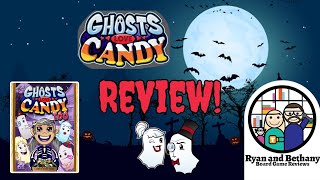
It's a little-known fact that ghosts love to eat candy. But they can only eat it one night a year...Halloween! On that night, the ghosts travel through the neighborhood looking for delicious candy. Using their best scare tactics, ghosts will haunt the costumed kiddos to steal their sweet sweet candy. But they have to be careful not to scare them away. Ghosts just want a candy delight, not to cause them a fright.
This new edition expands upon the original version with more kids (100 total!), a new "junk" set of treats that you do not want to collect (like toothbrushes, rocks, ketchup packets, pennies, etc.) and new ghosts.
Playing the game is easy. Select one of your ghost cards to bid for turn order. Then resolve by choosing a kid to haunt, taking their candy then using their unique ability. Treats score at the end of the game based on your ghosts specific preferences.
Note: Ghosts Love Candy Too is a revised and expanded new version of Ghosts Love Candy, released by Steve Jackson games in 2016.

- Fast to learn and fast to teach
- Strong, family-friendly Halloween theme
- Unique, asymmetric ghost abilities with secret goals
- High replayability due to diverse candy preferences
- Humorous, themed flavor with lots of character variety
- Appropriate for a wide age range (6+)
- spooky, humorous family-friendly candy-collection
- Halloween night, neighborhood trick-or-treating with ghosts collecting candy
- asymmetric, character-driven with unique abilities
Mechanics (from transcript analysis)
- Card Crafting — Each ghost card includes specific text that triggers various effects (place a candy, leave a candy, etc.).
- Card text effects — Each ghost card includes specific text that triggers various effects (place a candy, leave a candy, etc.).
- card-driven turn order — Each turn, players reveal a card; the highest number goes first, establishing order and influence.
- Deck and round structure — There are nine rounds; players play cards in any order, with new candy and targets appearing between rounds.
- End-of-round scoring with positive and negative candy values — Candy cards contribute points; some opportunities carry negative points depending on the kid’s traits.
- Haunt and candy theft actions — Players haunt trick-or-treaters to steal candy into their stash, affecting scoring and strategy.
- Hidden objective per ghost — Each ghost card has a secret candy preference and a special ability; players pursue their own goals without others knowing exactly what you want.
- Humorous costumes and thematic flavor — Costumed kid cards with puns and pop-culture nods provide flavor and variability.
- Interaction with other players' stashes and discards — Card effects can manipulate opponents' candy stash or discard piles, creating adversarial feel.
- Set-collection/bonus interactions — Certain combinations (e.g., Romeo and Juliet) provide bonuses, adding depth to strategy.
- Trick-Taking — Players haunt trick-or-treaters to steal candy into their stash, affecting scoring and strategy.
Video topics + discussion points
Quotes (from this video)
- I thought it was really neat how you had that kind of tug and pull of wanting certain candies but also wanting certain kitabilities
- it had a perfect mix of spookiness that made it a great game to play with our family
- the costumes by the way were hilarious... Thunderman
- it's a home run for our family
References (from this video)
- cute theme
- great for family or casual play
- variable player counts up to six
- thematic simplicity may reduce depth for some players
- bid/draft-style interference with candy values
- playful Halloween-themed candy economy with ghosts
- cute and lighthearted
Mechanics (from transcript analysis)
- Auction / Bidding — Players lay down ghost cards to capture candy valued differently by everyone
- Betting and Bluffing — What each candy is worth is known to the table but not to all players' choices
- bidding / cardplay — Players lay down ghost cards to capture candy valued differently by everyone
- hidden information / bluffing — What each candy is worth is known to the table but not to all players' choices
Video topics + discussion points
Quotes (from this video)
- The artwork on these cards is adorable and you're trying to capture rooms because essentially you want to be the head honcho of this manor. It's really fun. It's really cute.
- The components are amazing in this game, and I can usually find it for really cheap on sale.
- it's a ridiculous theme, but it's not scary or gross. It's more meant to be funny and campy.
- This is a fantastic solo only game. And I love the game, but I definitely lose more than I win.
References (from this video)

- Charming theme; approachable for a group
- Some may prefer heavier mechanics
- Cute yet spooky; negative points for scaring too much
- Cute spooky theme where ghosts steal candy while scaring kids
- Light-hearted, card-driven simultaneous play
- Time's Up
- Medium
Mechanics (from transcript analysis)
- Simultaneous card play — All players choose and reveal cards at once; candy/kid interactions drive scoring.
- Variable card values — Each ghost card has a different candy value affecting scoring decisions.
Video topics + discussion points
Quotes (from this video)
- It is so thematic and really makes you feel like you are literally hiking
- Zoo Tycoon is a fantastic game
- Arc Nova is getting hype for a good reason
- Time's Up brings chaos and laughs
- Arc Nova is my number one this month
References (from this video)

- Engaging asymmetry from craving cards that spread out candy goals
- Family-friendly design reduces aggression by framing competition around wants
- Diverse kid abilities create dynamic interactions and strategic variety
- High replay potential due to evolving card interactions and varied abilities
- Endgame may feel restrictive as available card options dwindle
- Can become chaotic if many abilities trigger simultaneously
- Ghostly mischief and candy collection
- A Halloween neighborhood where ghosts haunt kids to collect candy
- light, humorous, family-friendly
Mechanics (from transcript analysis)
- Hand Management — Players hold a color-matched hand of cards and play one card per round.
- haunt and trigger abilities — Haunting a kid activates abilities on the kid cards, either immediately or later in the round.
- round-based progression with card depletion — Nine rounds total; once a card is used it is removed from a player's hand.
- Set Collection — Candy stacks have different values; players decide which to steal based on craving cards.
- set collection / candy value optimization — Candy stacks have different values; players decide which to steal based on craving cards.
- simultaneous card play with turn order determined by value — Cards are played face-down and revealed; higher numbers act first.
- Unique Player Powers — Each kid card grants a different ability that can alter round outcomes.
- variable player powers via kid cards — Each kid card grants a different ability that can alter round outcomes.
Video topics + discussion points
Quotes (from this video)
- it's definitely a very fun game for me and my kids
- the design just really works
- read all the abilities and see what the abilities can do and what it will change in your game
- Steal candy from the neighborhood kids without scaring them
- they just absolutely get it to the table almost every day now since we got it