







Gruntz Deep Dive
What the Community Thinks About Gruntz
Gruntz arrives as a surprising depth charge in a compact box. Reviewers consistently describe it as a head-to-head tactical experience that demands surprising strategic engagement for its small footprint. The consensus is warm but conditional: this is a game of genuine richness that rewards repeated play, but it asks players to invest time in learning unit interactions and accepts that it works best with an opponent invested in the same complexity. Gaming with Edo and Jessica declared being "absolutely smitten" with the game, while the full spectrum of responses from casual appreciators to hardcore two-player fans lands firmly positive. Notably, reviewers praise what Gruntz does mechanically, while flagging that the game's pacing and physical board design could be refined in future printings.
Core Mechanics That Define Gruntz
Diceless Tactical Unit Combat
Gruntz removes the dice and places all tactical control in player hands. Each unit type beats certain opponents and loses to others, creating a rock-paper-scissors dynamic that reviewers describe as immediately clear but increasingly nuanced with play. Infantry cannot damage tanks but tanks cannot touch aircraft. Bombers destroy tanks while fighters zip overhead harmless. The elegance is that players must learn a single reference chart, yet the depth emerges from positioning and sequencing. Edeto appreciated how "the rate in which you add to the board as you play and the players are sort of trying to play each other off strategically" creates constant decision pressure. Designer Carter Scott (published by Allplay) strips away randomness, leaving only planning and adaptation.
Magnetic Unit Customization
The magnetic attachment system transforms a truck or tank into a mobile platform with distinct capabilities. A truck carries troops; add a gun turret and it becomes an anti-aircraft platform. Before You Play noted that "vehicles are customizable" and "there's a bit of learning curve" because "each piece moves, deploys, and attacks in a different way." This is not mere chrome: whether a player brings a cargo truck or a cannon mount fundamentally changes their tactical options that turn, forcing adaptation against an opponent who is mirroring those same choices. The physicality of swapping attachments creates a tactile satisfaction that reinforces the game's military theme without requiring a rulebook full of exceptions.
The Gruntz Experience
Intense Head-to-Head Tension
Reviewers consistently describe Gruntz as a tense game where one mistake compounds. Before You Play explained that the game is "not forgiving: if you mess up this one turn, it's like not forgiving." This creates escalating pressure because damage compounds. Vehicles destroyed stay destroyed; your supply is finite. The tension rises from pure information asymmetry and positioning chess, not from dice rolls or hidden hands. Adam from BoardGameCo summed it simply: "It is incredibly tense." That tension comes from knowing your opponent understands the same chart, sees the same board, and will exploit any opening you leave.
Emerging Mastery and Strategic Depth
New players struggle; experienced players thrive. Before You Play noted that "as you play more and more, that plan starts to unfold. But then as you play against, you know, the same person over and over, they start recognizing what you're going to try to do. And that's kind of where the headiness comes in." The game reveals itself over plays. Early games feel like learning a language; after a dozen plays, players begin reading the board like chess, anticipating three moves ahead. Edeto found this transition rewarding: the "little simple mechanics" give way to strategic depth that justifies repeated play against a consistent opponent.
What Makes Gruntz Stand Out
Surprising Depth in a Small Package
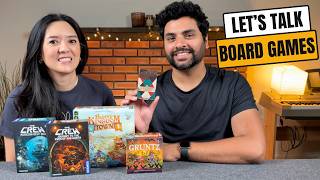
Before You Play marveled: "So much game in such a small package." The box is modest; the strategic surface is vast. Reviewers expected a filler and discovered a serious two-player system. The 25-minute playtime on the box proved wildly optimistic (reviewers reported 30-35 minutes), but that mismatch itself signals how much the game demands of players. Bower's Game Corner, naming Gruntz the game of the show for Origins, admitted to not being "the target market" for what initially looked like a light tactical game, then declared it "one that I will own no matter what." That transformation from skepticism to devotion defines why Gruntz resonates: it punches far above its weight class.
Delightful Physicality and Thematic Cohesion
The pieces feel good. Wooden tokens, magnetic attachments, a cloth board with designated zones for aircraft to strafe across (diagonally, like the sky). Before You Play praised "the artwork that are on the pieces themselves is super cute. The art is adorable." The game's cartoony aesthetic does real work: it makes a WWI-era tactical duel feel approachable rather than grim. The magnetic attachments aren't just mechanically clever; they create a satisfying physical ritual of loading your truck or tank for the turn ahead. Rolling Dice and Taking Names noted the comparison to Advance Wars felt natural because "different units could beat certain things" in both, but Gruntz owns this mechanic more completely through its design.
Potential Drawbacks
A Learning Curve That Demands Patience
Before You Play was candid: "There is definitely a learning curve. Like the first couple of games you're trying to figure out like, wait, what does this do?" First games are rough. Players restart mid-game, replay from a mistake, rebuild understanding. The game provides a rules reference card but no in-game coaching; mistakes teach faster than any explanation. This is a feature for some players (the ones seeking mastery) and a bug for others (the ones wanting casual fun). Reviewers universally acknowledged the upfront cost of learning, though none regretted paying it.
Pacing Collapse When One Player Leads
Edeto identified a structural weakness: "The game can overstay its welcome if a player like sort of has a clear advantage in win state, but it is like for whatever reason not able to capitalize on closing...there's some room for a sneak-in win, but there's definitely games where there's no reason to play for another 10 minutes." The game lacks a resignation mechanism or dramatic late-game catch-up. Once a player gains sufficient board control, the outcome is mathematically clear but the clock keeps running. Players have resorted to forfeiting rather than playing out the inevitable. This is less a mechanical flaw than a social contract issue, but it matters for groups that prefer games to reach natural conclusions.
If You Enjoy Gruntz
Players who find Gruntz compelling will discover kinship in games of pure information and positioning. Chess rewards similar strategic patience and opponent-reading, though Gruntz plays faster and with higher luck tolerance (unit matchups absorb some of the variance). Advance Wars, the Nintendo strategy franchise, shares Gruntz's rock-paper-scissors unit system and the same satisfaction of moving pieces to control territory, though Advance Wars wraps the system in campaign narrative and fog of war. White Castle Duel offers comparable two-player head-to-head abstraction with a smaller skill floor. Leaders delivers asymmetric tactical combat with deeper unit differentiation, though it occupies a heavier weight class. General Orders provides two-player worker placement with similar learning curves and replayability rewards.
What Reviewers Are Saying
"It's like that kind of play where every unit has their little rule. You have your sort of rock, paper, scissor: what kills what. But something about the rate in which you add to the board as you play, and the players are sort of trying to play each other off strategically."
— Gaming with Edo & Jessica
As you play more and more, that plan starts to unfold. But then as you play against, you know, the same person over and over, they start recognizing what you're going to try to do. And that's kind of where the headiness comes in. It's very heady. It's one of those games where the more you play, the more the feel of the game will sort of evolve.
— Before You Play
"It was so fantastically deep and I absolutely loved it, and I wasn't the target market. It's one that I will own no matter what. That is Grunts. It's fantastic. If you like two-player head-to-head little quick kind of games where it's like, let's run that one back cuz I wanted to try a different strategy, this is one you need on your radar."
— Bower's Game Corner