







Half Truth Deep Dive
What the Community Thinks About Half Truth
Reviewers tend to come to Half Truth expecting a polite trivia night and leave impressed by how much livelier it plays. Mind Suggested Game ranked it 31st on a personal top 50 list, calling it a trivia game that is better than Trivial Pursuit full stop and a title that is criminally underrated. The channel says it shows the game to anyone who mentions trivia. The Dice Tower host Tom Vasel finds the concept fun because it lets players push their luck, and calls it a good party game. Grant Lyon admits to disliking trivia games that make players feel dumb, and singles Half Truth out as a trivia game that does it better.
The praise is not unanimous, and the main reservation comes from a host who found the first session hard going. Rolling Dice & Taking Names played it repeatedly during the early pandemic and ended up fond of it as a family game, even though the first round left the host flustered.
Core Mechanics That Define Half Truth
Simultaneous Wagering on Answers
Each card lists six possible answers, and every player decides how many of them to back with poker chips. Mind Suggested Game explains that a player who knows little can bet on a single answer for an even chance, while a confident player can stake two or even three. The bonus for a perfect three-for-three is matched by a harsh penalty: one wrong answer wipes out the round's points. Rolling Dice & Taking Names describes the scoring in more detail. A die sets how many spaces the player moves along a victory point track, but only if at least one chosen answer is right, and each extra correct chip adds points on top. That combination is what turns the game into a risk management exercise. Players must weigh a safe single bet against a bolder spread of chips, and reviewers keep returning to that push-your-luck decision as the core appeal.
Deduction Through Elimination
Half Truth also rewards reasoning when memory fails. Rolling Dice & Taking Names describes a question that mixed Harry Potter locations with Lord of the Rings locations. The hosts who had read the Harry Potter books picked out their answers quickly, and the host who had not got the rest right by eliminating what they recognized from the other series. The same podcast says the cards are written to fool players. A prompt about Metallica songs leaves out the first three songs most people think of, and a card about horses that won the Triple Crown leaves off the most obvious answer altogether. That tension between knowledge and misdirection makes deduction more useful here than raw recall.
The Half Truth Experience
Everyone Stays Involved
Mind Suggested Game frames the design as a fix for its biggest complaint about Trivial Pursuit, where not everyone gets to answer every question. In Half Truth every player is wagering through the whole game, so quieter players stay engaged and the group learns where each person's knowledge lies. The same channel ranks it as one of the least rowdy entries on its party game list and notes that it plays well with teams. The promotional video that Tim Chuon filmed also presents the game as a team format. Rolling Dice & Taking Names reports that games stayed close, usually within a few points, which keeps the experience fair for mixed groups of veterans and newcomers.
Playful Guessing and Learning
The tone is social and a little silly. Rolling Dice & Taking Names describes a group that sat down insisting it would know nothing, then discovered that placing bets on what it thought it might know was great fun and taught it new things. Mind Suggested Game pitches the game to trivia buffs who enjoy pushing their luck, and to anyone who simply wants to pick up interesting facts. Because each card has a mix of correct and incorrect answers, even a player with no knowledge of the subject has a real chance to score, which makes the game welcoming for families and friends across different levels of knowledge.
What Makes Half Truth Stand Out
Designers Who Know How to Mislead
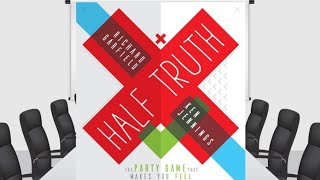
The pedigree is part of the pitch. Richard Garfield, the creator of Magic: The Gathering, teamed up with Ken Jennings, the Jeopardy champion, and reviewers credit that pairing for a question style that is clever rather than cruel. Rolling Dice & Taking Names calls the writing very clever because it tries to fool the player at every turn. Tom Vasel of The Dice Tower likes the way the concept turns a familiar trivia card into a choice about how much to risk. The writing rewards players who think about what the card is really asking, not just what they remember.
A Deep Stack of Topics
Reviewers appreciate the breadth of the card deck. Mind Suggested Game points to a large set of category cards so that somewhere in almost every game there is a niche that one player knows and nobody else does. Rolling Dice & Taking Names says the mix of sports, pop culture and history suits groups with uneven expertise, and the hosts hoped future expansions would keep that mix rather than splitting it into single-theme decks. The card supply is large enough that one group had not finished the first box after several sessions. The game began as a Kickstarter project, and Tim Chuon's behind-the-scenes video documents the commercial shoot that promoted that campaign.
Potential Drawbacks
The First Game Can Feel Overwhelming
Rolling Dice & Taking Names admits the first session left the host feeling dumb and mentally drained. The same host says the game became easy to enjoy in casual clothes at home after a few plays, and was clear that it works for everyone once it clicks. Still, this is the concern Grant Lyon raises about trivia in general, and some of the cards are demanding enough that new players may feel out of their depth at first. Groups that want an easy entry point should expect a learning curve before the banter takes over.
Luck Can Carry More Weight Than Knowledge
Because a single correct answer scores, a player can lean heavily on a coin-flip guess. Rolling Dice & Taking Names openly says that sometimes you just have to guess and hope, and the hosts enjoyed that part, but it is a real trade-off. Tom Vasel frames the game around pushing your luck rather than showing off what you know, which will suit players who like gambling with their chips. Players who want a pure test of trivia knowledge may find that the guessing carries too much of the final outcome.
If You Enjoy Half Truth
- Trivial Pursuit: This is the game reviewers measure Half Truth against. Mind Suggested Game names not everyone getting to answer every question as its main gripe with the classic, and Grant Lyon says that in it you either know the answer or you lose. If you enjoy the trivia itself and want to see the classic that Half Truth was built to improve on, Trivial Pursuit is the natural comparison.
- Jeopardy: Half Truth's co-designer Ken Jennings built their fame as a Jeopardy champion, and reviewers connect the two closely. Rolling Dice & Taking Names points to their record on the show, and Mind Suggested Game says that after trying out for teen Jeopardy, Half Truth is the closest thing the host has to that experience. If you like Jennings's wide-ranging knowledge and the thrill of a sharp answer, Jeopardy is the source material behind the designer's reputation.
What Reviewers Are Saying
"the concept of half truth is great because one of my biggest gripes about trivial pursuit is that not everybody gets to answer every question but in half truth everybody is involved the whole time and you really get to know what people are good at and maybe not so good at."
— Mind Suggested Game
"after the first time we played it and I felt so dumb but let me tell everybody after we've played it now three times man you can play this in your PJs."
— Rolling Dice & Taking Names
"All you have to do to get points is get one right. But you can push your luck and try to get more right to get extra points."
— Grant Lyon