
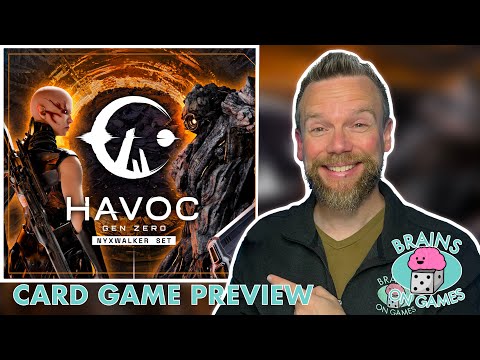



HAVOC Deep Dive
What the Community Thinks About HAVOC
Reviewers approach HAVOC as a Kickstarter prototype, and most of them say so up front. The game is a deck-crafting, lane-battling skirmish for two players, or four in teams, published by Nyx Studios. Across the three discussions, the consistent message is that the core idea is strong and the theme is memorable, while the physical prototype still has rough edges that reviewers expect to change before release. Several reviewers were sponsored or sent review copies, and they say so openly, which makes their enthusiasm and their caveats easier to weigh.
The most detailed write-up comes from a board game channel that treats HAVOC as a mid-weight strategy game and spends most of its time on how the cards interact. The channel that ran two full gameplay videos stresses the difference between the pre-built decks and a deck the player built from scratch, and it returns to that point several times. Both of those channels are clearly having fun, and their fondness for the game comes through in their sign-offs.
Core Mechanics That Define HAVOC
Deck Building
Deck construction is the mechanic reviewers return to most often. Players build their own decks from a large card pool that includes units, technology, traps, artifacts, and weapons that can be equipped to the Mech, and the choice of which factions to represent shapes what the deck can do. One reviewer built a deck around getting their pilot onto the board early, with buffs, movement, and aggression, and found that the plan rarely survived contact with the opponent. That experience led them to conclude that a custom deck feels more satisfying than a pre-built one, because the player already knows every card and every trade-off.
Reactors and the Reactor Race
Reactors are the resource and timing engine of the game. Each turn the player gains a little more energy to spend on cards, and reactor cards both fuel that energy and unlock cards tied to them. Playing a reactor also gives a discount on matching cards, and reviewers liked the tension this creates. The Mech cannot be deployed until a late round, but a player who has played more reactors than the opponent can bring it out sooner, which reviewers called a reactor race. One reviewer noted that the race can be a scramble to collect every reactor before the opponent does, and that the pilot's ability to hunt for a reactor with Expedition makes the search itself a meaningful choice.
The HAVOC Experience
Head-to-Head Skirmish With a Card Game Core
Reviewers describe HAVOC as sitting between two genres. One reviewer said the game "doesn't feel quite like a skirmish game" and "also doesn't feel like a lane battling card based game," calling the blend an interesting hybrid. Movement and positioning matter because range and adjacency decide who can attack whom, yet the fight is still driven by the cards in hand and the abilities on the table. The result feels tense in the middle game, where a single well-placed attack can swing the board and every unit is potentially exposed.
A Thematic Science-Fiction World
The theme is one of the game's strongest selling points. Reviewers praised the lore and the artwork, describing how the mechanics and the world reinforce one another, with biomechanical creatures, rival factions, and a Mech that doubles as a vehicle and a weapon. A self-described story-first reviewer explained that the flavor text is worth reading aloud, and that the battlefield's scale makes the stories feel more vivid. In play, the same reviewer added that odd tabletop moments, such as a poisonous gas attack on their pilot, became part of the charm and gave the session a narrative of its own.
What Makes HAVOC Stand Out
Adjacency and Retaliation
Reviewers singled out adjacency as a clever wrinkle. Ranged attacks can hit targets across the board, but a melee attack against an adjacent unit exposes the attacker to retaliation, so moving into position is a real risk. One reviewer called this a fun strategic element, and liked that some cards can surprise an opponent by appearing mid-game, which keeps board states from becoming predictable.
Accessible Rules With Real Depth
Reviewers repeatedly noted that the cards are easy to follow once they are on the table. One channel said the team rarely had to look up keywords during play because the card text was clear and repeatable, which made the game feel quick and accessible despite its depth. Reviewers also think the game rewards repeat sessions, with one saying they wanted to rebuild their deck and dive back in after each game. Brains On Games placed the title in a tradition of science-fiction collectible card games, comparing the pilot-and-Mech pairing to the Decipher Star Wars card game that got them into the hobby.
Potential Drawbacks
Prototype Tracking Wrinkles
The most consistent criticism is about the prototype's components rather than the rules. Brains On Games found that tracking which cards had already acted was harder than it should be, since there is no token to show a unit is still in battle prep or has been used. The same reviewer noted that the game lacks a tracker for the energy spent each turn, so players must keep a running total in their heads once the energy pool gets large. The reviewer added that these wrinkles may be fixed before release, and suggested that a good organizer in the retail box would help players keep their decks separate and ready to play.
Early Pilot Deployment and Game Length
Reviewers also warned that the most ambitious strategies are risky. The channel that built a deck for an early pilot found that the pilot was exposed once it left the Mech, and that a single poison or gas card could cripple its attack before the game even reached the Mech phase. Reviewers said the two-player duel is where the game shines, and the channel that tried the four-player version did not feel it was the best way to play. Several reviewers also acknowledged that games stretched out, and that long matches can drift when players have to recalculate many interactions at once.
If You Enjoy HAVOC
Reviewers placed HAVOC alongside a handful of familiar titles. Magic: The Gathering and Pokemon came up as examples of card games where the board is a secondary concern, while KeyForge was mentioned as a comparison for lane-adjacent play. Marvel Champions came up in the context of the preconstructed decks, since one reviewer enjoyed the game most when playing against an opponent who had built their own set rather than the ones handed out by the publisher. The classic Star Wars Customizable Card Game was also invoked for its ships, pilots, and equipment. Players who enjoy card games with a strong theme and a spatial battlefield, especially ones who like building their own deck, are the natural audience for HAVOC.
What Reviewers Are Saying
"I liked the preconstructed decks I've had fun with them every time I've played but the uh the custom deck the one that you do yourself very satisfying"
— Quackalope
"this game comes down to a lot of strategic deck building or deck crafting and construction very very purposeful and strategic card play"
— Quackalope
"the fact that melee combat is risky because you're going to take damage if you attack an opponent that's that's adjacent to you um that's a a fun strategic element to it as well"
— Brains On Games