














Imperium: Legends Deep Dive
What the Community Thinks About Imperium: Legends
Reviewers place Imperium: Legends in the mid-weight deck building space, with the civilization theme doing much of the work. Allies or Enemies describes it as a deck builder that delivers a full civilization experience in about 90 minutes, taking a civilization from its early days through to its rise as an empire. Board Games UnLocked counts it among its favorite deck builders and is especially enthusiastic about the solo experience.
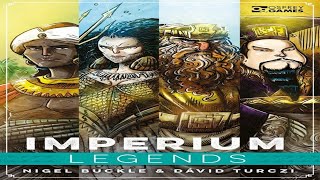
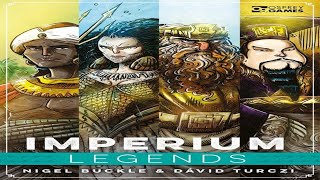
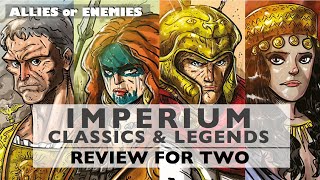
Presentation draws praise. Allies or Enemies singles out the art by Dimitro, noting that each nation has its own theme across its cards and that the history behind the cultures has been researched closely, down to details like the original Welsh names for Arthur's knights. The same review finds the card backs and general graphic design plain, and the cards feel a little plasticky, with some fraying after heavy shuffling, so sleeves are worth considering.
Reviewers are also clear that the game asks for patience. The rules are dense, each civilization plays very differently, and a first game with an unfamiliar faction is likely to go poorly. Reviewers treat that as part of the appeal once the learning curve has been climbed.
Core Mechanics That Define Imperium: Legends
Deck Building From a Shared Market
Every player begins with the same small deck and a shared market of cards representing land, developments, and other civilizations. Allies or Enemies notes that each player starts with five cards in hand. Across the game, players spend actions to acquire cards, exile cards from the market to deny rivals, and cull weak cards through their history. Each time a deck is reshuffled, the player also takes a card from a face-down nation deck and adds it to their deck, and later purchases can pull stronger cards from the development deck. Board Games UnLocked describes this cycling as the central engine, since the choices about what to buy and what to trash shape the deck for the rest of the game.
Unrest and the Path From Barbarian to Empire
Civilizations begin as barbarians and push toward their Empire state. Board Games UnLocked explains that once the unique side deck runs out during reshuffles, the player becomes an Empire, and Barbarian abilities give way to Empire abilities. Unrest works against that progress. Allies or Enemies describes fame cards as the good additions and unrest cards as the ones to avoid, and Board Games UnLocked notes that unrest counts against a player's score at the end. Clearing it takes actions, discards, or population, so a player who lets unrest pile up pays for it in both tempo and points.
The Imperium: Legends Experience
Solo Play Against the Bot
Solo play is where reviewers spend much of their time with the game. Board Games for One notes that the bot is an intelligent opponent that scores points of its own, with multiple difficulty levels and a campaign mode. Board Games UnLocked describes the bot system in detail: a die roll determines which card is revealed, and a chart for the chosen civilization decides what the bot does with it. The reviewer argues that this approach captures how each faction feels, and says the game is better solo than with more players.
Confrontational Two-Player Play
Multiplayer reactions are more mixed. Allies or Enemies recommends two players or solo, arguing that two players still have an opponent to steal from or throw into unrest, while larger groups spend a lot of time waiting for their turn. Board Games for One describes the game as confrontational, the opposite of cooperative storytelling. Board Games UnLocked found that a four-player game worked well, though the length of a full table is a consideration.
What Makes Imperium: Legends Stand Out
Asymmetric Civilizations With Distinct Puzzles
Board of It argues that the civilizations are asymmetric, each posing a different puzzle, and that multiple routes to victory exist within each one, which makes the replayability very high. Allies or Enemies offers concrete examples: the Vikings never become an empire and have no history, the Celts spread unrest to their rivals, the Scythians want to expand relentlessly, the Arthurians chase quests for the Grail, and the Utopians have no nation or development deck at all. Reviewers say the rulebook takes time to master, but the reward is that each civilization feels like a separate game.
Series Components That Work Together
Imperium: Legends uses the same core rules as Imperium: Classics, so the two can be combined. Board Games UnLocked describes owning both with an insert that brings everything together. Board of It notes that Imperium: Horizons includes replacement cards for Classics and Legends along with a comprehensive rulebook, which addresses earlier complaints about clarity. Allies or Enemies adds that the civilizations and starter cards are what separate the games.
Potential Drawbacks
Rulebook Clarity and Learning Curve
Allies or Enemies says the rulebook leans toward legalese, and Board of It notes that the clarity of the two original rulebooks drew complaints. Reviewers advise a patient first game with a low-complexity civilization, and they expect to need a few plays before the strategy clicks. Board of It also points out that the replacement cards and errata are a point of friction for some players who dislike changing their components.
Downtime With More Players
Turns can take a while, especially when a civilization has many end-of-round cards, and because players tend to focus on their own tableau, time spent waiting is common. Allies or Enemies therefore recommends playing with two players, solo, or three if the group is patient. Board Games UnLocked notes that the solo mode moves quickly because the only turns to manage are your own.
If You Enjoy Imperium: Legends
Players who enjoy the mix of deck building and civilization progression can look to Unmatched Legends and Cobble and Fog, which Allies or Enemies uses as reference points for the feel of the game. Board Games for One compares the depth of its deck building to Marvel Champions, though it notes the two are not quite at the same level. Readers who want the same rules with a different roster should try Imperium: Classics, and those who want the newest entry in the series should look at Imperium: Horizons.
What Reviewers Are Saying
"The thing with Imperium is if this type of game is what you like then probably Imperium will become one of your most beloved games. These civilizations are asymmetric or playing differently and providing you with a different puzzle on top of that."
— Board of It
"For solo play you are playing against an intelligent bot that is scoring points as well and there are I think four different difficulty levels. There's also a campaign mode, gotta love that for solo play."
— Board Games for One
"This is a game that's going to take a little bit of getting used to. Some have had troubles with the rulebook which does admittedly skew a bit legalese for its own good."
— Allies or Enemies