/pic8681935.jpg)
From February 19 to March 26, 1945, American forces waged a relentless assault against a well-fortified enemy, determined to seize control of the island’s strategic airfields. The battle was marked by fierce resistance from the Japanese defenders, who had meticulously constructed a network of underground tunnels and fortifications. The Marines faced relentless attacks, as they fought their way across the island’s rugged terrain. The iconic image of Marines raising the American flag atop Mount Suribachi became a symbol of American determination and sacrifice. Iwo Jima was crucial to the Allied war effort, serving as a vital base for fighter planes escorting long-range bombers on missions to the Japanese mainland.
Iwo Jima: Hell On Earth is a hex & counter wargame based on this iconic battle. This solitaire wargame puts you in command of U.S. Marine Regiments as they battle entrenched Japanese Battalions during the iconic 36-day Operation Detachment. Each game turn represents approximately four days, condensing the intense conflict into nine turns of strategic decision-making.
—description from the publisher

TDG: Iwo Jima: Hell on Earth
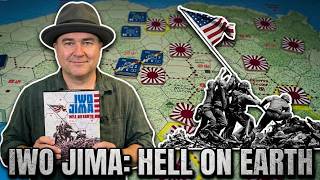
- Unique system with combat and attached support ratings for units
- Markers for activated units and used support are a cool mechanism
- Presents a great tactical problem for resource management
- The feeling of taking out Japanese forces with bombardment is satisfying
- Reconnaissance in force and full assault options work well with the support mechanism
- Japanese recon and harassment can be impactful
- Command markers provide special advantages
- Unrevealed Japanese markers can lead to 'nasty surprises' like Banzai charges
- Felt a lot of agency for the player
- Successfully captures the history of the battle while providing fun and engaging gameplay
- Can be a little hard to keep track of activated units and used support (personal issue, not game fault)
- Getting 'intelligence failure markers' is frustrating
- World War II, US Marine Corps attempt to subdue the island of Iwo Jima
- Iwo Jima, 1945
- The history of the battle really came through and it did a phenomenal job of capturing both the history and fun and engaging gameplay.
Mechanics (from transcript analysis)
- Assaults — Players can perform assaults using a unit's combat power and support, calculating combat ratios and rolling on a table for results.
- Bombardment — Players can spend bombardment points to attack enemy units from afar, trying to take them out.
- Command Markers/Intelligence Failure — Special advantages that can be drawn with command points, but intelligence failure markers take up space and waste points.
- Command Points — Players roll a die for command points which can be spent on various actions: reinforcements (moving a unit up one step), deploying reserves to beaches, drawing command markers (special advantages), or removing intelligence failure markers/retreating/routing markers.
- hex-and-counter — The game uses a hex-based board with counters representing units.
- hidden units — Japanese battalions are placed face down, so their exact nature is unknown until revealed.
- Japanese Raids — Japanese units can attack American units within two hexes during a dedicated phase.
- Movement restrictions — Movement is affected by weather and terrain, and there are zone of control rules.
- Reconnaissance in Force — Players can attempt to reveal hidden Japanese units by moving adjacent to them and rolling a die, potentially taking hits themselves.
- Response Markers — If assaulting a hidden Japanese unit, a response marker is drawn from a bag, which can lead to events like Banzai attacks or enemy support capabilities.
- Solitary Play — The game is designed to be played by a single player.
- Support units — Units have a support rating that can be used for their own attacks or to support up to three other units, indicated by markers.
- Unit Damage/Elimination — Units take hits, rotating through steps (full strength, next level strength, flipped counter) before elimination.
- Victory Points — Victory is determined by earning points for destroying Japanese combat units and capturing objective spaces on the board.
- Weather Determination — A die roll determines weather (good or bad), which impacts movement.
Video topics + discussion points
Quotes (from this video)
- My only vulnerability is that I care too much. And knives and bullets and cheesecake.
References (from this video)
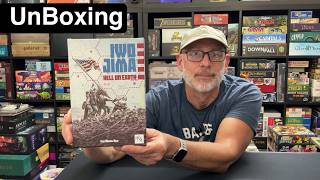
- Fascinating looking solo game
- Fantastic cover artwork
- Nice component insert with good artwork
- Liked the small dice size
- Player aid opens as a book
- Detailed rulebook with scene-based introduction
- Looks really good
- Solo game the host really wants to play
- Small text on the rulebook might be hard to read
- US Marine Corps taking over Iwo Jima, a Japanese stronghold during World War II.
- Iwo Jima
Mechanics (from transcript analysis)
- Dice Rolling — The host speculates that dice are rolled for locations and mentions rolling dice for combat odds.
- Hex and counter — The host deduces it's a hex and counter game from the back of the box.
- token placement — The host notes the presence of tokens and their potential randomization or random drawing from a bag.
Video topics + discussion points
Quotes (from this video)
- that cover that artwork man just soak that in cuz I think that looks fantastic.
- This is just a little insert that they printed they set inside get some nice good artwork in there. Got to show you that they took the time to put it together ah I love it.
- this is a small box game okay this is perfect I like it.
- it does this this game looks like it's pretty detailed there's a lot going on here. So it looks just fascinating.
- this is a solo game that I really want to get to the table and play it looks fantastic.
- I mean I really like Iwo Jima I like all the games that have been based on it and all that and all the shows and stuff like that that are based on that it's one of my favorite aspects of World War II.