









King of Monster Island Deep Dive
What the Community Thinks About King of Monster Island
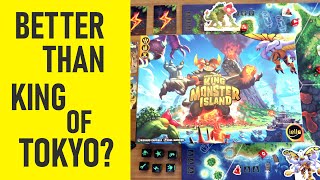
King of Monster Island is a 2022 fully cooperative game designed by Richard Garfield and published by IELLO. It sits in the King of Tokyo universe but changes the goal entirely. Between one and five players take on the roles of giant monsters who must defeat a titan-like boss before it builds three pylons and opens an interdimensional portal. Reviewers agree that the game borrows King of Tokyo's dice engine, and they largely agree that it has more depth than its family-friendly packaging suggests. Where they split is on whether that depth is worth the effort it demands.
Three Minute Board Game is the most positive voice in the set. The channel describes the game as "way better than expected" and calls it a "very clever Co-op that requires you to play in a planned out and Cooperative way." Board Game Sanctuary also responds warmly, praising the production and the cooperative design. Its reviewer calls the game an 8 out of 10 for fans of the King of series and says the design fills a niche in the King of Tokyo world that had not been filled before. Meeple University is more reserved. Its reviewers see the game as a solid middle-of-the-pack cooperative title, one that brings little that is new to people who already know cooperative games. Before You Play is the most ambivalent of the group. Its reviewers found the boss turn procedural enough to feel exhausting over many rounds, although they still enjoyed the puzzle of keeping the monster in check. Across the channels, the shared view is that the game rewards teams who plan well and punishes those who treat it as a casual dice-chucker.
Core Mechanics That Define King of Monster Island
Dice Rolling in the Volcano and Across Three Rolls
Dice drive nearly every decision in King of Monster Island, and reviewers describe two separate dice systems. The boss rolls its red dice by dropping them into a volcano at the center of the board. Where those dice land determines where the boss moves, which minions activate, and where crystals form. On the player's turn, each monster rolls six dice and may keep some and re-roll the rest up to three times. Faces produce hearts for healing, claws for attacks, feet for movement, spanners for building support tiles, lightning bolts for energy, and stars for Fame. Meeple University notes that the King of Tokyo engine is recognizable here, even though the goals have changed. Three Minute Board Game points out a cooperative twist: a player can store unused dice in a region for a teammate to pick up later, so a roll that would otherwise be wasted becomes part of a shared plan. Board Game Sanctuary highlights the same idea, praising the "dice locking" approach that lets a player leave a die for the next monster who visits that zone.
Boss Battler With Fame-Driven Powers
The second core mechanic is the boss battle itself. Players face one of three bosses, each available at two difficulty levels, and each boss carries a card whose abilities strengthen as its Fame track fills. Board Game Sanctuary notes that the boss's powers accumulate, so its strength grows over the course of a session. Before You Play adds that players can spend the game trying to keep the boss's Fame in check, because the boss can level up as the game advances. Meeple University recommends starting with the easiest boss, since the tutorial scenario is so light that it can put newcomers off the rest of the game. The Loop is the comparison Board Game Sanctuary reaches for when describing how the boss's sequence and dice-driven movement play out. Before You Play also draws that parallel, noting that the volcano mechanism borrows heavily from the same design.
The King of Monster Island Experience
Collaborative Play Against a System
Reviewers consistently describe the game as a team effort against the system rather than against each other. Board Game Sanctuary explains that the cooperative nature "actually really works" because players must decide where to place their monsters, which dice to roll, and which minions to clear before the boss can activate them. The feeling is one of shared pressure: a player might use a turn to deal with a threat in their own region so that the group will not face a worse problem later. Meeple University frames this as a co-op game with a King of Tokyo engine rather than a cooperative version of King of Tokyo, and that distinction matters to the mood at the table. The game feels less like a brawl and more like a coordinated defense.
A Satisfying Engine Built Across the Table
The engine-building side of the game earns real enthusiasm. Meeple University describes a deeper engine than in King of Tokyo because players try to combine their rolls with those of other players. Energy becomes valuable because the game gives players more energy per lightning bolt than the base game does, so reviewers can afford to buy several power cards in a session. Board Game Sanctuary goes further, noting that saving energy and building up cards creates synergies both within a player's tableau and between players. Reviewers describe the moment when a well-timed combination pays off as the game's most rewarding feeling, even when the overall pace is slow.
What Makes King of Monster Island Stand Out
Allies as an Upgrade System
Three Minute Board Game and BoardGameCo both single out the Ally cards as the game's best feature. Three Minute Board Game calls them the best thing about the game and argues that they are an excellent way to handle upgrades compared with variable monster powers. BoardGameCo describes Allies as arguably one of the most fun parts of the game because they give each monster an asymmetric identity as the game progresses. Players gain stronger, more distinct abilities as their Fame grows, which keeps the player's progression visible throughout the session.
Three Bosses and Multiple Difficulty Levels
Reviewers also praise the variety built into the box. Meeple University points out that the game includes several difficulty levels, which it considers a strength, and it recommends working up from the easiest setting rather than jumping straight to the hardest. Board Game Sanctuary, in its rating video, describes King of Monster Island as "brutally tricky" but notes that it contains a lot of variation. That combination of challenge and variety gives the game a longer life than a single scenario would, and it is the reason several reviewers say they plan to keep it on their shelf.
Potential Drawbacks
Upkeep Between Turns
The most consistent criticism concerns maintenance. Meeple University describes the upkeep as high for a cooperative game, especially because the game is not a dungeon crawl where enemies move and choose targets in a way that is easy to track. Before You Play reports a similar experience, finding that the boss's turn requires constant checking of the boss's powers, dice counts, and minion behavior before every player's turn. Both channels agree that the game may be too demanding for a true gateway experience. One player who is comfortable with rules can carry the bookkeeping for the whole group, but a table of first-time players may feel like it is doing accounting on the first game.
Downtime and the Alpha Player Problem
Board Game Sanctuary raises a concern about player counts. Because the boss activates at the start of each player's turn, a larger group spends more time waiting, and the boss can be hard to react to when players are spread across the island. The reviewer also notes a risk of an alpha player dictating moves, which can frustrate quieter players. Three Minute Board Game adds that the game is "a little long for what it is," and Meeple University wishes the game were faster, describing its pace as slow. Reviewers agree the game plays best at two or three players, where turns come around quickly and the group can still coordinate effectively.
If You Enjoy King of Monster Island
- King of Tokyo: Players who enjoy King of Monster Island's dice rolling will recognize the same rhythm of rolling, re-rolling, and resolving symbols, now applied to a cooperative goal with a shared threat.
- The Loop: Board Game Sanctuary compares the game's sequence of boss movement and dice-driven hazards to The Loop. Players who like the satisfaction of predicting and reacting to a moving threat will find a similar tension here.
- Pandemic: Board Game Sanctuary also describes cooperative play in a way that echoes Pandemic. Players who enjoy coordinating actions across a team to contain a growing threat will appreciate the shared pressure that King of Monster Island creates.
What Reviewers Are Saying
"That's why when I open this up I described it as a co-op game with the King of Tokyo engine rather than a Cooperative version of King of Tokyo. It feels different."
— Meeple University
"The Cooperative nature actually really works in this game. You are functioning as a group of monsters who are trying to battle against the system that the game is throwing at you."
— Board Game Sanctuary
"The best thing about this game is the Allies. I think this is an excellent way to do upgrades instead of variable monster Powers."
— Three Minute Board Game