





Masmorra: Dungeons of Arcadia Deep Dive
What the Community Thinks About Masmorra: Dungeons of Arcadia
Masmorra: Dungeons of Arcadia occupies an interesting position in the dungeon crawl space. While the game has found players who enjoy its fast-paced structure and mechanical depth, it has also drawn criticism from experienced reviewers. The Dice Tower's Tom Vasel, who reviewed the game a decade ago, expressed reservations about its execution: Vasel found it felt procedural compared to other dungeon crawls in this space, and the choice to represent all monsters as plain cubes rather than distinctive figures was a letdown. This tension persists in the community. Reviewers who engage with Masmorra's mechanics tend to appreciate the system's design and the satisfying moments when a well-timed ability or lucky die roll creates a memorable turn, but the game does not inspire universal enthusiasm across the broader board gaming landscape.
Core Mechanics That Define Masmorra: Dungeons of Arcadia
Dice-Driven Action Selection
At the heart of Masmorra lies a dice-rolling mechanism that structures each hero's turn. Players roll six black action dice and may re-roll any number of them. The dice provide symbols (movement, attack, magic, shields, elixirs) that fund different actions throughout a turn. Players can spend symbols to pay for hero abilities, which themselves can be docked (spent) to create additional symbols. This layered activation system creates meaningful decision points: should you use magic to modify a die face, activate a hero ability for symbols, or save your dice for movement and combat? The system rewards planning and adaptation, as players must evaluate dice results and decide how to spend their limited resources.
Modular Tile-Based Dungeon Exploration
The second pillar is the modular dungeon itself. Players spend movement points to explore new rooms, drawing tiles from size- and level-segregated stacks. The dungeon is never the same twice; rooms are placed as discovered, with some revealing treasures, monsters, traps, or special effects. Rooms contain spawn symbols, trap indicators, treasure tokens, and monster difficulty markers. As players explore, the dungeon grows organically around their routes. Moving between rooms or interacting with traps can trigger wounds and other consequences. This modular approach keeps the experience fresh and prevents players from merely executing a predetermined path, instead rewarding spatial awareness and risk assessment as they decide which doors to open and which dangers to confront.
The Masmorra: Dungeons of Arcadia Experience
Head-to-Head Competitive Tension
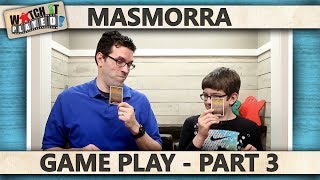
Played competitively, Masmorra turns into a direct duel rather than a parallel dungeon crawl. Treasure cards let one hero interfere with another's turn outright: a card like Fear of the Dark can strip an opponent's roll down to one fewer die right as they're set to pull ahead, and the receiving player can fire back with a counter-spell to cancel the effect. In a recorded Watch It Played session, this kind of direct interference produced genuine table talk and mock outrage between the two players, the sort of back-and-forth needling that a purely solitary dungeon crawl never generates. Every roll has the potential to draw a reaction from the other hero at the table, not just from the dungeon itself.
Streamlined Single-Hero Focus
Players control a single hero rather than a party, reducing bookkeeping and keeping focus sharp. The leveling system unlocks new abilities as the game progresses, giving heroes more options and encouraging players to invest in their character's development. There is also a persistent sense of exploration and discovery as the dungeon tiles emerge, forcing players to adapt plans on the fly rather than commit to a single strategy.
What Makes Masmorra: Dungeons of Arcadia Stand Out
A Tighter Spin on the Arcadia Quest Universe
The game occupies a unique niche within the Arcadia Quest universe, offering a distinctly different experience from its predecessor while sharing thematic cohesion. Unlike Arcadia Quest, which is a campaign-focused skirmish game, Masmorra strips away the campaign layer and delivers a tighter, competitive dungeon race where the first hero to reach 16 experience points wins. This streamlined design choice makes Masmorra more accessible for single-session play.
Interactive Treasure Cards Add Table Talk
Beyond the modular tiles, Masmorra's treasure cards give players tools that reach across the table. A hero who draws the right card can hand an opponent a weaker turn at exactly the wrong moment, and the opponent can hold a counter-spell in reserve to answer back. This layer of direct interaction sits on top of the dice-rolling and exploration loop, so a game is never purely a solitaire race against the dungeon; it's also a running skirmish between heroes competing for the same experience points.
Potential Drawbacks
Cube Monsters Lack Personality
The most substantive criticism leveled at the game is its reliance on procedural feel and the aesthetic choice to represent monsters as generic cube dice rather than distinctive miniatures. Experienced dungeon crawl players may find the game lacks personality in its component design, especially when compared to other games in the CMON stable or direct competitors in this genre.
Luck-Driven Swings Can Favor One Player
The heavy emphasis on dice rolls can make the race to 16 experience points feel swingy. In the recorded Watch It Played competitive session, one hero raced ahead early through a run of strong rolls and well-timed dock-and-reroll choices, leaving the other player facing a steep comeback with the episode ending well behind on the experience track. Players who prefer games where tactical mastery more directly determines victory may find Masmorra frustrating when an opponent's fortunate roll opens a lead that skill alone can't easily close.
If You Enjoy Masmorra: Dungeons of Arcadia
Players drawn to Masmorra should explore Arcadia Quest, the game that shares its universe and many mechanical DNA strands but offers a campaign structure instead of a sprint. Arcadia Quest expands the dungeon crawl experience into a longer-form story, making it appealing to groups who want investment and progression across sessions. Other dice-driven dungeon crawls like those in the Fuse or King of Tokyo families offer similar moment-to-moment decision-making and accessible rules. For those specifically interested in modular dungeons and quick play, games that emphasize tile-laying exploration and competitive races through procedurally-generated spaces deliver similar satisfaction.
What Reviewers Are Saying
"All the monsters were cubes which I didn't really care for. Dice, I don't know. It's just it felt very procedural, not nearly as good as other dungeon crawls."
- The Dice Tower
"Winning games is fun."
- Watch It Played
"If I decide to dock a die and spend a coin, I can roll any unused dice. I like this ability because it means during a turn if you save some dice and then they prove to be not as useful, you have another chance to roll them to get what you want."
- Watch It Played