





Meeple War Deep Dive
What the Community Thinks About Meeple War
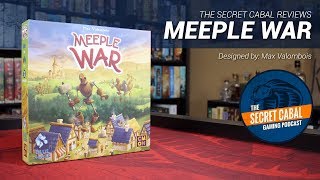
Reviewers who have played Meeple War mostly agree on how it plays and disagree on how it is packaged. The Secret Cabal Gaming Podcast is the most enthusiastic voice in this group. Its full review calls Meeple War a real-time strategy game that succeeds where many other designs have failed, and argues that it feels like a board game rather than a video game translated to the table. In a separate roundup of overlooked favorites, the same channel calls it a "tiny little war game" with the production quality and strategic depth of much larger titles.
The Dice Tower takes a more measured position. Its retrospective gives the game a seven out of ten and describes it as a decent worker placement game with a theme that is a little wonky, which places it well below the enthusiasm of the Secret Cabal reviewers.
The sharpest disagreement concerns the title and box art. Both Secret Cabal reviews say the name undercuts the game. The meta joke of calling the units meatballs in a game named after meeples struck one reviewer as making a joke out of the game itself, and the cover and rulebook feature large wooden warriors that some players will find off-putting. The same reviewers praise the interior art, buildings, and tiles. The community consensus, in short, is that Meeple War plays better than its box suggests.
Core Mechanics That Define Meeple War
Buildings as a Slow, Worker-Driven Engine
Each player holds a hand of nine buildings and can play any of them face down into one of three building spaces. A worker then travels down the construction path, which takes two, three, or sometimes four rounds, before the building flips face up and opens a new action path for future workers. One reviewer called this their favorite aspect of the game and tied it directly to the real-time strategy comparison: strategies must be planned two to four turns ahead, and builds must be sequenced so that production flows steadily rather than arriving all at once. Destruction matters as well. If an enemy blows up a catapult, the owner can no longer build that building and has to pivot to a different plan, which the reviewer considered one of the best parts of the design. Some buildings also branch, letting a worker choose between two actions.
Three Routes to Six Victory Points
The game ends as soon as a player reaches six victory points, and reviewers stress that there are several routes to that total. Killing enemy meeples earns bravery points, with seven bravery points converting into one victory point. Holding the strategic towers scores steadily, although one reviewer characterized it as a good supplemental strategy rather than a primary path. Destroying enemy buildings is the most lucrative option, scoring one point for each defensive space a building had, but it is slow because buildings carry many defense points. Reviewers see this variety as the core of the game's appeal, since each route pushes players toward different plans and everyone can pursue victory somewhat differently.
The Meeple War Experience
Patience, Foresight, and the Payoff of a Running Engine
The feeling reviewers describe most often is anticipation. Because construction takes several rounds, a plan made early in the game pays off much later, once the engine is fully operational and the workers are moving along their action paths. One reviewer found this deeply satisfying, comparing the moment to watching a real-time strategy plan come to fruition. The same reviewer also values the pivot points: a strategy built around one building can be abandoned for another and still feel like a rewarding turn of events.
Tactical Positioning on a Growing Map
The map expands as the game goes. Moving a meeple into an empty space lets a player draw and reveal a new tile, and many tiles change the flow of play. Caves let units pop up two spaces away, mines carry units across the board in a single move, forges supply weapons and shields, and ancient god altars force a player to sacrifice one meatball to eliminate an enemy a few tiles away. Combat is deliberately straightforward, a one-for-one trade in which the side with units left standing controls the space. Reviewers find that simplicity rewarding because it puts the emphasis on movement and positioning. One reviewer described the choice of whether to send a detachment to claim a tile as a real decision, because the effort it costs has to be weighed against what the tile offers.
What Makes Meeple War Stand Out
A Genuine Real-Time Strategy Feel in a Board Game
The praise that recurs most often is that Meeple War achieves the real-time strategy feel that other board games only gesture at. One reviewer notes that many designs borrow RTS concepts without ever feeling like the genre, and argues that Meeple War is the first to do it convincingly through its building queues, production flow, and expansion across the map. The same reviewer also points to its 4X qualities, since players build, explore, and expand in the same game.
Dense Strategy in a Compact Box
Reviewers also praise how much the game packs into a small package. One reviewer describes it as a dense, full experience in a smaller box, with strategic options at every level: overall victory route, building choice, and the branching actions within individual buildings. The Secret Cabal roundup emphasizes the same quality, presenting the game as a small box that delivers strong mechanisms for building, controlling points, and scoring victory points.
Potential Drawbacks
A Theme and Title That Undersell the Game
The most consistent criticism is presentation. Reviewers find the name, the meatball wordplay, and the cover art with its wooden warriors off-putting. One reviewer calls the front of the box "completely abysmally bad" and suggests the game would be talked about far more with a more appealing theme and a bigger box with miniatures. Another reviewer admits the title nearly kept them from trying the game at all. Both still recommend it, but they acknowledge that many potential players may never pick it up because it does not look the part on a shelf.
Strategies That Stay on the Surface
One reviewer acknowledges that, despite its many systems, Meeple War is not a brain-burning game, and its strategies are fairly surface level. The combat is one-for-one, and the rules create room for combos and clever building choices without demanding deep calculation. The Dice Tower's assessment points the same way, calling the game a decent worker placement design rather than an outstanding one. Players who want a deep, puzzle-like engine may find it lighter than expected, while players who want an interactive, fun experience with clear goals tend to come away satisfied.
If You Enjoy Meeple War
- Daimo: Rebirth of the Empire: The Dice Tower highlighted this as a solid example of hybrid games that combine worker placement with movement around the board, a blend similar to Meeple War's placement-driven building and map control.
- Holmes, Sherlock and Mycroft: The Secret Cabal describes this compact two-player worker placement game as one that grows more complex as new action spaces appear, which echoes the evolving board that reviewers praise in Meeple War.
- Cave Troll: The same roundup describes this dungeon area majority game as a contest for control of rooms and treasure, which parallels Meeple War's competition for tiles and strategic points.
- Blood Rage: The Secret Cabal roundup uses this title as a benchmark for production quality, saying Meeple War matches it in component quality. Fans who value that level of presentation may find this a worthwhile comparison.
What Reviewers Are Saying
"This is a game of patience and foresight. Your strategy has to be two and three and four turns into the future, like a real time strategy game."
— The Secret Cabal Gaming Podcast
"The artwork is great inside the box with the buildings and the tiles and everything else. All the components are wonderful. I just wish that this one had a little more faith in it and really gave it a good production."
— The Secret Cabal Gaming Podcast
"The theme's a little wonky, but it's a decent worker placement game."
— The Dice Tower