



Mental Blocks Deep Dive
What the Community Thinks About Mental Blocks
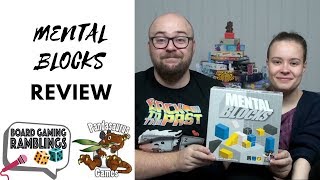
Reviewers who cover Mental Blocks agree on its central appeal: a cooperative puzzle that asks a group to rebuild a structure none of its members can see in full. In its review, Board Gaming Ramblings describes the game as a pure puzzle at heart, where every player holds a card showing one angle of the finished design and must describe what they see without simply showing their card. The channel was surprised by how much thinking such simple rules produced, and it described the game as possibly one of the best of its kind that it had played.
The consensus is not unanimous on first contact. The same channel's review and its top 100 countdown both describe a rough first session with a full table, where everyone talking at once made the game feel chaotic. Opinions shifted once groups played with fewer people. That pattern, a poor first impression that improves at a smaller table, recurs across the coverage, and reviewers generally point to three or four players as the sweet spot. Once the group settled into that format, the channel's keep-or-call segment on the game described it as reliably fun each time it was played, as that episode shows.
Praise centers on the puzzle itself, while criticism tends to focus on the size of the table and the friction of communication. Reviewers say the game is strongest when it stays a pure puzzle and weakest when the group grows large enough that additional angles simply duplicate information the team already has.
Core Mechanics That Define Mental Blocks
Cooperative Game
Mental Blocks is built on shared success. Every player works toward the same win or loss, and the group either completes the structure correctly or does not. Reviewers describe the team as the only route to victory because each person sees just one side of the design. The group has to pool those partial observations before it can trust a solution. Board Gaming Ramblings stresses that players describe what they see to the others and match it against what everyone else is seeing, which turns communication into the main activity at the table rather than a side effect of it. The cooperative structure therefore shapes the whole tone of play, favoring patience and careful description over individual cleverness.
Voting
The group commits to an answer through a vote. When a team believes it has found the correct arrangement, a player calls for a vote, and the puzzle is accepted only if more than half of the table agrees that it is right. If the vote passes and the arrangement is correct, the table wins. If the arrangement is wrong, the table loses. Reviewers treat this final step as a moment of collective nerve, since the group must decide together whether its shared picture is good enough to stake the round on. The vote turns the puzzle into a decision as well as a construction task, and it is the point where the team's confidence gets tested.
The Mental Blocks Experience
The Pressure of the Clock
The timer is central to how the game feels. Rounds run about ten minutes with three or four players, and reviewers describe the clock as a constant, quiet nudge. Even when a table still has time remaining, players feel an urge to finish. Board Gaming Ramblings describes this as a pressing feeling that keeps the group moving. The harder puzzles sharpen that pressure because they ask players to remember that a structure may contain layers no one can see from their own position. Reviewers describe the frustration of realizing that a half-formed picture may be hiding depth, and that realization is what makes the clock feel so tight.
The Absorbing Spatial Puzzle
Reviewers describe the play as a tactile puzzle that rewards imaginative thinking. Players rotate pieces, consider how a shape looks from another side, and decide whether a gap belongs to the structure at all. The enjoyment comes from the moment of recognition when the team realizes that a piece fits from a perspective nobody had considered. Board Gaming Ramblings says the game is hard to put down because the rounds move so quickly that players keep asking for one more. That quick loop of attempt, observation, and adjustment is what keeps reviewers coming back for another round.
What Makes Mental Blocks Stand Out
Modular Rules That Change the Game
Reviewers consistently praise how adaptable Mental Blocks is. The game can be played as a pure puzzle or with restrictions that alter how people communicate, such as silence or limits on which blocks a player may touch. Minor and major glitches change how certain pieces behave, which adds another layer of variation. Board Gaming Ramblings says these options make the game feel completely different from one setting to the next, and the channel treats that range as one of the design's main strengths. Even a group that does not enjoy the restrictive variants can settle on the pure puzzle and still find a complete experience.
Large Puzzle Library and Easy Teaching
Reviewers highlight the number of puzzles in the box and the wide range of difficulty. Board Gaming Ramblings points to a library of sixty puzzles that climbs from family-friendly layouts to demanding challenges, and it says the box offers strong replay value for the price. The rulebook is short, with roughly six pages of material, and most of the essentials can be explained in a few minutes. That combination makes the game easy to pull out with a mixed group, including younger players, and reviewers say it works as well with heavy gamers who want a pure puzzle as it does with casual groups.
Potential Drawbacks
Sensitivity to Player Count
The most consistent criticism is that the game becomes unwieldy at higher player counts. Board Gaming Ramblings found that with eight players there were more angles than the group needed, so some participants had little to do because the team already had the information it needed. The same channel reports that a nine-player game did not go well, although the reviewers were tired at the time and acknowledged that the setting may have affected their enjoyment. The shared advice is to stick to three or four players for the best experience, which narrows the game's usefulness at larger gatherings.
Early Chaos and Uneven Clarity
New groups can find the early rounds chaotic. The first session in the review had everyone talking at once, and the reviewers note that certain shapes are not always easy to read. The reviewers said that the difference between a triangle and a square is not completely intuitive when a card is viewed from certain angles, which can slow a group down before it finds its rhythm. Reviewers also say the restrictive variants are not for every table, and the channel's own group preferred the pure puzzle over the more constrained styles.
If You Enjoy Mental Blocks
Players who enjoy the way Mental Blocks asks a group to interpret partial information from each member may find similar satisfaction in Dixit, which likewise relies on players communicating through an indirect clue and seeing how the table reads it. Both games reward a group that enjoys piecing together a shared picture from incomplete signals rather than racing a clock.
What Reviewers Are Saying
"This is always fun when we play it. I'm always amazed at how they thought of this as a concept and as a game, because you're trying to rebuild a structure but you don't know what it looks like."
— Board Gaming Ramblings
"I feel like as a pure puzzle game that's how I would like to play this game because there's so many hard puzzles you have to really work together and try to solve that spatial puzzle which you don't get in so many games."
— Board Gaming Ramblings
"First time we played it I hated it and then we played it with less people and that was much more fun. And now it's a game that I thoroughly enjoy every time we bring it to the table."
— Board Gaming Ramblings