


Mighty Shot! Deep Dive
What the Community Thinks About Mighty Shot!
Discussion of Mighty Shot! so far comes from two videos on the Man vs Meeple channel. One is a hands-on play session with miniatures, and the other is a preview segment recorded while the Gamefound campaign was still going up. Reviewers describe a head-to-head duel that blends tactics and dexterity, with card play as a supporting layer rather than the centerpiece. The tone is enthusiastic but candid. The hosts praise the design for turning combat into a physical skill test, while cautioning that the same skill requirement can frustrate players who do not enjoy flicking games.
The play session carries the stronger case. Its hosts spent real time with the factions and came away enthusiastic about the duel, while the preview segment is openly speculative. One host had not seen anything from the publisher before, and the preview hosts repeatedly said they had only read the campaign page. That gap matters, so the strongest guidance here comes from the hands-on material.
Core Mechanics That Define Mighty Shot!
Flicking Tokens Replace the Dice
Combat happens on a private shot board that belongs to each player. The hosts stress that this board is hidden from the opponent, which turns every attack into a contest of personal execution. Players flick small ammo tokens toward a target at the far end of the board, in the style of Crokinole. The target is divided into zones. The front rows are the easiest to reach, while the red spaces farther back count as difficult shots. Landing a token in a difficult zone eliminates the minion standing there and deals damage to the controlling hero equal to that minion's value. Nothing in this process is random, and the hosts describe the outcome as settled by touch rather than by rolls.
Ammo sets the rhythm of each turn. A faction starts with a pool of ammo tokens, and a missed shot exhausts one token, flipping it to its colorless side. A player keeps shooting as long as active tokens remain, so a streak of misses can end a turn quickly. Certain cards can refuel exhausted tokens, which lets a player take another attempt. The hosts describe this as the heart of the tension, because a player who burns through ammo has no further shooting options that turn.
Minions, Colored Spaces, and the Shared Center
The main board is a battlefield of colored locations. Each minion carries a power that activates when it moves onto a space of matching color. Those powers vary by faction, so a single well-placed minion can make an attack easier, make an opponent's attack harder, or inflict automatic damage at the start of a turn. Heroes are never struck directly. Damage to a hero comes from killing minions, and every minion carries a value that its controller takes when it dies. The shared central spaces are contested by both players, and holding them inflicts damage at the start of each turn, so board control matters as much as accuracy.
Each turn offers a choice among action tiles. Two of them let a player either move a minion or play a card, in whatever combination they prefer. The third triggers the hero's signature shot, which the hosts describe as a once-per-turn ability with little reason to skip. Actions can be taken in any order, so a player can shoot first and then play a card to set up a fresh attempt. The hosts tie the tactics of the game to this sequencing.
The Mighty Shot! Experience
A Steep Learning Curve Softened by Forgiving Factions
The hosts agree that the skill ceiling is high and that new players benefit from a warm-up. Their advice is to let a newcomer flick ammo tokens at the start of the game to learn how hard a shot needs to be, and to get familiar with the mat and the weight of the tokens before a real match begins. Factions also differ in forgiveness. Thorvald's ability grants a second shot from the spot where a missed token landed, which one host found especially helpful despite admitting to being weak at dexterity games. The Jaguar faction is harder, since its ability requires landing a shot and then landing a second one with a Jaguar token. For families, the hosts suggest giving younger players the easier factions to keep matches fair.
A Rivalry Decided by Touch
Matches are designed as one-on-one duels, though the preview segment notes that teams and larger formats are possible with additional boxes. The duel feels personal because it comes down to precision. The Crokinole fan on the play session was unable to coast past the other host, who simply had the better touch that day. That result is a useful reminder that familiarity with a similar flicking game does not automatically translate into victory here. Winning depends on practice with this particular board and on understanding how the factions interact with it.
What Makes Mighty Shot! Stand Out
Asymmetry That Changes Nearly Everything Except the Core Loop
The biggest standout in the play session is the asymmetry. Every faction arrives with its own hero, player board, deck, and miniatures, and the hosts call the amount of difference a wild level of asymmetry. The basic loop of moving, playing cards, and shooting stays the same, so the factions feel distinct without demanding a new rulebook for each one. The hosts also highlight the behemoths, a catch-up mechanic borrowed from the boss events of video games. A player who reaches seven health draws a behemoth card and controls it with behemoth dice. Each roll either does nothing, deals automatic damage, or moves the creature one space, and a behemoth can step into an enemy home field to destroy minions there. A snoozing result lets the controller roll again. The hosts describe the behemoths as chaotic and wild, a comeback tool that can swing a struggling game.
Skill Over Luck and a Striking Visual Identity
Because combat involves no rolling, the hosts argue that the game sits apart from tactical titles built on dice and card-based rerolls. They describe the outcome as skill-based with little luck, and they tie that directly to the game's appeal for players who want their results to feel earned. The art and graphic design also draw attention. The preview segment praised the graphic design as excellent, and another host said the artwork looked incredibly similar to Super Fantasy Brawl and carried a Riot-like vibe. The play session also points toward a long life for the game. The hosts see the framework as infinitely expandable through additional heroes, behemoths, and factions, and they noted that the campaign offers add-ons with more factions.
Potential Drawbacks
Dexterity Demands Practice Before Enjoyment
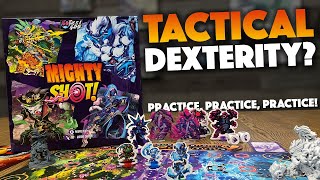
The skill-based design is described as a double-edged sword. Without luck to soften a bad game, a player who struggles with flicking can feel outclassed quickly, and the hosts were clear that the game rewards training. They suggest spending time with each mat and token weight before a first competitive match. Players who dislike physical precision, or who want a casual evening, may find the learning curve to be the main barrier. Even a self-described Crokinole fan was beaten by a better flicker in the play session, which shows how much the game depends on touch.
Dense Board Icons and an Early Information Load
The board's visual language takes time to absorb. Each space has a color, a surrounding ring, numbers, and topic symbols. One host's first reaction was that the board felt like icon overload, though the same host added that the density is not too much once the player aid is in hand. The meaning of each symbol is printed on that aid, so a newcomer will spend some early turns consulting it. Combined with the chaotic swings of the behemoth mechanic, the game can feel like a lot to digest before the first round is complete.
If You Enjoy Mighty Shot!
Readers who enjoy Crokinole will recognize the flicking core, and the hosts see a clear link between the two because of the tokens and the target zones. Dice Throne is the closest structural comparison the play session makes, since both are head-to-head contests built around distinct characters with unique powers and card play. Mighty Shot! swaps the dice for physical precision, which the hosts see as a compelling option for players who want dice-free combat. Super Fantasy Brawl appears in the preview segment as a visual and thematic reference, alongside the broader Riot style of champion games. Shuffleboard also comes up as a physical comparison, since one host joked that the shot board looked like what a Riot shuffleboard game would be.
What Reviewers Are Saying
"this is 100% skill-based, I would say, as opposed to a lot of war games or even like tactical games where maybe you're rolling dice, you're playing cards to reroll those dice. That's not happening here."
— Man vs Meeple
"So, it comes down to that skill and you got it comes down to practice, too. Like with any new dexterity gamer, especially flicking games, getting to know your mat, getting to know the weights and like practice, practice, practice before your first game."
— Man vs Meeple
"the artwork in this thing um also looks incredibly similar to something like super fantasy brawl or I think you said or any Riot property definitely inspired it definitely has that Riot sort of vibe."
— Man vs Meeple