



Monopoly Gamer Deep Dive
What the Community Thinks About Monopoly Gamer
Reviewers who played Monopoly Gamer mostly describe a loud, quick party game that trades Monopoly's slow property grind for Nintendo characters, coin theft, and a boss-driven finish. Board Game Sanctuary considers it best suited to families and younger gamers, and Board Game Replay describes it as light and party-like, fun even though it is mostly luck. Adam in Wales goes furthest in its favor, arguing that it is a real step in the right direction for Monopoly while still conceding that the final boss battle decides the winner.
The dissent is mostly about the reception rather than the play itself. The Meeple Mountain segment recounts the fan uproar that greeted the release and frames the variant as a flashpoint for Monopoly fans who had hoped for something different, ending on the narrator's line that it was the last game they ever played. Across the set, the strongest criticisms concern luck and character balance, while the strongest praise goes to the theme, the pacing, and the negotiation at the table.
Core Mechanics That Define Monopoly Gamer
Character Powers and Superstar Abilities
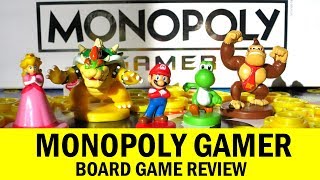
Each character brings a distinct ability that changes how the game plays. Landing on a star space triggers the character's superstar ability, and the power-up die can fire an enhanced version of an effect tied to the character. Adam in Wales highlights how sharply these differ: Donkey Kong specializes in stealing coins, Peach in collecting large rents, and Yoshi in sweeping up the coins on the board when the final boss is defeated. Board Game Replay captures a run of abilities that gathered an outsized haul, and the group jokes that the game is broken. Board Game Sanctuary also notes that the extra queen faces on the power-up die make some characters' bonus triggers come up more often, so character choice carries a real edge.
Power-Up Die and Boss Battles
Each turn a player rolls a movement die and a power-up die, and can resolve them in either order. The power-up die produces coin gains, shells that force other players to drop coins, and steals. Boss cards are flipped each time a player passes go, and the boss fight is the game's central scoring event. Players pay coins to attempt a roll that defeats the boss, the winner keeps the card and its bonus, and bosses count toward victory points. Board Game Sanctuary says the boss fights bring the game to its conclusion much more quickly, and that the gamble of spending coin on a boss gives players a reason to spend rather than hoard. Board Game Replay describes unsuccessful attempts passing around the table until someone succeeds or everyone gives up.
The Monopoly Gamer Experience
Swingy Table Talk and Negotiation
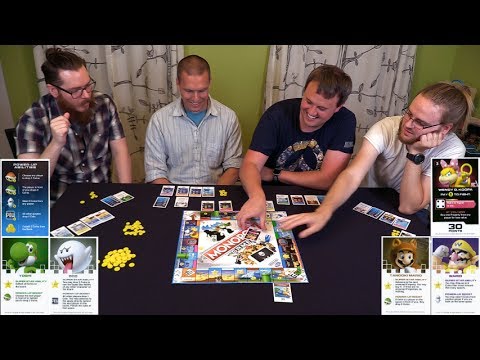
Reviewers describe a game where the board is a place to exchange money and make deals rather than to build an empire. Board Game Replay's group spends much of its session trading properties, paying debts, and yelling at one another, and the reviewer concludes that negotiation is where the most interesting decisions are made. Board Game Sanctuary says the game feels like Mario Kart on a board, while Board Game Replay compares its momentum shifts to Mario Party. That fits a game where a player who has almost nothing left can climb back within a few turns. Adam in Wales notes a related quirk: the rulebook says nothing about whether verbal promises are binding, which opens a layer of negotiation that older Monopoly versions never had.
Fast Pacing With a Built-In Clock
Most reviewers agree the game moves far faster than classic Monopoly. Boss cards are revealed as players pass go, so the game ends on a set schedule rather than playing on until one player is bankrupt. Board Game Replay credits the boss-driven timer with removing the long tail of classic Monopoly, and describes turns as quick enough that slow play feels wrong. Adam in Wales contrasts classic Monopoly, which can run three to four hours, with this version, which is over in about an hour. Board Game Sanctuary highlights the same timer effect as a major reason the game ends efficiently. Adam also warns that the decisive moment arrives at the very end, so much of the mid-game can feel less consequential than it appears.
What Makes Monopoly Gamer Stand Out
Scoring That Rewards Late Boss Fights
Board Game Sanctuary's favorite element is the scoring system. Players earn 10 victory points for every five coins they hold at the end, earn points for defeating bosses, and find that later bosses are worth more, which gives players who skipped early boss fights a way to catch up. Property points also rise as the board progresses, and properties do not need houses or hotels to matter. Adam in Wales notes that everyone is competing for points rather than money, which they see as a meaningful step for Monopoly. Board Game Replay's group shows how much this can swing a game, with one player who had almost nothing left winning three bosses in a row.
A Theme That Carries the Experience
Reviewers consistently praise the components and the theme. Board Game Sanctuary says the quality of the components evokes the Nintendo game so well, and that the coins replacing Monopoly money feel collectible. Board Game Replay describes the characters as pre-painted and very pretty. Adam in Wales finds the pieces colorful and lovely, and says the Mario theme makes the dropping of coins and jumping through pipes feel rich and enjoyable. The theme does much of the work of making a light game feel like an event, including for players who would otherwise avoid Monopoly. Board Game Replay says it would have answered "absolutely not" to playing a Monopoly game, and found this one fun.
Potential Drawbacks
Luck Dominates Decisions
Nearly every reviewer returns to luck. Board Game Sanctuary says the game is light on strategy but heavy on luck, and that players have little way to mitigate a poor die roll. Board Game Replay calls the game very random, says the fun depends on accepting that, and later says the outcome is almost entirely down to luck. Adam in Wales points out that the final boss battle depends entirely on a dice roll, so the player who beats Bowser is very likely to win. Reviewers mostly accept this as part of the appeal, but the fixed-length finish and boss-driven scoring make a single lucky roll more decisive than many players will expect.
Character Balance and Paid Expansions
Some characters look stronger than others. Board Game Sanctuary notes that playing as Mario makes the bonus power-up trigger more often because of the queen faces on the die. Board Game Replay sees imbalance in play as well, with one player's chain of abilities producing a haul the group joked was broken. The additional characters and party mode also draw criticism. Board Game Replay calls the collector's edition a bit of a money grab, since the full party mode needs many characters that are sold separately. Adam in Wales says the expansion packs have not been seen available anywhere. Board Game Replay suggests that drafting characters for party mode, with each player swapping among three characters during a turn, would reduce randomness and add strategy.
If You Enjoy Monopoly Gamer
- Mario Kart: Board Game Sanctuary says the game feels like Mario Kart on a board, with its power-up effects and movement around a track-like board where players collect coins.
- Mario Party: Board Game Replay says the game's swinginess is exactly how people describe Mario Party, with big momentum shifts and negotiation that keeps the table engaged.
- Monopoly (traditional): Board Game Replay says the game keeps the familiar properties, rent, and deal-making of the classic formula while condensing it into a few rules. Adam in Wales frames it as a way to experience Monopoly's core exchange of money and property in a faster, lighter form.
What Reviewers Are Saying
"Monopoly Gamer doesn't really feel like you're playing Monopoly at all. In fact, it feels like you're playing Mario Kart the board game."
— Board Game Sanctuary
"This was so much fun. This is Mario Party the board game. That's how swingy it is."
— Board Game Replay
"I wanted to no longer have to roll my eyes when someone asked if I like Monopoly. I wanted to be able to relate with these people so I did it."
— Meeple Mountain