/pic7431245.jpg)


/pic7431245.jpg)








Mycelia Deep Dive
What the Community Thinks About Mycelia
Mycelia has captured the attention of board game reviewers with its distinctive blend of tactile mechanics and living-world theme. Described as both immediately engaging and strategically rich, the game resonates with players who appreciate abstract design grounded in thematic authenticity. Community response emphasizes the game's accessibility alongside genuine strategic depth.
Core Mechanics That Define Mycelia
Sporing and the Wind Die
At Mycelia' heart lies a unique spore-propagation system that uses a wind die to determine spread direction across the expanding triangular board. Players place spores from their mushroom sources in triangular formations, with the wind die dictating the path each turn. This mechanic creates both thematic coherence and mechanical unpredictability. As one reviewer noted, the wind die forces interaction between players in ways traditional area control games often don't. Even when playing passively, players must manage spores drifting into opponent territory, and opponents can claim or block those spores, breaking mycelial networks and restricting future moves.
Fruiting, Decay, and the Life Cycle
The core loop revolves around three actions: sporing mushrooms to build networks, fruiting cards by spending spores from connected domains, and decaying mushrooms to unlock special abilities. Each mushroom can only spore twice before it must decay. Decay actions vary from immediate effects (removing spores from a tile) to permanent upgrades (allowing future mushrooms to benefit from upgraded abilities). Players balance rushing to end the game by filling all five player mat slots with decayed mushrooms against accumulating high-value cards for endgame scoring.
The Mycelia Experience
Abstract Design with Thematic Depth
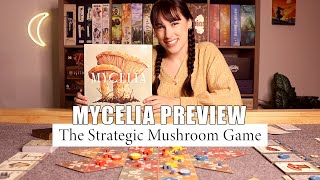
Reviewers consistently describe Mycelia as an abstract game with a thematic skin, but one that deepens rather than obscures the mechanics. The botanical accuracy of the 69-plus mushroom illustrations reinforces the strategic choices players make. Wind-blown spores feel organic rather than arbitrary, and the mycelial network concept gives genuine meaning to spatial control. Players report that the thematic framing makes the puzzle-like gameplay feel like tending a living ecosystem rather than manipulating abstract pieces.
Scaling from Two to Four Players
The game shines at two players, where area control and network disruption remain tactical without overwhelming board space. At three and four players, the competition becomes noticeably tighter and more confrontational. The expanding board (via the explore action) helps manage space, but with more players vying for the same nutrients and tile placements, the game intensifies. One reviewer noted that at higher player counts the game shifts toward active blocking and resource denial, making it potentially frustrating for players who prefer collaborative or non-confrontational experiences.
What Makes Mycelia Stand Out
Easy to Learn, Strategic to Master
Despite its moving pieces and wind die, Mycelia teaches quickly. The action structure is clear, and spore mechanics follow logical rules once explained. Yet the decision space deepens with every play. Players discover advanced tactics: blocking mother mushroom movement, timing decay actions to disrupt opponent networks, using insect tokens strategically, and reading the board state to predict wind die outcomes. The game rewards planning several turns ahead while remaining accessible to new players.
Botanical Authenticity and Beautiful Components
The game's 69-plus real-world mushroom illustrations are hand-drawn in a botanical style that elevates the visual experience. Each species is unique, and the color palette of the triangular board tiles (red, yellow, brown, green, and black for wild) creates an visually cohesive whole. Players report wanting to see the cards and board in play, making the game as much a visual delight as a mechanical one. The expansion introduces saplings and grandfather trees, adding new mechanics rooted in the mycelial symbiosis between fungi and trees, further enriching the theme.
Potential Drawbacks
Luck and Randomness in Spore Placement
The wind die introduces controlled randomness. While this creates thematic coherence and forces player interaction, it can occasionally frustrate players who prefer deterministic strategies. If the die repeatedly rolls against your network expansion plans, mitigation options feel limited. Some players described this as a strength, noting that the unpredictability keeps the game fresh; others view it as a barrier to deep long-term planning.
Meanness and Confrontation at Scale
Area control games are inherently confrontational, and Mycelia leans into this with spore theft, network disruption, and blocking mechanics. At two players this feels balanced and tactical. At four players, the game can feel directly punitive, with players deliberately sabotaging one another through mother mushroom blocking and spore theft. This is by design, but players uncomfortable with high player interaction and competitive zeal may find the experience exhausting rather than engaging.
If You Enjoy Mycelia
Consider exploring other area-control-driven abstracts like Tigris and Euphrates or Agricola, which share Mycelia's blend of thematic authenticity and spatial puzzle-solving. For players who love wind-driven mechanics, Dune or Winds of War offer similar randomization within strategic bounds. If the botanical theme and network-building aspects resonate, games like Cascadia (tile placement with ecosystem building) or Parks (tableau building with spatial exploration) may also appeal. The North American expansion, introducing saplings and grandfather trees, deepens the symbiosis theme for veteran players seeking additional strategic layers.
What Reviewers Are Saying
"It felt like playing an abstract game but it had a theme around it. It felt like playing some of those games like you know those puzzly-esque tile movement type games but it was thematic in the way that the game worked. Everything in that game felt very thematic like the way the wind dice influenced the spores, the life cycle of the fungus or the mushrooms."
— Foster the Meeple
"There is definitely a way I mean given that the wind die is a dice and it's randomized there would be instances where you could play this game at two player and it would be that wherein you just happen to roll and it does push you in different directions and then that happens but with the randomization of the dice it really again it forces that interaction. I very much like area control games and in a way that other area control at two player I feel like that would get crazy because you move your mother mushroom around and that basically gives you area control like it trumps everything else."
— Foster the Meeple
"I think it's a really nice looking game. I'm very interested in it. It's kind of abstract. The way you're building this fungi kingdom with mushrooms. The pictures I mean that's just great. Yes, that's beautiful. It looks like they really found one that's colorful and kind of captures the essence of mushrooms."
— Our Family Plays Games