





Nightmare Productions Deep Dive
What the Community Thinks About Nightmare Productions
Reviewers consistently treat Nightmare Productions as a lean, fast auction game with a horror-movie theme that gives the bidding a reason to matter. The Dice Tower's Tom Vasel, The Dice Tower calls it a reimplementation of older Reiner Knizia titles, sitting in a line of games that began as Tran Fabrique and later became Dream Factory before this horror edition from Trick-or-Treat Studios. Drive Thru Games places it directly alongside Modern Art and Medici, and John, Getting Games walks through a full four-player rules explanation that shows how much of the game rests on timing and reading the other players.
The consensus is that the core auction is the heart of the experience, and that player count matters. Drive Thru Games says the game plays smoothly at three and four players, with the five-player table feeling "a little bit too tight" for the auctions to stay satisfying. Reviewers agree that the game is quick, usually in the neighborhood of an hour, and that its rules are easy to teach. Where they differ is on how much weight to give the theme. Some treat the horror setting as window dressing on a pure bidding game, while others argue the cartoonish, cookie-cutter studio fantasy is what makes the whole package work.
Core Mechanics That Define Nightmare Productions
Auction / Bidding
Every round, players bid on the tokens sitting on the track, starting with whoever holds the start player token. Bids rise in turn, and a player who passes is out of that auction. The winner pays the bid into the middle, and the players who lost share that money evenly. John on Getting Games explains that the money never comes from outside the table, so every dollar in play is a dollar someone already holds. That closed economy is what makes the timing so tense. Drive Thru Games notes that the auction is closer to a classic Knizia-style eyeball-your-neighbor contest than to a complicated resource game, and that reading when an opponent is running low is as important as valuing the tile itself.
Reviewers also point out the interesting edge cases. Winning an auction with a bid that leaves you nearly broke can lock you out of the next several auctions, and Getting Games shows players deliberately opening bids high to drain an opponent's cash before a stronger tile comes up.
Tile Placement
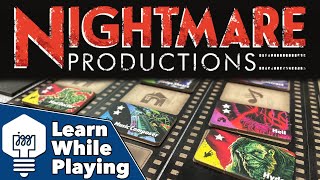
Won tiles go onto one of a player's three movie film strips, each with icon-matched slots for creatures, locations, props, directors, equipment and music. Contracts are the flexible tiles that fit almost any non-cameo slot, and cameos are optional bonus stars that the reviewers describe as a way to raise a finished film's rating. Once every required slot is filled, a movie is complete and its total star count is matched against a stack of rating tokens. Getting Games explains that the rating token is what scores at the end, and that a plus sign on a token wins ties. This placement puzzle is what turns the auction into a movie-making contest, because a tile that is valuable in the abstract may be useless on a film that already has the wrong icons.
The Nightmare Productions Experience
Interactive / Dynamic
The feeling reviewers describe most often is the back-and-forth tension of an open table. Drive Thru Games calls the whole auction phase a "little bit of chicken," because players are constantly watching how much cash others have left and waiting for the moment someone overspends. Getting Games shows the same dynamic in practice: a player with little money has to decide whether to bid just to make an opponent pay, knowing the money will be redistributed back to the table. The result, as John puts it, is that "you're kind of waiting for the right time to pull the trigger," and the table reacts to every move.
Horror
The theme never takes itself seriously, and reviewers enjoy that. Drive Thru Games describes the experience as playing a "disingenuous" movie studio that hacks together the latest horror buzzwords, mixing werewolves, mummies and killer dolls into whatever film is on the table. The cartoonish artwork and the silly studio and movie names reinforce that tone. Getting Games frames the Horror Con draft as the moment the theme becomes most vivid: players gather tiles from a row of flipped-up cameos and creatures, and the film that takes shape feels like a genre B-movie that has been assembled from spare parts.
What Makes Nightmare Productions Stand Out
The Closed Money System
Reviewers repeatedly single out the fixed pool of money as the feature that separates this game from many auctions. Drive Thru Games compares it to the old Nightmare-era games and says the closed system "makes it really cool" because there is no income phase. John on Getting Games adds that money cannot be created during play, so every bid is a real transfer between studios. That makes each decision about when to spend and when to save carry weight across the whole game.
The Worst Movie Award
Drive Thru Games calls the worst movie award one of the most interesting parts of the design. Because a player can earn 10 points for the lowest-rated film, the end of the game encourages deliberately tanking a production. Reviewers see this as a twisted but satisfying counterweight to the scoring, and they note that it rewards players who step outside the race for quality.
Potential Drawbacks
The Five-Player Squeeze
Drive Thru Games finds that the game works best with three or four players. At five, the auction becomes tight, and the reviewer says the experience can leave a player feeling behind the eight ball. The criticism is not that the game is bad at five, but that the reviewer would vastly prefer a smaller table where every player can stay involved in building productions.
Dependence on the Tile Row
Getting Games shows how a player who spends heavily early can end up with almost no money and very little to bid with for several rounds. The reviewer notes that a low cash position can make the middle of the game feel slow for that player, and that the random layout of the Horror Con tiles can make a plan collapse. For some groups, the luck of which tiles appear is part of the fun, but for others it blunts the sense that good play controls the outcome.
If You Enjoy Nightmare Productions
Players who enjoy Nightmare Productions's closed auction will find a similar satisfaction in Modern Art and Medici, which Drive Thru Games names as the closest comparisons because they share the same bare-bones bidding and the same focus on reading the table. Players who like the film-studio theme and the mix-and-match feel of the production phase will appreciate Dream Factory, the earlier edition of the same design that Drive Thru Games describes as having the same vibe with fake actors and parody names. Raw is another good match for players who want an auction game where every bid carries weight and the market is always in motion.
What Reviewers Are Saying
"It's not like an income phase where you get extra money. It's like you've got what you've got, and you've got to sort of wheel and deal kind of with the other studios in a way, but it's just a closed system, and that makes it really cool."
— Drive Thru Games
"It's right in that kind of Modern Art, Medici level where the game is just the auction, really. There's not a lot of window dressing around it in terms of mechanics. It's just a pure sort of straight eyeball your neighbor bidding."
— Drive Thru Games
"The actual game itself is really good where you are. It's a closed auction, so every auction you win, that money is split between everybody else."
— Tom Vasel, The Dice Tower