
Overstocked Deep Dive
What the Community Thinks About Overstocked
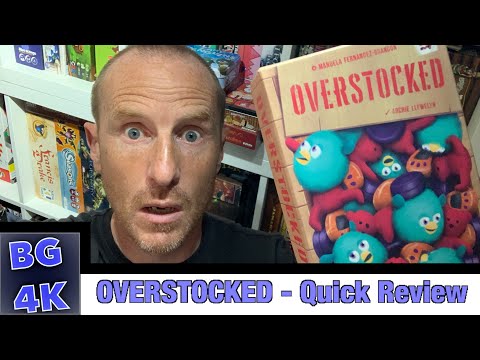
Overstocked is a short card game from Play for Keeps in which players stock a warehouse with toy crazes from the 1990s while avoiding the penalty for overstocking. The reviews that exist are mixed to negative. BoardGameBollocks described it as an average card game that offers very little in strategy, though the reviewer found its end-game scoring worth discussing and settled on a middling score. The same channel returned to the game in a later video about titles it was ready to part with, and that verdict was far harsher. The reviewer called the review copy truly awful, said it was drab and boring, and noted that the copy had no rulebook included.
Johanes, Board Gaming Ramblings took a more even-handed view while working through a batch of games in a keep-or-kill format. The reviewer found the game an enjoyable enough experience with a whimsical theme and a short runtime, but did not expect to play it again. The praise across the reviews points to a narrow set of strengths: a quick scoring round that resembles Medici, a worker element that adds some interaction, and a playtime that never overstays its welcome. The criticism covers the theme, the art direction, the logic of the scoring, and the way the board becomes cluttered as the game progresses.
Core Mechanics That Define Overstocked
The game is played over six rounds. Each player is dealt six cards showing grids of toy icons, picks one card face down each round, and then all cards are revealed at once. The lowest number goes first, and each card is placed either into the player's own warehouse or into the shared popularity area in the center of the table. Two mechanics stand out in the reviews.
Medici-Style Connected Area Scoring
The end-game scoring is the element reviewers return to most often. Players find the largest connected group of matching toy icons in their own warehouse and multiply it by the largest connected group in the popularity area. The twist that Play for Keeps built into the design is that the number produced in the popularity area acts as a negative multiplier. BoardGameBollocks said the scoring reminded them distinctly of Medici, where points track the money you collect, and spending that money is how you earn more points. Overstocked follows the same pattern, but it adds a counterintuitive penalty: crowding the popularity area with one toy can drag your final score down.
Worker Placement and Blocking
Workers are the element that adds interaction to what is otherwise a minimal card game. Cards can be placed over most of the grid, but they cannot cover workers, so players must choose placements carefully. BoardGameBollocks noted that a worker placed in a strategic spot in the popularity area can block other players from using that space, giving the game a light take-that quality. The reviewer described the effect as minimal, but it is the main source of direct player interaction.
The Overstocked Experience
Visual Overload in the Later Rounds
The most consistent complaint about the play experience is that the board becomes hard to read as rounds accumulate. BoardGameBollocks said that by the fifth round the game turns into a sea of icons, and that the reviewer found it difficult to focus on their own warehouse while also tracking what other players were building. The reviewer compared the result to a color blind test chart, describing it as a hypnotic mess in which the number one is trying to find is hidden among the others. That confusion led the reviewer to stop caring about careful placement and simply play cards wherever they fit.
Limited Control Over the Hand
Because each player works from a hand of only six cards, the reviews describe a game where luck sets the terms. BoardGameBollocks observed that players cannot manipulate which cards they receive, so they are given these random cards and must make the best of them. The reviewer felt that someone else's disruptive placement in the popularity area frequently undermined a carefully built plan, which left the experience feeling more like reacting than deciding.
What Makes Overstocked Stand Out
A Quick Six-Round Game
Even the harshest reviewer did not dispute the length. BoardGameBollocks said the game does not take too long to play, and that the six-round structure keeps the experience from dragging. The reviewer described the runtime as the right length for a game of this type, which is an important point for a title whose main virtue is that it is brief and easy to finish.
Tense Last-Turn Reversals
Despite the mixed verdict, Johanes, Board Gaming Ramblings described a game that produced real drama. The reviewer spent much of a session in a position to take heavy negative points, then used the final turn to place a card well, scoring a large positive total while another player took a penalty of 50 points. The reviewer said that moment made the game enjoyable and admitted to liking it more than expected. The swings the scoring creates are what gave that session its tension.
Potential Drawbacks
Theme and Artwork
The theme and the art direction drew the sharpest criticism. BoardGameBollocks said the theme of 1990s toy crazes feels bizarre and will appeal only to a narrow audience. Players who were not born in that era may not recognize many of the toys, and the reviewer struggled to identify several of the icons. On the visual side, the reviewer said the box looks professional, but the card art uses washed-out pastel tones and muted beige shades that make the cards look unappealing. The reviewer noted that their copy might not match the final production, but the criticism still rests on the review copy. Because the reviewer had also received a copy without a rulebook, the reviews make clear that the presentation of the review copy fell short in more than one way.
Scoring Logic and Limited Depth
The reviews question whether the scoring makes sense as a theme. In BoardGameBollocks, the reviewer argued that penalizing the most popular toy is hard to justify, because the goal of the game is to get stock into the warehouse. The reviewer summarized the problem by imagining a supervisor asking why so much of one toy was ordered, which is a reasonable question but one the rules do not answer. Combined with the six-card hand and the limited number of decisions, the reviewer concluded that there is not really enough strategy in the game to sustain repeated play.
If You Enjoy Overstocked
BoardGameBollocks compared the game directly to Medici, asking why anyone would play Overstocked when they could simply play Medici. The comparison is grounded in the scoring: both games turn collected value into points through spending decisions and a final tally. Players who enjoy the money-to-points twist in Overstocked will likely find Medici a deeper version of the same idea, with more room for strategy than the reviewer found in Overstocked.
Beyond Medici, players drawn to the quick scoring and the blocking interaction in Overstocked may enjoy other short, tightly scored card games where a single late placement can change the outcome. Those recommendations go beyond what the reviewers specifically said, so they are best approached as starting points for further research rather than as endorsements from the reviews.
What Reviewers Are Saying
"The score mechanism doesn't really make any sense, does it? The way it works is that you're gonna get negative points for the most popular toy."
— BoardGameBollocks
"We had a really tense game where I was in the position to get a lot of negative points for a long time, and I managed at the last turn to put a card in a good position and make myself score a lot of positives. Another player got negative 50 points for that."
— Johanes, Board Gaming Ramblings
"Here's a game that was sent to do a review and it's truly awful. It's a game called Overstocked. Funny enough, they didn't even bother to put a rulebook in this one. It looks awful."
— BoardGameBollocks