



Ozob: A Cyberpunk Board Game Deep Dive
What the Community Thinks About Ozob: A Cyberpunk Board Game
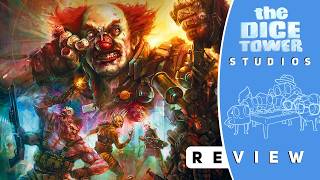
Reviewers agree that the theme is the first thing that draws people in. Ozob: A Cyberpunk Board Game adapts a character created in Brazil during the 1990s, a clown with a live grenade for a nose who also appeared in Cyberpunk 2077, and the setting of corporations, gangs, and a neon-lit city gives the box a strong identity. Where opinions diverge is on originality. Z Garcia of The Dice Tower scored the game an 8 out of 10, calling it good and recommended, while arguing that it is not quite excellent and that its mechanisms feel borrowed. The One Stop Co-op Shop, in its Shelf Life segment, described it as pretty good and rooted in the same family as Death May Die and Zombicide, with enough scenario variety and level-up structure to earn another play. Tom Vasel of The Dice Tower, while previewing an early copy at Gen Con, noted that the game had been teased for a while and that the channel had already covered it on Crowdsurfing.
Core Mechanics That Define Ozob: A Cyberpunk Board Game
Push-Your-Luck Attribute Flipping
Each turn begins with the active crew member revealing cards from a shuffled attribute deck, adding their bonuses to a running total until the player chooses to stop or busts. Reviewers describe the bust as the central tension. Z Garcia explained that revealing a third crossed-out card forces the player to stop immediately, and the character still takes the turn but loses two health. Because health and the energy used for rerolls share a single slider, the marker that drops after a bust also governs how much rolling the character can do. Z Garcia called the result a pushing-your-luck system in which some turns feel tremendous and others collapse after a couple of bad flips, and the reviewer valued the swings even while noting that it limits control.
Locked Dice and Energy-Based Rerolls
Combat and skill checks resolve with dice that carry success, miss, and lock faces. A locked face cannot be rerolled, while the other faces can be rerolled by spending energy from the shared slider. Z Garcia noted that a weapon such as Shamira's katana can add an extra die after a movement action, so the number of dice a turn produces depends on the choices made earlier in the same turn. The reviewer praised the lock concept specifically, describing the way dice can get stuck on a hit or a miss as a fresh idea within a familiar framework. The three-action turn structure, covering movement, bribing or hacking checks, and attacks, gives this dice system room to matter every round.
The Ozob: A Cyberpunk Board Game Experience
Swinging Luck and High Highs, Low Lows
Reviewers describe playing Ozob as an experience of sharp peaks and valleys. A strong run of attribute flips can carry a character through several enemies and onto the Road to Fame track, where defeating foes grants fame, items, and new cards for the character's deck. A bad flip early in a turn can leave the player working with a diminished pool of dice and a lower health total for the rest of the round. Z Garcia said they embrace the high highs and low lows, but also warned that anyone who wants a firmer sense of control will find that this game does not provide it. The reviewer contrasted it with Cthulhu Death May Die, which they felt gave players more agency over their outcomes.
Gritty Cyberpunk Atmosphere
The setting carries much of the experience. Z Garcia described the game as adult in tone, with strong language and a hardcore, unapologetic cyberpunk setting, and they noted that the theme is what first attracted them to the box. The look of the components reinforces that identity, with the mission boards styled to resemble grainy surveillance footage and labeled with camera numbers. Shelf Life called the Cyber Punk theme pretty fun and cited it, alongside the level up system and scenarios, as the reason to give the game another play.
What Makes Ozob: A Cyberpunk Board Game Stand Out
Restraint in Design
The most consistent point of praise from Z Garcia is that the designers did not overload the game with ideas. Given the chaotic energy of the theme, the reviewer expected a box stuffed with mechanisms and instead found a design that is careful about what it includes and what it leaves out. Z Garcia compared this discipline favorably to Cthulhu Death May Die, saying that both games are flavorful while still showing restraint, and concluded that the result feels more focused than the subject matter would suggest. The reviewer described the game as a whole as fun, well put together, and driven by clear choices from the designers.
Art Direction and Table Presence
Reviewers consistently highlight the visual design. Z Garcia called the artwork on nearly everything very good and praised the graphic design and iconography, and they singled out the dice as awesome. The mission boards, which assemble into the play area, look like camera footage with a grainy finish, which the reviewer described as a silly detail that nonetheless deepens the cyberpunk atmosphere. The visual identity is a consistent thread across the reviews, and it is the element that reviewers were most willing to praise without reservation.
Potential Drawbacks
Derivative Mechanics
The most substantive criticism comes from Z Garcia, who found the game's mechanisms not very original. The reviewer said the card flipping immediately recalled Mystic Veil, and that many other systems, including the mission design, dice rolling and rerolling, and sticky enemies that follow characters when they move past them, felt similar to Cthulhu Death May Die. The reviewer was clear that this is not a dealbreaker, because the new ideas such as the locked dice and the cycling spawn points are enjoyable, but the overall impression is that the game is derivative. Shelf Life made a related point, comparing Ozob directly to Death May Die and concluding that it does not reach that standard for them, although they still found it worth replaying.
Production and Table Handling
Z Garcia identified several production concerns. The shared slider on the plastic player tray is annoying to move, because the health and energy tracker shifts constantly during play, unlike the one-directional tracker in Zombicide, and the reviewer felt the tray is not well suited to that frequent movement. Many miniatures in the box have warped bases that cause them to rock on the board, and the reviewer described their quality as acceptable rather than impressive. Downtime is another concern, since each player works through the full sequence of flips, actions, and events on their own turn. Z Garcia said that the game feels slower than comparable titles with four players and recommended two or three as the sweet spot.
If You Enjoy Ozob: A Cyberpunk Board Game
Players who enjoy Ozob's push-your-luck attribute flipping will find a similar tension in Mystic Veil, where turning cards over until you choose to stop is central to the experience. Players who appreciate the sticky enemies, the mission structure, and the dice rerolling will recognize much of the same design feel in Cthulhu Death May Die, which Z Garcia described as similar in its mechanisms and more controlling of outcomes, and which the reviewer said they love. Players drawn to the board-driven skirmish feel, the scenario variety, and the crew-of-heroes premise will find a related rhythm in Zombicide, which Z Garcia said clearly inspired the board design and which One Stop Co-op Shop described as Zombicide-ish in its overall feel. Death May Die is the natural comparison for anyone who wants the same cooperative scenario play with a sharper sense of control over the outcome.
What Reviewers Are Saying
"It is very obvious that they are being careful with their decisions of what to put in the game and what not to put in. That the game in some twisted way kind of feels minimalist."
— Z Garcia, The Dice Tower
"And this one is very Death May Dieish, like Zombasicide-ish. That's definitely what they were going for. It's got these different scenarios and different heroes you can play and different enemies and it was pretty good."
— One Stop Co-op Shop
"One little thing that I love is that the boards which you use to make up the map you're playing on look like camera footage. They have that sort of grainy look."
— Z Garcia, The Dice Tower