/pic1196191.jpg)
/pic6091316.jpg)
/pic1805937.jpg)
/pic4287832.jpg)
/pic1196191.jpg)
/pic2482309.jpg)
/pic3564805.jpg)
/pic4023671.jpg)
/pic4748836.jpg)

/pic6940547.jpg)
/pic6619019.jpg)
/pic7177337.jpg)










































Zombicide Deep Dive
What the Community Thinks About Zombicide
Zombicide occupies a unique space in the horror cooperative gaming landscape. Reviewers emphasize its flexibility and accessibility while acknowledging the intense challenge it presents to players. The game strikes a careful balance between straightforward mechanics and emergent narrative, creating memorable moments that linger long after the final zombie falls. Community sentiment recognizes Zombicide as a toolkit that adapts to different gaming groups, rewarding both casual players seeking entertainment and serious enthusiasts demanding strategic depth.
Core Mechanics That Define Zombicide
Modular Board Design
The modular board system allows for infinite replayability through tile arrangement and scenario configuration. Each game board is constructed from separate tiles that can be arranged differently depending on the scenario, creating fresh layouts that prevent the experience from feeling repetitive even after dozens of plays. Reviewers highlight how the modular approach enables scaling from quick, story-driven sessions to extended campaigns across multiple scenarios. The flexibility also permits players to house-rule and customize the board setup, making Zombicide accessible to groups with varying preferences for complexity and playtime.
Cooperative Combat with Dice Resolution
Combat resolution relies on rolling dice against zombie threats, with player weapons determining hit thresholds and damage potential. The dice mechanic introduces genuine tension and unpredictability, ensuring that even well-planned strategies can unravel when rolls fail. Survivors find weapons throughout the game world, each with distinct combat profiles ranging from silent melee options like crowbars to loud firearms. The progression from improvised tools to devastating weaponry creates a satisfying power curve as players search rooms and equip survivors with better equipment, though reviewers note that weapon availability remains partially randomized, maintaining challenge throughout the game.
The Zombicide Experience
Chaotic and Frantic Gameplay
Zombicide creates urgency through escalating zombie spawns and noise mechanics that punish careless action. The game intensifies rapidly as survivors fire weapons, open doors, and move through the environment, each action creating noise that attracts shambling hordes. Danger levels increase during the game, spawning more zombies in larger groups, transforming early-game optimism into desperate last stands. The unpredictability of which zombies appear and where they spawn keeps players reacting rather than executing perfect plans. This chaos becomes thematic rather than frustrating, with experienced players learning to embrace the disorder and adapt on the fly.
Collaborative Problem-Solving
Survivors must coordinate their actions to achieve objectives while managing limited resources and dangerous board states. Players balance offensive pressure against defensive positioning, deciding which survivors search rooms for weapons versus who holds the line against zombie attacks. Trading items between survivors creates strategic choices about resource distribution, and special abilities encourage different survivor roles. The hidden information about objective placement and zombie spawn results means that communication and collective decision-making become as important as individual mechanical execution, reinforcing the cooperative nature of the experience.
What Makes Zombicide Stand Out
Rich Expansion Ecosystem
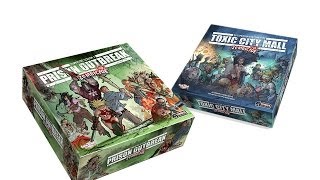
Zombicide boasts an extensive library of expansions and scenario packs that provide thematic variety and mechanical depth without requiring a complete game reset. The base game includes numerous scenarios on included cards, and additional expansions introduce new survivors, weapons, zombie types, and themed environments. Expansions like Toxic Sewers, Rue Morgue, and Prison Outbreak layer new complexity while maintaining mechanical consistency. Reviewers appreciate that new content scales difficulty and introduces fresh strategic challenges, preventing the base game from staling even after repeated plays. The vast scenario library means dedicated groups can find content supporting months of gameplay.
Accessible Rule Structure for Complex Experiences
Despite handling many mechanical systems, Zombicide maintains relatively straightforward core rules that new players learn quickly. Turn structure follows a clear pattern: survivors activate sequentially, zombies respond predictably, and resolution mechanics use intuitive dice rolls. The app available for gameplay assists with complex administrative overhead like zombie spawning, reducing mental load and allowing players to focus on tactical decisions. This accessibility invites casual players while respecting veteran players with house rules and variant options that add nuance, making Zombicide scale gracefully across experience levels.
Potential Drawbacks
Targeting Mechanism Complexity
Some mechanics, particularly around zombie targeting and line-of-sight resolution, contain fiddly rules that require careful reading to execute correctly. Reviewers note that while the core systems function well, specific edge cases around how zombies navigate spaces and determine targets can confuse newcomers. The noise token system adds thematic richness but demands player attention to track which survivors create audible threats. House-ruling these mechanisms is common and often encouraged by the community, suggesting that the default rules could streamline these aspects without losing strategic texture.
Difficulty Swings and Balancing Challenges
Zombicide's difficulty can fluctuate dramatically based on dice rolls and spawn luck, occasionally creating scenarios that feel unwinnable early or trivial if survivors find powerful weapons quickly. The escalating danger levels mean that late-game rounds intensify dramatically, sometimes eliminating survivors in rapid succession. Reviewers acknowledge that the game occasionally produces runaway situations where one lucky find or unlucky spawn determines victory, reducing meaningful decision-making in affected moments. Despite this, the toolkit nature of Zombicide allows groups to adjust scenario rules or difficulty settings to match their preferred challenge level, mitigating these concerns through customization.
If You Enjoy Zombicide
Players drawn to Zombicide's cooperative zombie-slaying mayhem will find kindred experiences in Dead of Winter, which layers hidden traitor mechanics atop survival themes, and Gloomhaven, which provides tactical combat in a modular campaign structure. Pandemic offers cooperative crisis management with similar escalation mechanics, while Arkham Horror: The Card Game delivers thematic horror investigation with recurring scenarios. For those seeking modern asymmetric gameplay, Shadespire provides squad-based tactical combat, and Zombicide's video game adaptation extends the franchise into digital format for solo zombie hunting.
What Reviewers Are Saying
"Zombicide is a toolkit that allows you to mold the game to you like in and you can have a great laugh with that."
— BoardGameBollocks
"It's a vast game you could set this up anyways why you want and it will never get old is it it can be a bit hard there's a few clunky rules with the targeting mechanism but you can house roll that out and put in your own rules for that."
— BoardGameBollocks
"When you get the gasoline you can combine that with the glass bottles to get the molotov all right so uh let's do that let's let's get the uh gasoline here."
— Watch It Played