







Zombicide: Green Horde Deep Dive
What the Community Thinks About Zombicide: Green Horde
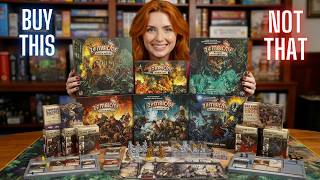
Reviewers consistently present Zombicide: Green Horde as a cooperative game in which the table itself is the opponent. In a Kickstarter roundup, the channel cardboardrhino described it as a standalone game that is also fully compatible with the earlier zombie side releases, with survivors gaining weapons and spells while the game controls a growing wave of orc zombies. The more experienced the heroes become, the more zombies rise to meet them, and that tension is the core of the pitch.
The most detailed walkthrough comes from Watch It Played, which played a prototype copy during a Kickstarter campaign and was clear that final components would differ. Their session shows where the community's opinions concentrate: the new horde system, the way combat and noise shape the zombie movement, and how quickly the threat escalates once a Necromancer appears. Other reviewers focus on the cooperative feel and the miniatures. Drive Thru Games called it a really good co-op with a satisfying spatial puzzle, and ON TABLE Board Games ranked the broader zombie side series among its favorite dungeon crawlers because it is easy to teach to casual players.
Agreement is strong on the basic appeal and on the difficulty. The open question is how much the random escalation rewards careful planning and how much it simply punishes a bad draw, and the reviews in this set land on both sides of that line while still praising the core design.
Core Mechanics That Define Zombicide: Green Horde
The Horde
The defining mechanic of Zombicide: Green Horde is the horde itself. When new zombies spawn, some spawn cards show a symbol that tells the table how many zombies of that type to move into an off-board area dedicated to the horde. Watch It Played explained that the horde keeps growing while spawns are resolved, and it stays off the board until a card instructs players to "Enter The Horde." At that moment, every stored zombie floods into the space that originally spawned them. The payoff is that other spawning stops for that round, which BoardGameGeek highlighted as a relief, even though the resulting cluster of zombies is a serious problem. Necromancers push this system further. A Necromancer escapes toward the nearest spawn token, converts it into a permanent spawn, and the game is lost if six spawn tokens accumulate on the map.
Experience-Gated Equipment and Hero Progression
Heroes earn experience by killing zombies, and that experience drives both their abilities and their equipment. Each piece of gear shows a diamond in a specific color at the top, and the item can only be used once the hero reaches that experience tier. In the Watch It Played session, a hero who had just reached the blue tier could not use the Lava Burst, because the diamond had been removed, and fell back on a weaker telekinetic blast. Higher tiers unlock new abilities, and the track wraps around into an "ultra red" mode, so long-running heroes keep gaining options. Watch It Played also noted that matched equipment sets, such as a Norse sword and shield, grant extra benefits when used together.
The Zombicide: Green Horde Experience
Foreboding
The game feels like a clock that is always ticking. Watch It Played described the first scenario as already underway with orc zombies hot on the party's heels, and their turns ended with the zombie phase looming over every decision. When the horde finally unleashes, the mood shifts sharply. BoardGameGeek summed up the experience by calling the horde "killer" because it "keeps building up," and noted that the orc walkers hit for two while the abomination can kill most heroes with a single hit. That pressure is what makes the game feel like a race against inevitable doom rather than a series of isolated fights.
Collaborative
Despite the threat, the experience is firmly cooperative. ON TABLE Board Games emphasized that the game is cooperative, so players can help one another, and that everyone tends to have a lot of fun in the adventure. Drive Thru Games described the feeling as putting out fires, with players working together to set themselves up so fires never start. Shared decisions, such as using a noise token to lure zombies away from a hero, turn the table into a joint planning exercise rather than a contest between players.
What Makes Zombicide: Green Horde Stand Out
A Growing Family of Zombie Games
Reviewers repeatedly stress that Green Horde plugs into a larger system. Watch It Played noted that the game is set in the same universe and timeline as Zombicide: Black Plague and is fully compatible with it, while still working as a standalone experience. ON TABLE Board Games described mixing Black Plague, Green Horde, and the Invader release as one continuous dungeon crawl. That modularity gives groups a long runway of content, and it is a major reason reviewers see the series as more than a one-off release.
Table Presence and Miniatures
The figures are a frequent highlight. Drive Thru Games praised the detailed miniatures and the way the painted models make the game enjoyable to set up and play, and it specifically appreciated the orc zombies because they add variety compared with the all-human zombies of earlier entries. Watch It Played also pointed to the variety of sculpts within each zombie type, which keeps the board visually distinct from one scenario to the next.
Potential Drawbacks
Swingy Difficulty and Punishing Escalation
The most common criticism is that the difficulty can swing sharply. Watch It Played described surviving the first round "barely," and once a Necromancer and an "Enter The Horde" card combine, the board can become overwhelming in a single turn. BoardGameGeek likewise described the horde as "tough," which points to the same concern: a bad draw can cascade into a loss faster than the group can respond. Reviewers who enjoy the escalation still tend to note that the margin for error is thin.
Rules Tracking During Play
Green Horde asks players to track a lot of state at once. Watch It Played noted the need to watch line of sight through hedges, to place noise tokens after loud actions, to respect friendly fire priorities, and to check each equipment tier. The session also showed players referring to the instructions on the bottom of the cards as each new zombie type or spawn rule appeared. Groups that want fast, low-friction turns may find that the bookkeeping slows the game more than the rulebook itself would suggest.
If You Enjoy Zombicide: Green Horde
Players who enjoy the horde's escalating pressure will find a close relative in Zombicide: Black Plague, which shares the same universe and is fully compatible with Green Horde. Reviewers describe Black Plague as the refined version of the original system, so it is a natural next step for anyone who wants more of the same flavor. Players who value the cooperative tension and dense atmosphere might also consider Kingdom Death: Monster, which a Going Analog quiz described as a highly rated, nightmarish co-op game, and Gloomhaven, whose compact Jaws of the Lion version the same channel referenced in its trivia round. For players who loved the dungeon crawl loot and the sense of growing heroes, ON TABLE Board Games compared Massive Darkness to the zombie side series and recommended it as a similarly strong option.
What Reviewers Are Saying
"So I picked up the Green Horde, and I was like, wow, this is really fun. This is a really good co-op, and the scenarios that I've played of it are really cool."
— Drive Thru Games
"This one says Enter The Horde. This is bad. This means we now take all of the zombies we've been collecting in The Horde space and they go into the space that spawned them. The Necromancer has truly summoned an army for us to deal with."
— Watch It Played
"I also appreciate the entire zombie side series for being a dungeon crawler that I can easily play even with completely casual players because the roles are easy to explain. The game is cooperative so we can help each other and everyone has a lot of fun in this kind of adventure."
— ON TABLE Board Games