






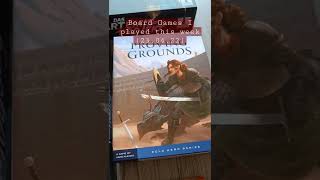
Proving Grounds Deep Dive
What the Community Thinks About Proving Grounds
Proving Grounds is a solo dice game designed by Kane Klinko and published by Renegade Game Studios. The premise is a trial by combat. The player takes the role of Maya Strongheart, falsely accused of murder, who must survive an arena full of enemies to prove her innocence. Reviewers agree on the setting and the presentation, but they split sharply on the gameplay. Rodney Smith, Watch It Played walks through the full setup and rules in a straightforward teaching video, and notes that the box includes an illustrated short story that explains how the hero ended up in the arena.
Players who enjoy a short, pressured solo session come away positive. Sir Thecos lists the game among their recent plays and calls it a really interesting real-time solo game. Board Games UnLocked praises the production in its top 100 discussion and estimates that a typical game takes about ten minutes. In a separate video on games that need expansions, the same channel places the game on the list and argues that the base box already contains modules that an expansion could build on.
The negative side is just as direct. In a Board Games UnLocked video on games the hosts do not like, the host says the game never worked for them and describes it as a game they despise. The complaints center on the randomness of the enemy deck and the one-minute clock. Reviewers who like the game and reviewers who dislike it are often describing the same features, so the disagreement is really about whether the pressure feels exciting or unfair.
Core Mechanics That Define Proving Grounds
The Dice Pool, Sets, and Rerolls
Each round begins with a dice pool. In the training game, the player starts with a green die, a yellow die, a blue die, and five white dice. Rodney Smith, Watch It Played explains that the player rolls the whole pool and then sorts the results into groups of matching numbers. A group of dice that share a value is called a set, and the player can reroll one set at a time, choosing whether to keep rolling it or to stop. Reviewers do not describe the reroll rule identically. Board Games UnLocked describes the rule as rerolling only the singles, the dice that do not match any other die, which shows how much the rule depends on reading the rulebook carefully before the timer starts.
Rolling continues until the player decides to stop or the timer runs out. Renegade has a companion app with a built-in timer, and reviewers note that any one-minute timer will work. The clock is what gives the game its character, because every decision has to be made while the dice are still moving.
Assigning Dice to Enemies and Wounds
The enemies sit in spaces around the hero, and each one has a battle marker on a track. An enemy is defeated by assigning dice whose total meets its requirement, and some enemies also require a particular color. When the requirement is met, that enemy's marker moves forward. A die that has already been used cannot be used again, so leftover dice must go to other enemies or stay in the pool. If an enemy goes unmet, its ability resolves against the hero, and the resulting damage is placed on the exhaustion track. A full exhaustion track costs health, so the player has to decide each round whether to chase an enemy or to protect the track. Rodney Smith explains this sequence in order, and the rules show how each roll feeds directly into the damage the hero takes.
The enemy deck is shuffled and drawn at random, so the player never knows which combination of requirements will appear. That is where the dice and the deck interact. A hard enemy that requires three dice, with another demanding a specific color, can consume the whole pool before the rest of the board is handled.
The Proving Grounds Experience
Pressure From the Clock
Board Games UnLocked describes the one-minute timer as real time and says the app's sound and light give the session an atmosphere. Players who like real-time games will recognize the feeling of rolling as quickly as possible while the timer counts down. Each round is short, and that brevity is part of the appeal for players who want a solo game that fits a break in the day.
Helplessness Under a Crowded Board
The opposite feeling appears when the board fills up. The host of Board Games UnLocked describes a session in which the timer did not allow enough time to allocate dice before the next enemy arrived, and says that the enemies surrounding the hero made every decision feel forced. The difference between a tense puzzle and a loss of control comes down to how much room the player has to respond. The same host argues that a slightly longer timer, or more chances to reroll, would have given the player a real opportunity to finish the enemies they faced.
What Makes Proving Grounds Stand Out
Production and Presentation
Reviewers spend a good deal of their positive commentary on the look of the game. Board Games UnLocked says the production is awesome, and the companion app adds ambient sound effects to the timer. Rodney Smith, Watch It Played points out that the illustrated short story gives context to the combat before the first roll. The Board Games UnLocked host also notes that it is the first in a series of solo-only games from Renegade, which gives the publisher a clear identity for players who want more solo options.
Optional Modules and Variety
The base game is only part of the package. Rodney Smith explains that the optional modules increase variety and difficulty, and that the companion app lets a player choose which modules to add through an advanced game option. Rodney Smith covers the Dragon module, where a dragon die can be rerolled whenever a set would be rerolled, and the Shields module, which forces the player to reroll all non-white dice when an enemy raises its shield. The Sun and Moon module adds bonuses for hitting enemies directly in front of the hero and penalties for those the hero misses, which turns the hero's facing into a strategic choice. Board Games UnLocked describes a similar module in which the player rotates a dial to face the enemies, since enemies behind the hero are more dangerous.
Potential Drawbacks
Randomness That Outweighs Choice
The most serious complaint comes from the host of Board Games UnLocked, who says the game relies solely on randomness and luck. The reviewer describes a run where the dice never went their way and where the hard enemies that appeared at random were too difficult to defeat in the time allowed. For players who want strategy to matter more than the roll, this is a fundamental problem rather than a tuning issue. The same reviewer suggests that more time to allocate dice would have made the difficulty feel fair.
Limited Content in the Base Box
Some reviewers look at the base game and see a foundation rather than a complete experience. The Board Games UnLocked host who placed the game on the expansion list wants an expansion, reasoning that the modules already in the box show how much more the design could support. Players who want more enemies and new situations to fight will find that the base box alone may not satisfy them, which is why the expansion argument comes up in that discussion.
If You Enjoy Proving Grounds
Players who like the idea of dice combat under time pressure should look at Project Elite. The host of Board Games UnLocked compares the frustration of Proving Grounds to playing Project Elite solo, so the comparison gives a sense of how the two designs feel under the clock.
Players who value difficulty that comes from the enemy deck and the luck of the draw will recognize the approach of Ghost Stories. The same reviewer brings up Ghost Stories when explaining that the difficulty in Proving Grounds comes from randomness rather than clever design, which makes it a useful comparison for anyone deciding whether that style suits them.
What Reviewers Are Saying
"These are optional modules that you can use to increase the variety and difficulty as you play."
— Rodney Smith, Watch It Played
"I hated this game so much, man. It's just, I tried it. I was like, okay, I'm gonna keep trying, I'm gonna keep trying. And it just never worked for me. Just the dice never went my way, so I just, I didn't have fun at all playing this."
— Board Games UnLocked
"Then I played Proving Grounds, a really interesting real-time solo game."
— Sir Thecos