





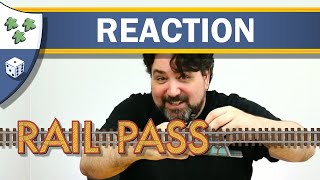


Rail Pass Deep Dive
What the Community Thinks About Rail Pass
Rail Pass occupies a genuinely rare niche in board gaming. Reviewers across channels describe it with infectious enthusiasm tempered by honest acknowledgment that this cooperative dexterity game is not for everyone. The consensus is clear: if you like physical chaos, silent coordination under pressure, and 10 minutes of laughter with friends, Rail Pass is brilliant. One reviewer called it "ridiculous in the best way possible," while another noted it should be a finalist "for sheer uniqueness in game vision." The game generates vocal evangelism from those who get it, even as players acknowledge that the design appeals to a very specific appetite for coordinated mayhem.
Core Mechanics That Define Rail Pass
Pick-Up and Deliver with Dexterity Constraints
Rail Pass forces players into a delivery puzzle with a physical twist. Colored cubes (cargo) must reach matching destination cities within the 10-minute timeframe. Players physically load cubes onto small plastic trains at their home stations, then physically pass those trains across the table to neighboring players in order to transport cargo closer to its destination. The mechanic is pure spatial problem-solving: you see which cubes need to go where, but you can only load from the ends of your cube row, forcing imperfect choices. The dexterity element emerges naturally from the physicality. If cubes fall off during a train handoff or passage through a tunnel, they are lost cargo, triggering point penalties. One reviewer described the moment of realization: "Your cubes come in two different ways. You have a snake essentially, and you can only take from the ends of your cube train."
Simultaneous Action with Communication Blackout
All players act at the same time without turn order. This creates the texture of real-time cooperation. But Rails Pass imposes an unusual constraint: players have no voice. The only permitted sound is a train whistle announcement ("choo choo" or "toot toot") to alert others to an incoming train. No planning, no negotiation, no apology when mistakes cascade. One reviewer explained: "You can't talk. You can't communicate... all you get to say is choo choo." This silence forces non-verbal coordination. When a train arrives in your hands, you must decide instantly whether to unload, reload, or pass it on to the next station. The pressure is time and attention, not points or hidden information. What emerges is coordinated chaos, but the game never feels relentlessly stressful like real-time games focused on individual achievement. The cooperative goal keeps the energy shared rather than competitive.
The Rail Pass Experience
Controlled Chaos That Never Spirals into Stress
Reviewers were careful to distinguish Rail Pass from Escape: Curse of the Temple or other real-time games that can feel frenetic. One noted: "It's not one of those games where you're roll roll do this do that you're not screaming... it never feels super hectic." The 10-minute format and simplified decision tree allow the chaos to breathe. You are not juggling dozens of cards, competing for resources, or watching a timer for phase-based penalties. You are moving trains and cubes within a tight window. The physical nature of the game means mistakes are visible, immediate, and funny rather than punitive. When a train tips and spills cubes, everyone sees it happen. The moment becomes a shared laugh rather than a silent frustration.
The Weak Link Becomes the Story
Rail Pass has an elegant way of surfacing player skill differences. One reviewer observed: "Immediately you realize there's a weak link at your table and that's what makes it so much fun." This is not ruthless elimination but affectionate recognition. The player whose hands are less steady, or whose spatial sense lags, becomes the focal point of collective effort. Everyone rallies to help them succeed. The game's cooperative structure transforms a liability into a source of shared purpose and laughter. It is a game about mutual support dressed up as a train delivery puzzle.
What Makes Rail Pass Stand Out
Genuinely Unique Genre Combination
One reviewer issued a direct challenge: "Can you name like ten real-time cooperative dexterity games off the top of your head?" The answer is likely no. Games combine one or two of these elements frequently. Real-time puzzle games exist. Cooperative games are common. Dexterity games have a niche following. But the intersection of all three, cooperative real-time gameplay that requires physical coordination, is nearly vacant. Rail Pass fills that space with confidence. The combination forces a specific kind of table interaction: you cannot hide behind cards, and you cannot succeed alone. Every player's hands and attention matter visibly.
Perfect Length and Tone for Its Niche
At exactly 10 minutes, Rail Pass respects attention and energy. It does not overstay its chaotic welcome. Players can dive in without commitment, play multiple rounds, or end the evening on a high note. The tone is inherently silly (railway announces, cubes tumbling off trains, hands holding multiple trains at once) but grounded in real mechanics. Reviewers called it "a little gem" and "one of the best convention games" precisely because it delivers novelty without demanding repeated plays or heavy rules overhead. It works as a party breaker, as a convention discovery, or as a palate cleanser between heavier games.
Potential Drawbacks
Real-Time Dexterity Is Not for Everyone
One reviewer was transparent about personal fit: "This is a very unusual game that fits into an odd niche and it's a niche of games that I myself don't really enjoy." Real-time games create anxiety in some players. Dexterity elements amplify that discomfort. Players with motor skill limitations or anxiety around time pressure may find the experience punishing rather than fun. The game does not offer a "slow mode" or modified rules for different comfort levels. If silence and physical coordination under time pressure feel stressful rather than playful, Rail Pass will not be enjoyable.
Physicality Requirements Exclude Some Tables
The game demands hands-on engagement and requires standing or reaching across the table during play. Players with limited mobility or those unable to hold and manipulate small components will find barriers to participation. Unlike card games or abstract strategy games, there is no workaround for physical limitations built into the core design. The novelty and charm of Rail Pass emerge directly from the physical act of handling trains and passing them between players.
If You Enjoy Rail Pass
Rail Pass shares DNA with real-time cooperative games like Escape: Curse of the Temple and Space Lair. If you gravitate toward these, Rail Pass offers the fastest entry point and the lowest pressure, pure fun without the sting of failure. For dexterity games, Maple Circus and Tokyo Highway offer different tones but similar physical engagement. Animal on Animal provides stacking and balance puzzles in a smaller format. For cooperative real-time experiences, 9 Times Panic (a variant on Just One) captures the communication constraint and time pressure without dexterity, allowing you to test whether the silent race against the clock mechanic appeals before committing to a physical game.
What Reviewers Are Saying
"Rail Pass is a ridiculous 10 minutes of fun that I really think shouldn't be overlooked. It's hectic chaos, players do this by taking their actions simultaneously in any order and repeating any action as often as necessary, but while all this is going on players must avoid dropping or spilling their cargo, literally because this is a dexterity game as well."
— Watch It Played
"It never feels super hectic. It's not one of those games where you're roll roll do this do that you're not screaming, especially because you can't even talk."
— Tabletop Tolson
"It's 10 minutes of absolute chaos and most importantly fun. Rail Pass is just a little gem—it's not something I need to play all the time for sure, but at convention Rail Pass might be one of the best convention games out there."
— Watch It Played