





Rainforest City Deep Dive
What the Community Thinks About Rainforest City
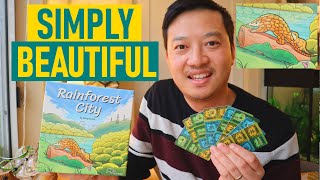
Rainforest City has earned consistent praise from the board gaming community as an underrated gem that brings something refreshingly different to the hobby. Board Game Dad, a prominent reviewer who has featured the game multiple times, calls it fantastic and completely underrated, noting that it stands out precisely because it offers a new take on game design from outside the dominant European games tradition. Board Game Sanctuary's Danny describes it as a cozy game with a strong theme and message, highlighting its appeal to players seeking both accessibility and depth. What unites these perspectives is recognition of the game's elegant design, its meaningful integration of theme with mechanics, and its effectiveness at creating meaningful choices, despite, or perhaps because of, its intuitive ruleset.
Core Mechanics That Define Rainforest City
Simultaneous Card Drafting with the Rotating Dial
The most distinctive mechanical element of Rainforest City is its approach to card selection. Each round, four pairs of cards are laid in the center. The lead player rotates their fruit-colored dial to point at the pair they wish to take, and they take both cards from that pair. However, the brilliance lies in what happens next: the dial's position determines which single card each other player may take. As one reviewer describes it, this creates a merry-go-round of fruit salad where what you take from nature, you must return. This innovation ensures constant engagement; because card distribution is visible and deterministic, every player always receives something on every turn, eliminating downtime while maintaining meaningful tension over what others will gain from your selection.
Food Chain Ecosystem Building
The game's core puzzle revolves around constructing functioning food chains within three distinct habitat types: forests, mangroves, and reefs. Animals and plants are ranked 1, 2, or 3 in the food chain hierarchy, and each level requires the previous level to eat from. A termite (level 2) needs trees (level 1) to survive; a crab (level 2) needs mangrove trees; otters (level 3) can hunt any level 2 creature. Placing an animal tile without its required food source forces it to the compost heap, costing points. The elegance is that this system enforces continuous spatial puzzle-solving: a player must expand terrain cards adjacent to their existing ecosystem while simultaneously managing animal placement, hoping future draws will provide the food sources their current creatures need. Unlike traditional tile-laying games that reward filling space, Rainforest City forces players to think vertically through food-chain dependencies and horizontally through terrain adjacency.
The Rainforest City Experience
Elegant Simplicity With Meaningful Depth
Reviewers consistently emphasize how the game feels to play despite its strategic layering. One observer notes that everything about the game makes sense: when an animal cannot fit in a region appropriate to its habitat, it gets composted. When a player places a house (gaining points), they must discard a resource and accept future point penalties from any animals living nearby it. When players draft cards, their choice directly impacts everyone else. These rules could create cognitive overhead, yet the game achieves a notably low complexity rating in terms of teachability and intuition. Board Game Sanctuary's Danny describes it as a laid puzzle that's thinky but pleasant, suggesting the game offers genuine decision-making weight without the paralysis of analysis.
The Stressful Beauty of the Puzzle
Board Game Dad acknowledges that the game can feel stressful, not because of complicated rules but because of its emotional core: players care about getting the animals fed. The game transforms resource management into an ecological narrative where failure means leaving creatures without sustenance. As more animals join the city, those animals need food, and so a player then needs to worry about getting more food, as one reviewer explains. This pressure is intentional design; the conservationist theme makes every waste feel meaningful. The compost mechanic carries literal weight. Placing an animal in an unsuitable habitat isn't just a tactical error, it's an act of ecological failure that counts against the final score and serves as a persistent reminder of poor planning. For some families, this tension energizes play; for others, it creates genuine anxiety. Both experiences reflect the game's success at making players emotionally invested in the ecosystem they are building.
What Makes Rainforest City Stand Out
A Conservation Theme That Actually Matters
Rainforest City is grounded in the biodiversity of Singapore, and that specificity extends throughout the design. The rulebook includes information about actual Singaporean flora and fauna and how they interact within real ecosystems. The game teaches that in nature, organisms depend on strict relationships, and a player cannot simply add more animals without considering what they eat. The design even reflects human environmental impact: when a player places a house on their tableau, they must discard a fish to do so, and the house creates shadow costs by preventing adjacent animals from living peacefully. As one reviewer puts it, building a home also means losing a forest, and that has such a meaningful effect on the player. This is not a game where the theme is decoration; the mechanics enforce the theme, and the theme justifies the mechanics.
The Perfect Balance of Control and Chaos
Simultaneous play typically creates one of two problems: either players have no control over their fate, or play slows to a crawl as players calculate every ripple. Rainforest City navigates between these rocks with remarkable elegance. Because cards come in pairs, and the lead player's choice determines distribution, every player faces a constrained decision space. A player cannot plan for the perfect card, but always has a choice between two options available to their color. One reviewer notes that because there are two cards at every location, a player will always have some sort of choice about what they require and what they introduce, calling it a beautiful touch that guarantees growth in the tableau and a sense of control over one's destiny in the game. This system eliminates the alpha-player problem common in cooperative games while maintaining player agency.
Potential Drawbacks
Intense Puzzle Pressure May Overwhelm Casual Players
While Board Game Dad loves the game, the channel notes that their family does not play it frequently because of the stress it generates. The simultaneous play and the constant threat of animals ending up in the compost heap can create anxiety, particularly for players who become emotionally attached to the animals and want to solve the ecosystem perfectly. Even though a player is pursuing objectives to earn victory points at the end of the game, the drive to make sure every animal gets fed keeps adding more mental obligations along the way, as one reviewer explains. The game excels when players embrace the puzzle; it struggles when they treat it as a relaxing experience. This is not a flaw, it is a design choice, but it does mean Rainforest City requires the right audience.
Availability and Learning Curve for Spatial Reasoning
Rainforest City ships from Singapore, making it difficult to acquire in Western markets. Reviewers note it can be very hard to find in the United States and recommend ordering directly from Singapore, which adds both cost and delay. Additionally, spatial pattern recognition is essential to success; players who struggle with visualizing how cards fit together may find the game frustrating rather than satisfying. One reviewer cautions that without a spatially geared mindset, or without being very good at working out spatial patterns, a player might find the game a bit of a struggle. However, the same reviewer notes the remedy: spending time studying one's own turn and others' turns reconfiguring the tableau eventually reveals solutions that were sitting right in front of them.
If You Enjoy Rainforest City
Players drawn to Rainforest City's puzzle-driven design and simultaneous play should explore Sagrada and Calico, which share the tile-placement and pattern-recognition core. For those seeking simultaneous action without the spatial complexity, Planet Unknown and Earth offer more straightforward card selection with engine-building depth. Tiny Towns provides similar ecosystem-building satisfaction with slightly simpler rules, though without Rainforest City's conservation narrative; Board Game Sanctuary's Danny recommends it as a more readily available alternative for those who cannot source Rainforest City. For players wanting educational depth alongside puzzly mechanics, The Spill offers cooperative gameplay centered on environmental themes, though with a different mechanical framework.
What Reviewers Are Saying
"I have complex feelings about this because while I love this game we don't play it very much at home and I can tell you why. The issue with this game is it's not a very light feeling game, it's kind of a stressful game. As you add more and more animals into your city, those animals need food, and so then you need to worry about getting more food, and of course you can't add more food unless you create space for more animals. And so even though you're trying to pursue objectives in order to get victory points at the end of the game, in order to do that you're constantly adding on more objectives because of course you want to make sure that every animal gets fed."
— Board Game Dad
"The thing is, because there are two cards at every location, you will always have some sort of choice about what you require and what you introduce. And that is such a beautiful touch to the game, the fact that you always get something. There's always growth in your tableau. As well as that, you always have some sort of control over your destiny in the game."
— Board Game Sanctuary
"The game is like completing two complementary puzzles laid on top of one another. It's like building the layers of a rainforest as you try to ascend to the canopy. Rainforest City is a gem of a game that fills in a niche in my puzzly board game collection that I don't think I have quite yet. I would definitely give this game an eight out of 10."
— Board Game Sanctuary