The 10 Best Board Game Innovations Ever Made




Transcript
Number 10 on my list of most favorite innovative games is a game that embodies exactly what this video is all about. It does something design-wise that is truly unique, embodies the theme. It's fun to play. It is a variation on a deck builder. Of course, we're very familiar with deck builders. This is a much used mechanic. Typically, you're drawing five cards. You're playing the cards, acquiring new cards, putting them in the discard pile, and shuffling it all up when your draw pile is empty. Or you've got the deck builders like Concordia where you get to hold your entire hand of cards or your entire deck of cards and play any of them in any order you want, but you can't play them again until you take a turn to pick them up. The thing with all deck builders though is that the act of the deck building and the playing of the cards has very little meaning. What does it mean in Dominion that you draw five cards and you and you play and discard them and acquire new cards? What what exactly is this act of drawing cards signify? It signifies nothing. It's just a mechanic for gameplay. But this game adds meaning to deck building.
Now, it's about time I tell you what it is. Food chain magnet. So there's a lot going on in food chain magnet, but the core loop is that every round you are setting up the hierarchy for your company, your your food chain corporation, starting with a CEO and branching out to management underneath you and the employees underneath them. You set up a company hierarchy, including a hiring agent that you use to acquire more cards. And those cards which aren't in the hierarchy and aren't working that round go to the beach. They go on vacation. Now, this innovative mechanic in Food Chain Magnate does something that sets it apart from other deck builders. Whereas other games have an arbitrary five card limit, in Food Chain Magnate, you could theoretically play all of your cards, but you're limited by something very real, very meaningful, your management capacity.
This is a strategy that you can choose to pursue. You can choose to hire lots of managers and have lots of employees so that you can perform many actions or you can take a strategy where you slim it down and you keep only the essential personnel to pursue a very specific strategy. There's a lot of freedom in food chain magnate. And that brings me to the second thing that makes this game distinct. That is that everything has meaning in this game. Getting a new card. What does it mean? It means that you're hiring paying for cards. What does that mean? They're paying salaries, setting up the company structure, the roles, what they do, how these actions are executed, everything is very very uh significant in food shake magnate. That's something that I wish I saw more of. I get so excited when I see mechanics that embody the theme. Number nine comes from a publisher that has recently closed its doors. So, it may be difficult to get a hold of this one, but the idea of the innovation is something that I hope will live on and inspire future designs. Uh, the publisher is Game Brewer and the game is Oak. What I like about Oak is how it combines worker placement and hand management. If you look at the board for oak, you'll notice that there are several uh locations where you can place your workers, but none of them have icons to indicate what these spaces do. Instead, in Oak when you perform an action, you have to place a worker and play a card associated with
that location. If you have a card, but the space that you need to play that card is blocked, you can't perform the action. or if you have a space to place your worker, but you don't have a card that is associated with that space, you can't perform the action. You have to prioritize in this game. This is an excellent problem-solving space. However, in Oak, the only drawback is the overwhelming number of symbols. I actually had to print photo copies of the appendix to give to players so that they could grapple with how many symbols are in this game. However, not a big deal because after all, the game is hard to get a hold of. Anyway, I am hoping that another game will come up someday that is just like it, especially with this worker placement card managing mechanic. If you know of a game, please recommend it in the comments so I can check it out. The next game is probably in my top five of favorite games ever. I love this game, not only because I think that the mechanics are intriguing, but also because the game is relatively unknown and underappreciated, so I love plugging it whenever I get the chance.
Uh, the game is called an age contrived. This is a game all about energy, represented by these acrylic tiles. The players are immortal gods who are trying to influence the physical realm by bonding their energy to the board. Now, generally speaking, the more energy that you bind to the board, the more points that you'll get at the end of the game. Here's the catch, though. The energy that you bind to the board in order to get points is also what you need to use in order to perform actions. To see how this works, it's best to just walk you through a typical turn. So, let me show you how this works. I have five tiles on my board and you need to see this as split between the energy that I have on top of these tiles and the energy that I have below. The energy below is spent to perform actions. And it's only the energy above that can be deployed when performing these actions. Most of the time, players want that energy deployed to monuments, as seen here. And on a single turn, they can use all of the energy they want to perform whatever actions they want. But at the end of a turn, players are often left with little or no energy for future actions. On later turns, players can restock their device, but for in-game scoring, some of that deployed energy must be permanently bound to the monuments on the board.
Therefore, in an age contrived, players must moderate the balance between bound energy for points and dispensable energy for actions. This trade-off is what makes great game design, and the fact that it comes packaged in a unique conveyor mechanic is what I call innovative. Number seven in our countdown of most innovative games is Arboria. Now, Arboria is kind of like a tile placing game or cards actually. You're taking cards, you're placing them in a tableau in order to create a grid or an ecosystem for creatures. You attract these creatures and place them in your grid in order to score victory points. That's how you win the game. However, that's not what I like best about the game. In fact, I kind of think that detracts from what I think is most interesting because what is innovative about this game is actually how you get the resources to pay for those cards and creatures. The board is all about worker placement, and it is incredibly well done. So, in order to get resources, you place a worker at the start of a pilgrimage. And at the end of your turn, all of the trails with your workers are going to advance, taking your worker and any other workers on that trail along with them. Whenever a track advances, all of the players can decide whether or not they want to hop off the trail. Now, why do you do this? Because at the beginning of a future turn, if you have any pilgrims who have hopped off of their trail, they get to go down the
track and pick up all of the resources along the way. So, you put this together, what it means is the more time you spend on a pilgrimage, meaning the more turns that the track advances, the longer your pilgrimage will be and the more resources you can pick up along the way. Now, I've seen stuff done like this before. Zulken, the Mayan calendar is a great example of worker placement where you get more resources the longer you spend on the track. However, what makes this game quite different is that in order for things to advance and get better, other people need to be landing there because the tracks only advance when a player puts their worker at the start of the track. So, there's a synergy between you and the other players. I think that's brilliant, but it's not the only thing that I love about this game. Those resources are not little tokens that you pick up and keep in your own personal inventory. Rather, they go into a shared pool and are marked with these little uh tracks.
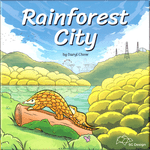
Again, it leaves the player with a very important decision at the end of their turn. They can either use the resources in the shared pool in order to buy cards and other things or they can instead take victory points for contributing these resources to the community. So this is a game where you can actually make a lot of points by taking advantage of the resources that other people have contributed or you can make a lot of points by contributing a lot of resources to the shared pool. It is a brilliantly synergistic game with everything that players doing affecting everyone else. Number six is Rainforest City. Rainforest City is a card drafting game where every time you take cards, you're either expanding your rainforest or you're adding animals to complete food chains and score points. The way that it works is it's a drafting mechanic, but with an awesome twist.
Players take turns being the lead player who will choose their favorite pair of cards out of four possible pairs. When they make their selection, they turn the tile with their player color to indicate which one they have taken. And then every other player's choice is forced. They can only take one of the two cards in front of their own player color. Now, I find this innovative for a number of reasons. Not only is it the simultaneous selection, which I have seen done before in games like uh Planet Unknown and Earth, uh but it's also that when you make your selection, you're selecting these pairs of cards in order to expand your rainforest. I even like how the cards actually work. You're using overlay in order to figure out the best orientation for each card. And then once you find the orientation of the card, you simply take the matching tokens and discard the card. You don't need it anymore. Uh but it it keeps things moving. It's just so elegant. Although I have reviewed this game in full length before, and the one uh caution against it is it's a pretty it's a pretty uh intense game. It's very very stressful to keep trying to get these animals a place to live. Uh that's Rainforest City. Number five is a game called Carnegie. It's another top favorite of mine and it is once again action selection, but this time it's action selection with regional income. On a player's turn, they select an action and
they and everyone else gets to perform that action. Whether that's building in their company or moving their workers or deploying their workers to projects, everyone gets to do this. However, before the action is performed, the player also triggers income, but they will only receive income if they have a worker in a project in the selected region. The reason this is so so brilliant is because everyone really needs to be paying attention to what their opponents is doing. Not just because they can interfere with each other, but because if you can anticipate what your opponent wants to do, you can also predict which region is going to be triggered next.
Knowing which region is triggered next helps inform you with where you should deploy your workers and which projects you should put them on. And so this is a game that has no element of luck. There's no dice. There's no cards. There's none of that. It's just pure interaction, action selection, and uh and uh players working off of each other. Brilliant game, Carnegie. Number four is a brand new game. It just came out this year in 2025. It's called Popcorn. And rather than try to just describe it, I think I just need to walk you through a turn to show you how this works. In Popcorn, players are managing a movie theater. And this game has several things going on. There's some bag management, there's some drafting, and there's a little bit of worker placement. So, at the beginning of a turn, players are going to take turns drafting in order to build their theater. So, I can buy a a theater, I can buy a movie, and I can advertise to get a new audience member added to my bag. The second phase of a turn is played simultaneously. It's the showing phase. It's during this time when you're going to be drawing from your bag based on the size of your audience and placing the audience members into the theaters.
Then you're going to evaluate your theater using the preferences of the audience. So notably, this one is going to be the happiest audience member. They've got a seat that they like. They're seeing a movie that they like. all indicated by the matching colors. So for this, they're going to perform a seat action. This is going to let me put a audience member from my exit back into the bag. And then they get to perform a movie action. They can perform any of these four movie actions. Like for example, taking a victory point. Okay. The second audience member, they don't they're not too keen on the movie here. They're blue. This is green. However, they do get to perform this gray seat action because everyone likes the gray seats. So, this gray seat action is to actually perform a movie action. So, we get to do one anyway. It just can't be the same one as last time. So, last time I took a victory point. This time, what I'll do is I'll I'll take an audience member and put it back in my bag. I like having that bag control. So, we go through and re-evaluate every audience member. The last phase of the turn is the theatrical run. And during the theatrical run, all of these movies are going to drop in value. They're less exciting now because a week has passed. So this gets represented by these lines moving up covering one of the actions. And so if you don't refresh the movies, then eventually these movies aren't going to be giving you any movie actions anymore.
I find that really satisfying, even though that has so many mechanics going on. You've got this like bag management and some sort of worker placement with drafting and all this stuff. It's very intuitive because everything about it makes sense. Everything from the movie selection and the audience member who likes the movie and the seat to the movies becoming uh worse as time goes on, as the weeks keep passing. I played this game with my kids. They loved it. I hardly even had to explain things. It just makes so much sense. Brilliant, innovative game. Popcorn. Number three is a game that once again I'm drawing from an old favorite. This is a game that people in the hobby will have known about. Ah, it's Twilight Struggle. It's a two-player game and it reenacts the Cold War. But what I like about the game, what makes this game so fun for me and the reason I keep pulling it out even today is that when a player uh plays a card in this game, they will get something. Usually it's operation points which they can use to manage influence on the board or they can use it for an event. But when they use it for the operation points, if the card belongs to their opponent, then the event is triggered for the opponent, which means it is very difficult to perform operations without simultaneously conceding something to your opponent. So, the game is all about
timing and it's all about struggle because you can't avoid the fact that your opponent is going to get something out of every little thing you do. There's something that they'll be able to take advantage from. best you can do is is get the right timing and maybe catch your opponent off guard or surprise them with a move because usually what's going to happen is they're going to have a very powerful event that they get in exchange for the operations that you get to perform on the board. Uh I love this about the game and I do enjoy playing it even today like I said but I still play it very infrequently be for a number of reasons. one, it's a very, very long game. In which case you can play Watergate. Watergate kind of follows that model. Um, two, both Twilight Struggle and Watergate are twoplayer games. I wish I wish there was a game that did this and it was like three, four, oh, come on, give me six players. like I want a game where I can play with many of my friends at the same time and every time I do something, they all get something that I don't want them to have. Now, I don't know how that could work. It's not it's not the same thing as Puerto Rico where, you know, the lead player gets the great action and everyone gets the small action. It's that the lead player gets an action that might even be worse than what your opponents get. It's that feeling of conceding something to your opponents that I love about that game. and I want
to see more games like it. Oh, if you know one, please let me know in the comments. Number two is Baghdad. Baghdad is a game with this impressive table presence. It looks very complex. There's a lot going on, but the core loop is actually very simple and ingenious. It focuses in on your player board where there are three slots for cards. During the course of this game, players will be taking turns. Each turn they'll be playing one card and at the end of the turn they'll be drawing one card. So they'll always have cards to play and when they play this card the previous cards get slid to the right and there are three slots for cards. Now every card that you play has icons on the top which are used for actions. So you play the card, you perform the action but the thing is those cards that you played previously they accumulate. So as you get more cards with the same icons there you can perform more powerful actions.
That's really, really great cards for icons for actions. The thing about this game is though, after the third card slides off the board to make room for your newest card, the bottom of the card is triggered. And the bottom of the card is usually what has some sort of scoring benefit. So, in Baghdad, every card you play is a tradeoff between your immediate needs and your long-term goals and your plan for what you're going to be scoring later. I love love love being torn between this decision, especially when every turn you get a chance to draft a new card knowing that it's going to be played and you're probably going to have to score the bottom. Yeah, I didn't say but if you don't satisfy the condition, you just discard the card. But what a waste that is. Uh I love that about Baghdad. Have never seen it before. It just came out this year. If you know another game like it, you got to let me know about it.
Number one is my favorite most innovative game. When I heard about what it was, I first thought, how is that even possible? The game is from and the innovative mechanic is simultaneous worker placement. Simultaneous worker placement. How is that even possible? I thought that worker placement means that you're placing a worker and then you're blocking your opponents from being able to take that action. So, it necessitates taking turns. You take a turn, you block the the action, and then the opponent goes, "Ah, you blocked my action." Ah, but here's how Formage works. The board is a giant cheese wheel because the game is all about making cheese. And it's divided into four sectors. On your turn, and because it's simultaneous, everyone else's turn. We're all taking turns at the same time here. You can place your workers only in your sector of the cheese wheel. Now, when everyone is done doing this, the whole board rotates, giving you a new sector to play into.
That's awesome. When it rotates, you even got the workers from your opponent who have slid into place, and they may be blocking you, as is often the case with a worker placement game. That's not the only thing, though. The other thing that I love about this game is how you get your workers back. Because this is another game where the workers will get more resources or perform stronger actions the longer they stay in their position. Every rotation of the wheel is one unit of time. Right? The key that tells you when the worker comes back to you is when the worker is once again facing you. It it works so well not only because it's cool, but because look look the worker is is on a little cheese wedge. It's cheese. It's an arrow. It's pointing to you. It's facing you.
Everything about the design of this game is obvious. It's so intuitive how it works. I've taught it to so many people. Everyone who learns this game goes, "Oh, oh, that's nice." And then there are no questions for the rest of the game. It just makes so much sense. And I think that's a key identifier of a truly innovative game. Not only is it unique, not only is it is does it embody the theme, but it's something that's intuitive, something that makes it easier to teach the game, makes it fun fun to latch on to and really sink your teeth into. So, those are my top 10 favorite innovative board game designs. Uh, again, I've said it multiple times throughout the video. I think that each of these games is one of a kind. In most cases, there are very few games like it.
But if I'm wrong, if you know something, please let me know. I'd love to explore more. Uh, thank you so much for watching. I hope you found this video uh helpful. And if you're trying to find some of these games, do look at the links in the description. For some of them, they're affiliate links, and that does help me out a lot. Thank you for watching. I'll see you next time. Bye-bye.