
After millennia of sterility, life has sprung again on Rauha. As a venerable Shaman, one of its five worlds has been entrusted to you. Your powers are divine and allow you to shape the environment in order to turn this world into a cradle of life energy, keeper of serenity and harmony for the centuries to come.
Obtain the most victory points, represented as Life Energy, to win the game. You have 2 Ages to turn your world into an energetic core of Rauha. In Age 1, vegetation, terrain, and wildlife will appear. In Age 2, civilizations will thrive.
The game takes place over 4 rounds, each divided into 3 turns followed by a scoring phase. Each turn, you will follow 5 steps:
1. Simultaneously take all Biome cards from the satellite whose symbol matches the one beneath your Avatar on your Player board (moon or star).
2. Choose one card to place on any square of your Player board or discard to the Black Hole.
3. Receive a Divine Entity if you create a row or column of matching symbols on your Player board.
4. Activate your Avatar, plus any Divine Entities in the same row or column as your Avatar.
5. Finally move your Avatar one notch clockwise along the edge of your Player board, changing the row or column that will be activated on the next turn.
During the Scoring Phase, you will activate all your Biomes with Spore tokens and any Divine Entities you may have, gaining crystals and points as shown on the components.
-description from publisher

Resafa - Board Game Review

Let's Play RA | Board Game Club

Another GIANT HAUL | No Regrets!!
Images

- Relatively not complex.
- Debut win for a new player.
- A more cerebral game, taking 43 minutes and 41 seconds.
Mechanics (from transcript analysis)
Video topics + discussion points
Quotes (from this video)
- RA, uh, 33 minutes and 28 seconds, and this was one of the biggest car crash games of RA that I've played.
- I have to admit, I did bounce off this one quite hard. I wasn't really a fan of it.
- And this one, I really like the gameplay, but it is too long.
- I think for an introductory Euro style game, this game does such a fantastic job of giving you the giving you the seven wonders experience in the most streamlined way possible.
References (from this video)
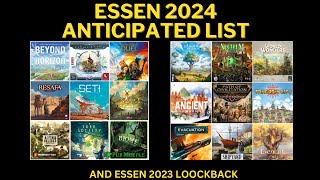
- anticipated complexity that may align with heavier games
- new sui title with intriguing thematic framing
Mechanics (from transcript analysis)
Video topics + discussion points
Quotes (from this video)
- I'm huge fan of Sanderson as many people are and I am just really looking forward to this one because it's a John DeClair game
- Beyond the Horizon it's the Standalone sequel to Beyond the Sun looks really interesting as well and a theme that I'm more comfortable with
- cvoluion was actually a game I talked about last year for the Essen
- it's a civilization themed deck-building type of game as well
- it seems like this is more along the complexity lines is like Pulsar 2046
References (from this video)

Mechanics (from transcript analysis)
Video topics + discussion points
Quotes (from this video)
References (from this video)

Mechanics (from transcript analysis)
Video topics + discussion points
Quotes (from this video)
- Everything here is a review copy because they're not out yet
- This is a very unique game
- If you like drafting games stuff like that you might want to check it out
- We are going to be at SMV… Friday from 2 to 6
- We’re going to try to get through as many as possible to talk about them before Spiel
References (from this video)
- Tight, card-driven engine with strong interlocking systems that reward planning and adaptation
- Clear and well-structured rulebook; components feel Euro-like and approachable
- The six-card system with color actions creates meaningful choices and minimizes downtime
- Balanced path options: produce, build, garden, canal, and color actions offer varied strategies
- Good to excellent two- to four-player dynamic; four players increase tension on competition for scarce resources
- Canal action is less accessible in two-player games; dynamics favor more players for maximum interaction
- Some variability is limited; most games feel similar in core puzzle unless cards shift significantly
- Endgame scoring cards can be heavy and may swing strongly if a player stacks certain bonuses
- Not the tightest or most thematic V. Sui title among his catalog; weight sits in the mid-to-heavy range
- Trade, resource management, and infrastructural growth in a desert setting
- Desert trade routes with a focus on caravan travel, canal building, and oasis development
- Engine-building euro with thematic flavor kept minimal; emphasis on systems rather than story
- Cura
Mechanics (from transcript analysis)
- Camel resource tracks — Camels act as a capacity tracker for resources; players allocate resources to camels and manage transport to maximize scoring potential.
- Card balance and hand size — Each player holds only three cards at a time, reducing decision time and forcing deliberate prioritization of actions.
- Card-driven action system (up/down actions on six shared player cards) — Players play one of six cards each turn to trigger a specific action and a color action; color actions advance tracks, grant scoring cards, or provide other abilities, with a mix of immediate and long-term benefits.
- Color action tracks — Three color tracks determine access to bonuses, cards, and abilities; progression on tracks unlocks new options and scoring potential.
- End-game scoring layers — Final scoring incorporates multiple components: Scarab tiles, garden/workshop/Canal interactions, card-based bonuses, and remaining resources.
- Garden connections and canal building — Gardens connect to provide ongoing bonuses; canals cost bricks and coins and yield points both during play and in end-game scoring, with water mechanics affecting scoring around rounds.
- Hand Management — Each player holds only three cards at a time, reducing decision time and forcing deliberate prioritization of actions.
- Open draft of bonus cards — At the start of each round three bonus cards are laid out for players to choose from, providing temporary boosts or engine-building opportunities.
- Production action — Produce by selecting two of your workshops; the selected cards yield resources, conversions, or other benefits based on the workshop text.
- Sack card mechanic — A small bonus card option that can be taken when no other immediate need is pressing; acts as a flexible, lesser-granting option.
- Tableau Building — Players build workshops and gardens on a personal tableau; workshops enable production and resource generation, gardens provide end-game scoring opportunities and bonuses linked to connected gardens.
- Tableau construction (workshops and gardens) — Players build workshops and gardens on a personal tableau; workshops enable production and resource generation, gardens provide end-game scoring opportunities and bonuses linked to connected gardens.
- Track Advancement — Three color tracks determine access to bonuses, cards, and abilities; progression on tracks unlocks new options and scoring potential.
- Trading/Market action — Move around the board to build trading posts and buy/sell resources, creating a flowing economy and end-game scoring opportunities tied to market activity.
- Variable card availability and semi-uncertainty — Not all level-3 cards are present in every game; players may reveal or look through top cards to gauge options, adding a memory/variance element.
Video topics + discussion points
Quotes (from this video)
- it's not a thematic game but we don't care about themes so it's it's fine
- the color actions feel powerful
- this is a medium heavy game
- the core puzzle is what's going to make you come back to the game to try to optimize that
- I give this an eight
References (from this video)

Mechanics (from transcript analysis)
Video topics + discussion points
Quotes (from this video)
- Don't sleep on this game folks.
- It's a lunchtime game now.
- It's a strictly card based game.
- This is a really unique racing card game you're like doing a bike race with these fun creatures.
- It's a freaking hoot.
- I am so excited to try it.
References (from this video)

- Tight six-round structure
- Historically flavored and strategic
- Potential complexity for new players
- Trade, water distribution, and city-building
- Ancient Middle East; merchants and infrastructure
- historical-economic
Mechanics (from transcript analysis)
- Multi-action card play — six rounds; three actions per round; strategic choice
- Resource and workshop construction — builds and markets to raise prestige
Video topics + discussion points
Quotes (from this video)
- two-player only trick-taking game
- the Trump is constantly changing
- chapter one is drafting cards that's chapter one
- 60 to 120 minute playtime
- not a deduction game
References (from this video)

- Tense, interactive bidding with meaningful decisions
- Strong thematic integration of Raah and Egyptian motifs
- High player interaction and dynamic turns
- Rule set can be dense and intimidating for new players
- Tile draws introduce luck that can tilt outcomes
- Game length can be substantial for casual players
- Civilization, monuments, Nile, gods and pharaohs; scoring hinges on multiple tile types and their combos.
- Ancient Egypt-inspired civilization-building with space-travel epochs and a central auction system.
- Live-play banter with Ra as a charismatic auction catalyst; humorous and improvisational commentary.
- Skull
Mechanics (from transcript analysis)
- auction/bidding — Players bid Sund discs to acquire tiles from a central auction board; Raah tiles trigger new auction rounds.
- Bag-draw drafting — Tiles are drawn from a hidden bag and placed into the auction pool, driving risk and strategic choices.
- Epoch-based scoring — The game runs over three Epochs; scoring occurs at each epoch end across board areas and bonuses.
- God tiles and power tokens — God tiles can be spent to swap or influence tile selection; they add controllable tempo shifts to bidding.
- Ra activation and movement — Drawing a red Ra tile or invoking Ra begins an auction and advances Ra along its track, accelerating the epoch.
- Tile scoring and types — Tiles have different scoring triggers (Monument, Nile, Flood, God, Civilization, Pharaoh) that influence end-of-epoch scoring.
Video topics + discussion points
Quotes (from this video)
- Raah is an auction game in which players are going to be competing to gain tiles from this secret bag.
- it's really that simple but who is going to be the pharaoh of them all
- The game ends after three Epochs; the Pharaoh and Nile sections are scored.
- Auction begins with a player to the left of the player who drew the raw tile to invoke raah
- When you invoke Ra you begin the auction and Ra's little boat moves along the track
- Raah is back, come on Ra — the crowd loves Ra