








River Wild Deep Dive
What the Community Thinks About River Wild
River Wild draws respect for its clever design and compact presentation, though opinions diverge sharply on its execution. Some reviewers find a rewarding puzzle experience that rewards thoughtful placement and strategic foresight. Others struggle with the spatial puzzle at its core, finding it either engaging or frustrating depending on how they approach the game. The consensus is clear: this is fundamentally a puzzle game, and your enjoyment correlates directly with your tolerance for that particular kind of cognitive challenge. Button Shy Games' design manages to pack meaningful decisions into 18 cards, but not every player finds those decisions equally satisfying.
Core Mechanics That Define River Wild
Tile Placement and River Carving
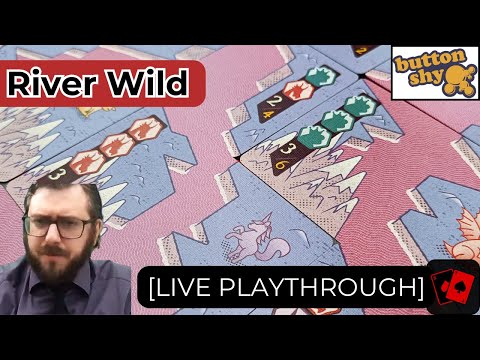
At its heart, River Wild is about plotting a river's course through a landscape. Each turn, you add cards that form both water and land, with river segments always connecting to other river segments and land always connecting to land. Mountains serve as the critical exception, acting as connectors between both terrain types. This constraint creates the puzzle: you must expand the river downward across your play area while simultaneously creating enclosed regions called "sacred lands" or protected valleys. The double-sided cards add flexibility, allowing you to flip them to access the mirrored side and gain extra placement options when the primary orientation doesn't fit your strategy. As the game progresses and space fills up, your placement options narrow dramatically, making early decisions surprisingly consequential.
Set Collection Through Regional Scoring
Every protected land you create has a scoring condition tied to it, a requirement for specific animals or combinations of animals. You collect these animals by placing cards that feature them, and special runestone tiles let you substitute any type of wildlife to help fulfill unmet scoring conditions. This mechanic creates the game's central tension: you need to thoughtfully position cards not just to carve the river, but to ensure the regions you close off contain the right mix of creatures to score points. It's this layering of spatial puzzle with set-collection reward that gives River Wild its distinctive challenge.
The River Wild Experience
A Satisfying Puzzle When It Clicks
Reviewers who connect with River Wild describe a deeply engaging puzzle experience where each decision matters. The game rewards players who think ahead, planning not just this turn's placement but several moves forward. When a tricky situation resolves cleanly, when you suddenly see how to close off a region exactly as you need it, there's genuine satisfaction in the geometry of it all. The fantasy theme with its magical creatures and scenic landscape creates an atmosphere that feels lighter than the heavy puzzle underneath, making the challenge feel more forgiving than it actually is.
Frustration When Space Runs Out
For others, River Wild becomes a lesson in spatial constraint. Early placements that seemed safe can box you into impossible positions. Players report feeling crushed mid-game, realizing they've inadvertently blocked themselves from achieving high scores or even completing scoring conditions at all. This leads some reviewers to restart and try again, using the compact size and quick playtime to attempt multiple runs in a session. The game's difficulty curve can feel arbitrary: sometimes a few unlucky card draws make scores plummet, while other games flow smoothly. This unpredictability, where you might reach a score tier you never expected, or fall frustratingly short, is part of River Wild's charm for puzzle enthusiasts and part of its friction for everyone else.
What Makes River Wild Stand Out
Elegant Spatial Puzzle in a Wallet-Sized Package
River Wild proves that an 18-card game can deliver genuine spatial puzzle depth. Reviewers consistently praise how much game fits into such a tiny box. The compactness makes it genuinely portable, you can pack it into a backpack or wallet and pull it out during a lunch break or travel. Yet the puzzle doesn't feel cramped or simplified; it demands the same forward-thinking as much larger games. This economy of design, where every card carries weight and meaning, feels almost surprising given the format.
Beautiful Art and Fantasy Theme That Invites Play
The artwork deserves specific mention. River Wild features gorgeous fantasy creatures, frogs, jackalopes, unicorns, and dragons, in vivid colors (particularly the neon pinks and purples of the original version, or the calmer greens and blues of River Mild). Reviewers describe the aesthetic as having personality and charm, making the game feel less like a brain-burning abstract puzzle and more like a whimsical puzzle-adventure. The visual clarity of the cards, with their clean illustrations and readable symbols, ensures the puzzle stays manageable even when your board fills up completely.
Potential Drawbacks
Spatial Puzzle Design Excludes Some Players
River Wild's biggest limitation is that it's fundamentally a spatial puzzle, and spatial reasoning doesn't come naturally to everyone. Reviewers who struggle with visualizing how cards connect and where regions will close off describe a frustrating experience. Even after multiple plays, some find themselves unable to reliably improve their scores, stuck in low-tier rankings no matter how carefully they plan. For these players, the game feels less like mastering strategy and more like hitting a cognitive ceiling.
Limited Replayability Without Strategic Breakthrough
Some reviewers report that once they've exhausted their initial experimentation, River Wild offers diminishing returns. The puzzle can feel like just placing cards without that "aha moment" of understanding how to consistently score well. The small deck of 18 cards means games follow similar patterns. While the randomization of card order and the different scoring conditions on each protected land create variety, the fundamental challenge remains constant. Players looking for emergent complexity or strategic depth beyond the initial puzzle-solving phase may find River Wild run its course relatively quickly.
If You Enjoy River Wild
Players who find satisfaction in River Wild's spatial puzzle will discover similar rewards in Ancient Realm, another Button Shy release praised by the same reviewer community. Ancient Realm offers a different kind of tableau-building puzzle that demands equally careful placement and long-term planning, though with a more complex ruleset. Unsurmountable, also from Button Shy, delivers a different but equally rewarding spatial challenge: building a path up a pyramid-shaped mountain. Both games share River Wild's commitment to packing meaningful decisions into a small format and both reward players who think ahead and plan their moves carefully.
What Reviewers Are Saying
This one really delivers on a smart design, fun play, easy to learn, challenging for a single player, and you know, easy to bring along and not solvable. I think you'll play it, you'll put it back, you'll pick it out, you'll play it again because it works.
— Gaming with Edo & Jessica
River Wild. Very interesting game as well. A very puzzly game. If you like puzzles, well, that might be your game.
— Sir Thecos
Whilst it's a wild game, it's very zen. I love it.
— Watch Review