/pic4521541.jpg)
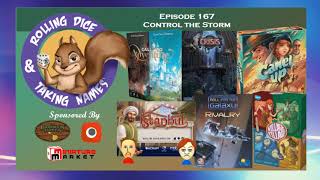
Roll for the Galaxy: Rivalry, the second expansion for Roll for the Galaxy, consists of three expansions in one box.
First, it adds expansion content to the base game: 62 more game dice, a new die type, start factions, home worlds, and more than double the number of game tiles for the bag as in Ambition, the first expansion for Roll. This material is compatible with Ambition, but that expansion is not required to play Rivalry. If you are familiar with the dice from Ambition, then you can add this content and start playing immediately. (If not, you'll need to read about the new dice.)
Rivalry also contains two optional game modules — the Deal Game and the Orb Game — which can be played separately or combined. These modules can also be combined with the goals in Ambition, although the publisher suggests not combining them all at once for new players!
• The Deal Game has a new deal phase in which players assign $ dice to a new deal board in order to swap assets they don't want for those they do — and pretty much everything is fair game in terms of possible trades. Not using all your credit track? Why not trade in the top part of it to get a useful die? Or, if you're running a large economy and need a credit track that goes to 11 (or even 16), why not trade away a couple of white dice to get a larger track?
Have a bunch of extra tiles clogging up your construction zones from previous Explores? Why not trade them in for new dice? Or, a chance to draw from the bag until you find a 6 cost development? Or a pair of VP chips? Or a talent counter? Or some credits? Or, another Leader die? Or, a chance to draw a world of a desired color from the bag? Or, to turn some Citizenry dice directly into Developers or Settlers? Or...
Seven deal dice are rolled each turn before players assign their workers to determine what asset types can be potentially gained or traded in that round. After you swap assets, your deal will start to mature over several rounds. If you (or someone else) calls "Deal" again before your deal expires, then you might want to send another dealer in to reverse your trade, trading back for what you originally spent and making some credits and talent counters along the way. Of course, while your deal is maturing, some other player might swoop in and reverse it before you wanted to, taking their cut and converting your attempted temporary loan into a permanent exchange. These things happen...
• The Orb Game gives one yellow "Alien Orb" die to each player, and the faces of these dice can be popped out and upgraded to various "lines" of faces that allow you to customize what you can do in the game. (Think of the lines as being akin to a tech tree.)
You can assign dice to become researchers in the Research phase, and for each assigned researcher, when someone calls Research, you get two "dots" of upgrades to your dice. The first dot gets you a 1-dot face in any line; extra dots get you better faces in that line. (If you want to switch lines for a given face after entering a line, pay 1 dot more.) These upgraded dice affect your play. For example, if you roll the 2-dot beige -1 develop face, you receive a -1 die discount on all developments you build that turn.
Orb dice are rolled in front of player screens at the start of a round. If, for example, you roll a face that grants virtual workers, then everyone knows that you will benefit if Explore occurs and can plan accordingly as they assign their dice and decide which phase to call.
To allow improved Orb dice more opportunities to affect play, the Orb game ends at 15+ tiles or when the initial VP chip pool is exhausted, which is increased to 15 VPs per player. At game end, each 2-dot and 4-dot face on your Orb die is worth 1 and 2 VPs, respectively.
• Replacement player screens including a summary of the optional games (in different colored type faces) and all three added dice types are also included.


- Adds significant depth and strategy to the base game.
- The Deal and Research mechanics help mitigate randomness.
- New dice with two symbols per face add interesting choices.
- Games consistently have close scores.
- The expansions are considered almost essential for players who enjoy the base game.
- Some players might find the added complexity overwhelming.
- Requires careful management of dice and resources.
- Building an empire through dice and exploration
- Galaxy
Mechanics (from transcript analysis)
- Action Drafting — Players draft dice for new phases and choose which phases to activate.
- Dice Assignment — Players secretly assign their rolled dice to different game phases.
- Dice Rolling — Players roll dice with various icons representing game phases.
- Engine Building — Players develop tiles and planets to create production and victory point engines.
- phase selection — Players choose one phase to activate, and others with dice assigned to that phase also benefit.
- Set Collection — Matching dice colors/goods with ships can provide bonus points.
- Variable Phase Activation — The 'Rivalry' expansion adds a 'Deal' phase, and the 'Orb Game' expansion adds a 'Research' phase.
Video topics + discussion points
Quotes (from this video)
- If you do not have asynchronous play you're dead to me
- The card art in this is absolutely stunning
- It was a cute fast filler game I enjoy playing that
- The game just immediately stops so you might not even totally finish the game
References (from this video)

- Adds significant new content through three modules.
- Improved component quality over the base game (player boards, strips).
- Interesting customizable dice mechanic.
- Visually appealing new artwork.
- Adds strategic depth and new ways to play.
- High price point compared to the base game.
- Some player aids are large sheets of rules and symbols.
- Entrepreneurial dice, space stations, trading, bartering, goals, and building worlds
- Galaxy
- Dice Forge
Mechanics (from transcript analysis)
- dice manipulation — Features customizable dice with interchangeable faces and new dice colors (dark blue) with unique symbol combinations.
- modular expansions — Includes three modules: one for use with the Ambition expansion (customizable dice), the Deal Game, and the Orb Game.
- Player boards — New, more vibrant player boards with updated grids and sturdier material.
- Set Collection — Goal cards from Ambition are included as tokens that can be used for victory points or as one-use workers.
- Variable player powers — New starting worlds and worlds that can be built offer unique actions and strategic paths.
- Worker Placement — Entrepreneurial dice with a dollar sign allow workers to be used without being expended.
Video topics + discussion points
Quotes (from this video)
- And it is a price reason.
- Roll for the Galaxy: Rivalry, however, comes out of the gate in Canadian buckazoids at 68, which seemed really bizarre to me!
- So, the customizable dice in this one are big modules in some sort of space station.
- This is unexpected: so there's a big... five pounds of cardboard in here. It's that thick.
- The big show, i think... the most interesting thing in this box... and the one that's probably going to getcha if you're looking at this in the game store, are these customizable dice.
- It means something! It means something! i'm like Richard Dreyfuss, from... Close Encounters.
References (from this video)

- Adds new game modes (Deal Game, Orb Game).
- Introduces customizable dice.
- Provides new tiles and factions.
- Includes new die colors and improved player screens.
- Offers a new 'Deal' phase and 'Research' phase.
- Tiles have a different paper finish than the base game, making them feel distinct.
- The rulebook or video omits information on how to spend research points in the Orb game.
Mechanics (from transcript analysis)
- Customizable Alien Dice — Players receive a yellow alien die with customizable faces in the Orb Game, which can be upgraded using research points.
- Deal Phase — A new phase in the Deal Game where players can open new deals, join existing ones, or refuse to deal, involving a priority track and dice exchanges.
- dice customization — The expansion introduces customizable dice with extra faces that can be swapped out, particularly relevant in the Orb Game.
- New Dice Colors — Adds a new die color: dark blue Pioneer dice, which match cyan worlds.
- New Game Modes — Introduces two new game modes: the Deal Game and the Orb Game, which can be played individually or together.
- New Player Screens — Provides new player screens with updated information for all dice colors and the additional sixth phase in the Deal and Orb Games.
- Orb Game Research — Introduces a Research phase in the Orb Game where players can spend research points to change the faces on their customizable alien dice.
- Phase Combination — In the combined Deal and Orb games, workers assigned to the dollar sign phase can be used as either a dealer or a researcher.
- Priority Track — Used in the Deal Game to determine player order for spending 'dealers' in the Deal phase.
Video topics + discussion points
Quotes (from this video)
- Hey, man - sshh. Be cool. Be cool.
- Hey - what? I was in the middle of somethingggggg [fades away]
- If you roll a pink arrow, you turn the die whichever way it’s facing. So it’s smart business to point it at a valuable face.
- If you’ve created an infinite loop, you have to keep turning the die until… YOU die. No - you just stop turning and nothing happens.
- Kurt Vonnegut’s butthole
References (from this video)

- Takes a very long time to get onto the channel due to complexity of understanding its multiple game modes.
Mechanics (from transcript analysis)
- Multiple Game Modes — The host mentions it has 'two different game modes, and you can combine the game modes,' requiring significant playtime to understand.
Video topics + discussion points
Quotes (from this video)
- i look kind of concerned, right? Look: my eyebrows are down.
- i'm a sick individual. But uh... i buy games for the dumbest reasons.
- As good as game as i've heard Terraforming Mars is, i'm going to wait until recessed boards are available before i make a purchase, because that seems like a pretty, uh... decent complaint about the game.
- Da da da da DA!
- Call me "Shorlock."
- Oh, just forget about it.
- Box Fart-O-Meter: zero. Are we surprised? i don't think so.
- Really, really bad! i'm not... at ALL impressed with the component quality on those!
- i think that's probably what he turned out to be in life.
- i'm such a jerk... i'm a jerk to Personal Assistant for no reason!
- i guess it's the future? i THINK that's what's happening? It's the future, and everybody's got wacky hair.
- The board is kind of not... lying flat, i've noticed. It's not really... it's kind of bubbling up. Have you ever ever had that problem?
- i'm going to save you... my casual racism.
- The people on these cards look like... kind of nerdy!