/pic6313647.jpg)
/pic8269897.jpg)
/pic6313647.jpg)











































Rolling Realms Deep Dive
What the Community Thinks About Rolling Realms
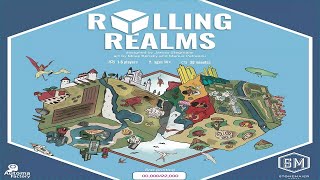
Rolling Realms arrived with an unusually warm reception partly because of what it is and partly because of how it came to exist. Designer Jamey Stegmaier created it as a free print-and-play during the COVID-19 pandemic so players could participate over video calls, and the community that rallied around those early versions became invested long before a physical copy was announced. By the time Stonemaier Games released a production version in 2021, a network of fans had already play-tested and shaped it. That origin story matters to reviewers, who consistently describe the game as something built from genuine community engagement rather than planned commercial calculation.
The critical response positions Rolling Realms as a solid entry in the roll-and-write genre, praised for its design cleverness and replayability. Fans of Stonemaier Games find it a rewarding celebration of titles they already own. Players newer to the publisher find it an enjoyable puzzle that stands on its own. Critics comparing it to genre peers generally place it alongside Cartographers and the Clever series, not necessarily above them in puzzle depth, but distinct in its modular breadth and the quality of its solo mode.
Core Mechanics That Define Rolling Realms
Mini-Games with Compound Scoring
The defining structure is eleven realm cards, each representing a Stonemaier Games title as a self-contained mini-game. Every round, three realm cards are randomly selected and every player works from the same three cards simultaneously. Over nine turns, two shared dice are rolled and players allocate one die result to one realm and the other to a different realm. Between Two Cities scores based on the lowest star total of the other two realms, creating a compound incentive to perform consistently across all three cards. Pendulum rewards delayed gratification through hourglass completion. Viticulture requires outlining grapes before committing a combined value to fill a wine order. Each realm has its own internal logic, and the specific combination of three determines which strategies are viable in any round.
Resource Management and Dice Manipulation
Resources are the tactical layer that elevates Rolling Realms beyond a simple fill-in exercise. Pumpkins, hearts, and coins are earned through realm activations and can be spent at any time. Spending two pumpkins adjusts a die value by one; three pumpkins do the same and also allow a die to be placed in a realm already used that turn. Two hearts generate an extra die when the rolled pair shows matching values. Coins either create an extra die equal to the number spent, or a bonus die of either value when the dice sum to seven. These bonuses chain together. A player who earns coins and pumpkins in the same turn can manufacture a die of a specific value, adjust it, and place it in an already-activated realm. Reviewers described these resource combos as some of the most satisfying decision-making in any roll-and-write they had played.
The Rolling Realms Experience
Breezy Yet Genuinely Puzzly
Rolling Realms plays in roughly thirty minutes with minimal setup. Reviewers emphasized that the convenience extends to multiple contexts: a casual gathering, a video call, or a solo session between larger games. The pace never drags because everyone acts simultaneously and the constraints are immediately clear. Yet beneath the quick playtime lives a real puzzle. One reviewer described the choices in Rolling Realms as the hardest they had encountered in any roll-and-write, a claim supported by the layering of resource combos on top of placement decisions. The game manages to feel casual while rewarding careful thinking, which is a difficult balance to strike in a genre where simplicity often comes at the cost of depth.
The Solo Mini-Golf Mode
The solo solitaire mini-golf format is, for many reviewers, the most compelling reason to own Rolling Realms. It presents eighteen defined golf holes, each specifying a particular three-card combination and a unique scoring objective. One hole might restrict play to only seven turns. Another requires exactly three stars in one realm, four in a second, and five in the third, with a note specifying that Tapestry cannot yield exactly five stars. The objectives escalate in difficulty and variety, creating genuine long-term challenge. Multiple reviewers tried playing the solo mode simultaneously with multiple people using the same hole objectives as a shared challenge, finding it an inventive group variant. Board Game Hangover rated the game higher specifically because of this mode, calling it a feature that gives the game a whole new meaning.
What Makes Rolling Realms Stand Out
Replayability Through Modular Combinations
Playing three cards from a pool of eleven across three rounds creates hundreds of possible configurations. But the variety goes deeper than combinatorics. Reviewers noted that the same realm plays differently depending on which other realms accompany it. The resources generated by one card influence how freely you can act in another. Ryan and Bethany articulated this clearly: the same card is a fundamentally different game depending on what surrounds it. Dice variance on top of this means repeated plays with identical realm combinations still yield distinct puzzles. Stonemaier has also released promotional realm packs tied to new game releases, meaning the available pool grows over time and configurations multiply accordingly.
Thematic Fidelity in Compact Form
The most consistently praised creative achievement is how clearly each realm evokes its source game despite containing only a few icons and numbers. Reviewers familiar with the source games described small moments of recognition: the two-step grape-to-wine process of Viticulture, the top-and-bottom action economy of Scythe, the cascade of completing a Charter Stones building and cross-referencing its crate value on a future turn. Ryan noted that even though realm cards do not play like the full games, they successfully capture their scoring logic in miniature form. For players unfamiliar with Stonemaier's catalog, the cards still function clearly as puzzles. For fans, the encounter with these micro-versions deepens the experience and makes the question of which future game might earn a realm card part of the ongoing appeal.
Potential Drawbacks
Dice Luck and Frustration
When the dice refuse to cooperate, the frustration is real. Board Game Hangover described sessions where the same value appeared roll after roll, leaving fewer viable spaces to fill. The solo challenges are particularly vulnerable because specific outcomes may be essential within strict turn limits. Resources provide some buffer but are finite and earned through normal play, so a player who falls behind on resources due to poor early rolls may find mitigation tools unavailable exactly when they are most needed. Bethany from Ryan and Bethany also observed that visible running scores make a large early deficit feel more deflating than in games where scores stay hidden until the end. The quick playtime softens this, but players who dislike luck-dependent games will not find a workaround here.
Initial Rules Complexity
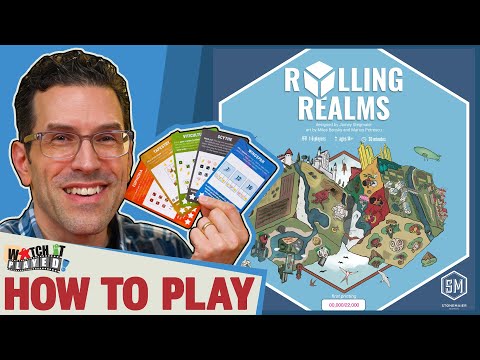
While each individual realm is not complex, learning eleven distinct rule sets requires genuine effort. Adam from Adam in Wales noted that every new round means teaching three new mini-game rules, because any given three-card combination may never have appeared before at the table. One player needs to stay on top of card text to keep things running cleanly. Adam also identified a gap in the rulebook: the rules explain how to fill in boxes and icons but do not explicitly state that each can only be used once. For veteran roll-and-write players this is easy to infer; for newcomers it causes confusion. Multiple reviewers recommended watching Rodney Smith's Watch It Played tutorial video before the first play rather than relying on the rulebook alone.
If You Enjoy Rolling Realms
Players drawn to Rolling Realms often respond well to other modular roll-and-write games. Cartographers shares the modular scoring approach and rewards spatial reasoning through map drawing. The Clever series, including Clever Cubed, delivers similarly demanding puzzles with interconnected scoring rows that reward efficiency the way Rolling Realms rewards resource chaining. Silver and Gold, which helped inspire Rolling Realms' dry-erase card format, is a lighter and more portable entry. For players captivated by a specific realm, the full Stonemaier Games titles offer the complete experience: Wingspan for its bird-collection engine, Viticulture for its seasonal worker placement, Scythe for its alternating action economy, and Between Two Cities for its cooperative-competitive city building. Pendulum rewards players drawn to the hourglass timing and engine-building arc found in the Rolling Realms version of that realm.
What Reviewers Are Saying
"I thought it was really interesting with the games that I was familiar with to see how those cards scored. It's crazy how it made sense with the game, even though it doesn't play at all like the game. It just made sense with how it scored. It was like this little version of the game on the card, and I just thought that was really neat."
— Ryan and Bethany Board Game Reviews
"The mechanism of incorporating a modular rule and a modular playing surface into a single card is a nice twist and it's a fun iteration on other games in the genre. It does have some fun and surprising twists, it's got a great backstory, and it's got loads of potential to grow."
— Adam in Wales - Board Game Design
"The solo game is great. The more I played the more I liked it. Because of the solo variant it gave this game a whole new meaning. It's so quick, it's ten minutes and then you reset and go, and you can play it wherever. It's just so convenient."
— Board Game Hangover